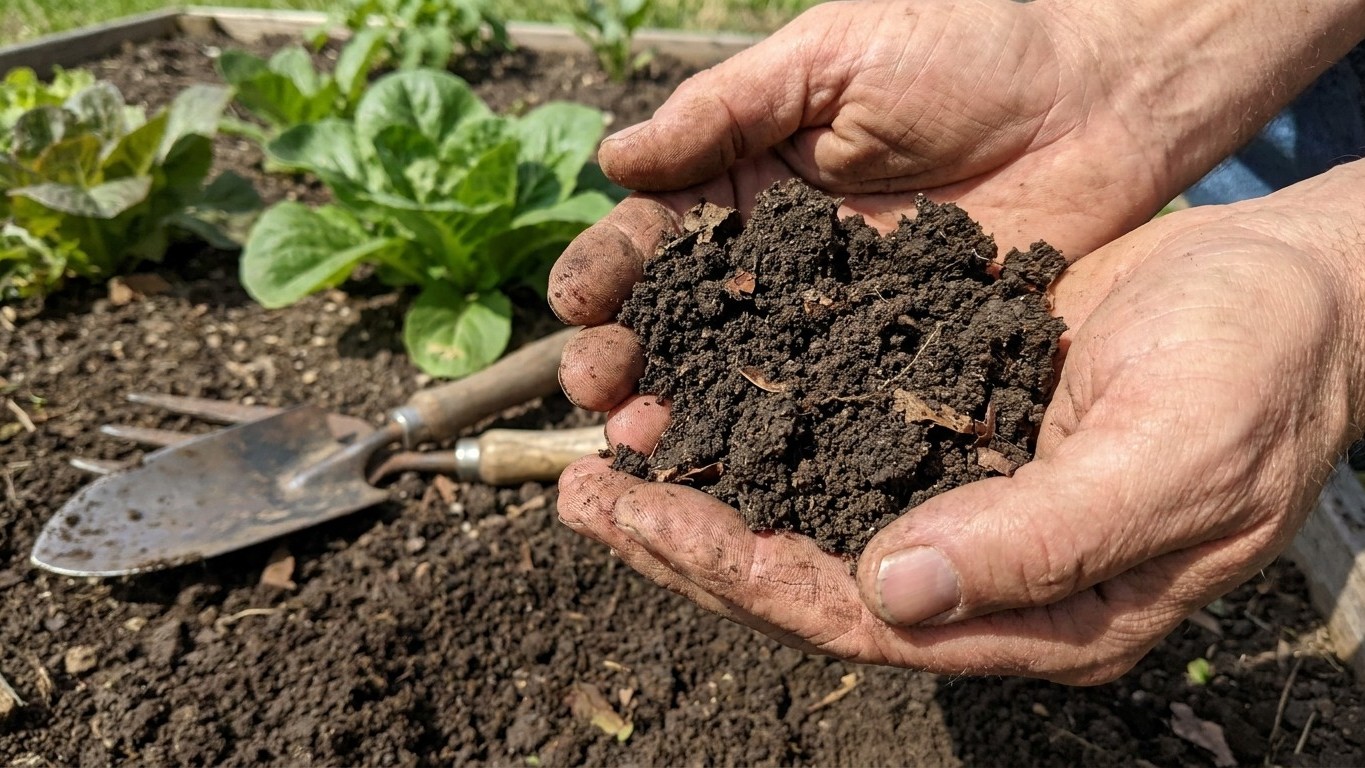

Mississippi’s official state soil is the Natchez series, a silt-heavy Inceptisol with a surface pH near 6.2, just 5 percent sand, 13 percent clay, and a full 82 percent silt. Organic matter sits around 1.8 percent. Below, what those numbers mean for your beds, and how to test and correct your own patch of ground.
What is under your garden

Mississippi named the Natchez series its official state soil back in 2003, and the choice makes sense: it’s a young soil, an Inceptisol, meaning it hasn’t had time to develop the strongly layered horizons you’d find in older, more weathered profiles. What it lacks in age it makes up in texture. According to USDA NRCS Soil Survey Geographic Database records for the major components of this series, the surface horizon runs 5 percent sand, 13 percent clay, and 82 percent silt, a combination that lands squarely in the silt loam category. The surface pH averages about 6.2, slightly on the acid side of neutral. Organic matter sits near 1.8 percent, and the series is classed as well drained.
| Reading | Value |
|---|---|
| Surface pH | about 6.2 |
| Sand | 5 percent |
| Silt | 82 percent |
| Clay | 13 percent |
| Organic matter | about 1.8 percent |
Here’s the honest caveat: this is the soil that represents Mississippi on paper, not the soil sitting under any one garden in it. The state stretches from Delta bottomland to loess bluffs to piney hill country, and a builder’s scraped or filled lot bears almost no resemblance to a mapped natural profile. Treat the Natchez numbers as a regional baseline, not a personal reading.
Reading your own soil in five minutes
Grab a handful of moist soil from a few inches down and squeeze it between your thumb and forefinger, trying to push out a ribbon. Silt-heavy ground like the Natchez series feels smooth, almost floury, and it will form a short ribbon that breaks easily rather than the long, slick ribbon true clay produces. For the second check, fill a clear jar about a third full of soil, top it with water, shake hard, and let it sit overnight. Sand drops within minutes, silt settles by morning as a middle layer, and clay stays suspended longest, often leaving the water cloudy for a day or more. A soil dominated by that middle silt layer behaves a lot like the state soil: it holds moisture well but crusts easily on top.
Testing before you amend
Eyeballing soil tells you texture and maybe drainage, but it can’t tell you pH or nutrient levels, and those are exactly what determine whether lime, sulfur, or fertilizer will help or hurt. Guessing wrong wastes a season and sometimes money on a bag of amendment the bed never needed. The regional pH figure of about 6.2 lets you expect your garden will land somewhere near neutral to slightly acid, but expecting isn’t knowing. Builder’s fill, years of wood ash, or heavy fertilizer use can all push a specific bed well off that baseline.
A proper soil test through the extension service costs little and reads far more accurately than any home kit. Here’s how to pull a sample that actually reflects your garden:
- Choose 8 to 10 spots scattered across the bed or lawn area, avoiding edges, low spots, and anywhere fertilizer or lime was recently piled.
- At each spot, dig a small core 4 to 6 inches deep, the zone where most vegetable and lawn roots actually feed.
- Drop all the cores into a clean bucket and mix them thoroughly, breaking up clumps by hand.
- Spread the mixed soil on paper to air-dry for a day, away from direct heat.
- Fill the lab’s sample bag or box with about a pint of the dried, mixed soil and label it with the bed’s location and intended crop.
The results come back with a pH reading, an estimate of phosphorus, potassium, and other nutrients, and usually a lime or fertilizer recommendation tailored to what you plan to grow, not a generic average for the state.
Amending it
Once the number comes back, the fix depends entirely on which way it leans. The Natchez baseline of about 6.2 sits close to the sweet spot most vegetables and turf prefer, roughly 6.0 to 6.8, so a garden tracking near that figure may need little more than routine organic matter. But plenty of yards drift further in either direction, and the correction differs sharply depending on which side you land on.
Lime, if your number drifts down
If a test comes back below about 5.5, the ground has turned acid enough to lock up phosphorus and stress brassicas like broccoli and cabbage, which want a milder pH. Lime is the lever here, not sulfur, which would only push the number further in the wrong direction. Ground limestone raises pH gradually, working over a season or two as it dissolves and reacts through the root zone, not in weeks. Split a heavy application into fall and spring doses rather than dumping it all at once.
Sulfur, if your number drifts up
If the reading comes back above about 7.3, the rule flips entirely: lime must never go on that ground. High pH locks iron out of reach of plant roots, and the tell-tale sign is new leaves turning yellow while the veins stay green, classic iron chlorosis on soil that’s actually too alkaline for the plant. The honest fix is elemental sulfur worked into the topsoil, paired with steady additions of organic matter, both of which lower pH slowly and safely over multiple seasons rather than overnight.
Organic matter, for the silt
Texture matters as much as chemistry here. With silt making up 82 percent of the Natchez profile and organic matter sitting at only about 1.8 percent, this ground is prone to crusting on top and compacting underfoot, even though it drains reasonably well overall. Compost, aged manure, and shredded leaves worked into the top few inches build the crumbly structure that silt alone can’t hold onto. Never add sand to a silty or clay-heavy bed hoping to loosen it; the two particle sizes pack together more tightly than either does alone, producing something closer to concrete than loam. Organic matter is the one fix that helps every version of this soil, whether it’s running acid, alkaline, or dead neutral, and it’s also the slowest one, taking two to three seasons of steady additions before the texture visibly changes.
Drainage and compaction
USDA classifies the Natchez series as well drained, meaning water generally moves through the profile without pooling for long. But well drained on paper and well drained in your actual bed after a summer downpour aren’t always the same thing, especially on silt-dominant ground that crusts on the surface and can shed water sideways before it soaks in. Testing your own drainage takes fifteen minutes and settles the question directly.
Dig a hole about a foot deep and a foot wide, fill it with water, let it drain completely, then fill it again and time how fast the level drops. A drop of 1 to 3 inches per hour is the range most vegetables and ornamentals tolerate comfortably. Faster than that, and the bed dries out quickly between waterings. Slower, and roots start sitting in water long enough to rot.
- If drainage is slow, work in organic matter yearly and avoid walking on wet beds, which presses the fine silt particles together and compacts the surface further.
- Skip double digging on this type of ground; turning wet silt over just smears it into a denser layer instead of loosening it, a technique most extension agronomists have quietly moved away from recommending.
- If a percolation test comes back under half an inch per hour after repeated tries, stop fighting the native soil and build a raised bed instead. Three years of amending a genuinely poor-draining spot often costs more time and money than framing a bed and filling it with a better mix from day one.
- Reserve moisture-loving plants for naturally low, slow-draining corners, and save well-drained raised areas for anything that hates wet feet, like rosemary or lavender.
Local help
Mississippi State University Extension runs the state’s soil testing lab and can walk you through sampling, results, and what to plant afterward at your county office. Testing there costs far less than guessing wrong with a bag of the wrong amendment. Find contact and testing details at extension.msstate.edu.
Common questions
Is my garden’s soil the same as the Natchez state soil?
Almost certainly not exactly. The Natchez series represents Mississippi broadly, but river bottoms, hill country, and any lot that’s been graded or filled will differ, sometimes completely, from the mapped figures.
Do I need to lime my Mississippi garden every year?
Not automatically. With a baseline pH near 6.2, many gardens sit close to ideal already. Lime only after a soil test confirms the number has actually dropped below about 5.5.
Why does my soil form a crust after rain?
Silt-dominant soils like the Natchez series lack the coarse particles that keep a surface open, so heavy rain can pack the fine grains into a hard cap. Regular organic matter additions loosen that surface layer over time.
Should I add sand to loosen heavy or silty soil?
No. Sand mixed into clay or silt-heavy ground tends to pack tighter, not looser. Organic matter, worked in gradually, is the safer and more effective fix.
Related guides
- Louisiana Soil: What You Are Digging Into, and How to Improve It
- Arkansas Soil: What You Are Digging Into, and How to Improve It
- Missouri Soil: What You Are Digging Into, and How to Improve It
- Will Carrots Fork in Mississippi Soil
- The Best Cucumbers to Grow in Mississippi
- What Eats Summer Squash in Mississippi, and When
- South Carolina Soil: What You Are Digging Into, and How to Improve It
- Wisconsin Soil: What You Are Digging Into, and How to Improve It