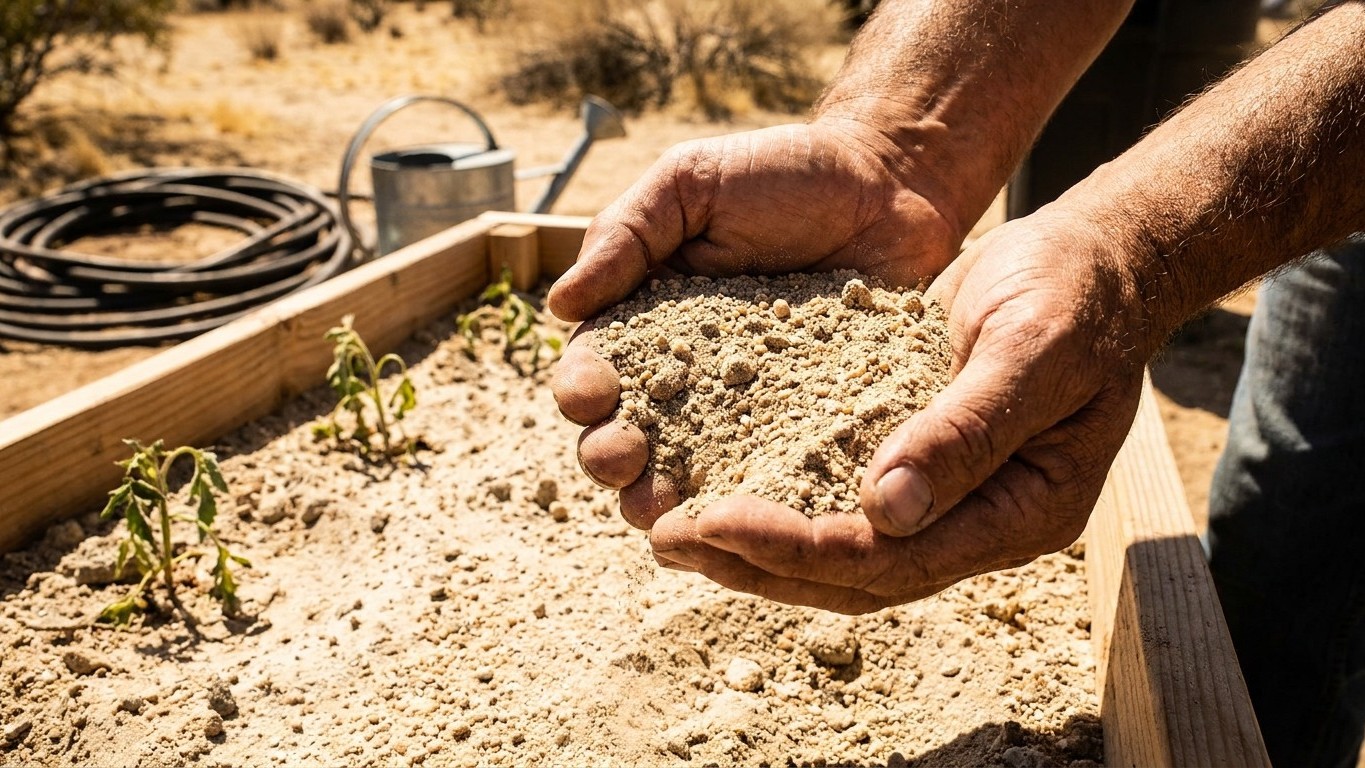

Nevada’s official state soil is the Orovada series, a dry-climate Aridisol that runs alkaline, sandy, and low in organic matter. That combination shapes almost everything about gardening here: how fast water drains away, how nutrients behave, and why so many transplants sulk their first season. Here’s what the numbers actually say, and what to do about them.
What is under your garden

Nevada’s state soil, named by state law in 2001 as part of the USDA NRCS State Soils program, is the Orovada series. It’s classified as an Aridisol, which is simply the technical name for soils that form under dry conditions and are, more often than not, alkaline and sometimes salty near the surface. The Orovada series sits well drained and sandy, with a surface layer that’s mostly sand and very little clay.
The USDA’s Soil Survey Geographic Database records representative values for the surface horizon across 223 mapped components of this series. Here they are, unrounded:
| Reading | Value |
|---|---|
| Surface pH | about 7.5 (alkaline) |
| Sand | 66 percent |
| Silt | 26 percent |
| Clay | 8 percent |
| Organic matter | about 1.4 percent |
| Drainage | well drained |
Those figures describe a soil that lets water pass through quickly, holds nutrients poorly because there’s so little clay and organic matter to grab onto them, and runs alkaline enough to lock up certain micronutrients. That’s the state soil, not necessarily your soil. A state this size holds hundreds of mapped soil series, and Orovada is just the one legislators picked to represent the whole. If your house sits on fill dirt, in an old floodplain, or on ground a builder graded flat before pouring a foundation, what you’re digging into could be nothing like this table.
Reading your own soil in five minutes
Two quick checks tell you more than guessing ever will. First, the ribbon test: take a small handful of moist soil, squeeze it between thumb and forefinger, and try to push out a ribbon. Sandy soil won’t hold a ribbon at all, it just crumbles. Clay-heavy soil forms a long, slick ribbon over an inch or two before breaking. Loam falls somewhere in between.
Second, the jar test. Fill a clear jar about a third full of soil, top it off with water, shake hard, then let it sit overnight. Sand settles first and fastest, forming the bottom layer within minutes. Silt follows, then clay, which can stay suspended and cloudy for a day or more. The thickness of each layer, relative to the others, gives you a rough read on your own sand-silt-clay mix, no lab required.
Testing before you amend
Guessing at soil amendments is one of the fastest ways to waste money in a garden. Adding lime to soil that’s already alkaline can push pH so high that plants can’t access iron or manganese at all, no matter how much fertilizer you dump on afterward. Adding sulfur to soil that’s already acidic does the opposite kind of damage. A soil test costs a few dollars and tells you, in actual numbers, what’s happening underground instead of what you assume is happening.
Because the Orovada series sits at roughly pH 7.5, gardeners across much of Nevada should expect their own ground to lean alkaline too. But expecting is not the same as knowing. Pockets of acidic soil exist wherever organic matter has built up over decades, near old compost piles, under conifer stands, or in soil that’s been heavily amended for years. The only way to know your number is to test it.
Taking a sample correctly matters more than people think. A single scoop from one spot can mislead you if that spot happens to be unusually sandy, unusually compacted, or sitting where a bag of lime spilled five years ago.
- Choose 6 to 8 spots scattered across the bed or lawn area you’re testing.
- At each spot, dig a small core 4 to 6 inches deep, which is roughly where most vegetable and flower roots do their work.
- Remove any surface mulch, grass, or debris before taking the core.
- Combine all the cores in a clean plastic bucket and mix thoroughly.
- Pull about two cups of the mixed soil for your sample and let it air dry if the lab requests it.
- Label the sample with the bed’s location and submit it with the extension office’s form.
When results come back, the pH number is the headline, but check the nutrient levels and organic matter percentage too. A lab result that shows 1 percent organic matter confirms what the Orovada figures already hint at: most Nevada gardens start with very little natural fertility banked in the soil.
Amending it
The Orovada series points in one clear direction on pH: alkaline, at about 7.5. That number rules out one entire category of soil amendment and points toward another.
Never add lime
Lime raises pH, and this soil doesn’t need it raised, it needs it lowered or at least held in check. Adding lime to ground that’s already at 7.5 or higher pushes it further into territory where iron becomes chemically unavailable to plant roots. That’s the direct cause of interveinal chlorosis, the yellow leaf with green veins you see on roses, blueberries, and citrus in alkaline soil. If you see that symptom, lime is never the answer, and checking whether lime was ever applied is a reasonable first question.
Elemental sulfur, the slow honest route
Bringing alkaline soil down takes elemental sulfur, worked into the topsoil, plus patience. Soil bacteria convert sulfur to sulfuric acid over weeks and months, not overnight, and the process works faster in warm soil than in cold. This is a three-season project, not a three-week fix. Expect to retest after the first season and add more if the pH hasn’t moved enough.
Organic matter, for both pH and nutrients
Compost, aged manure, and other organic matter do double duty here. They buffer pH modestly over time, and they address the second problem the Orovada numbers reveal: organic matter sitting at only about 1.4 percent. That’s low. Working two to three inches of compost into a bed each year builds the biological activity and nutrient-holding capacity that this sandy, mineral-heavy soil starts without.
Working with the sand
At 66 percent sand and only 8 percent clay, this soil’s biggest structural weakness is that it doesn’t hold water or nutrients well. Nothing stays put, fertilizer leaches through with irrigation, and beds dry out fast in summer heat. The fix is organic matter again, worked in generously, plus a shift in watering habits: shorter, more frequent irrigation instead of deep soaks that just push water (and nutrients) past the root zone. Never add sand to try to “improve” clay-heavy pockets elsewhere in the yard; mixing sand into clay without enough organic matter tends to create something closer to concrete than loam.
The pH correction is the slow project here, measured in seasons. The organic matter and watering adjustments show results within one growing season, sometimes faster.
Drainage and compaction
Orovada soil is classed as well drained, which tracks with its sandy composition. Water moves through a soil this coarse quickly, so standing water after a rain or irrigation session is unusual on true Orovada-type ground. If you’re seeing puddles that linger for hours, your soil likely has more clay than the state series, more compaction, or both, and it’s worth checking directly.
A percolation test settles the question in an afternoon. Dig a hole about a foot deep and a foot wide, fill it completely with water, and let it drain once to saturate the surrounding soil. Fill it a second time and time how long it takes to drop. A rate faster than about 6 inches per hour suggests fast, sandy drainage similar to the Orovada profile. A rate slower than 1 inch per hour signals compacted or clay-heavy soil that will need real intervention.
Compaction is a separate issue from soil texture, and it’s common wherever foot traffic, parked equipment, or construction machinery has pressed down on bare ground. Double digging, the old practice of turning soil two shovel-depths down, has fallen out of favor because it disturbs soil structure and biology more than it helps, and the compaction often returns within a season or two anyway. For badly compacted ground, especially where construction fill sits under a thin layer of topsoil, a raised bed is often the more honest answer than years of amending. Building up 10 to 12 inches of good soil over compacted ground sidesteps the problem instead of fighting it indefinitely.
- Fast-draining, sandy ground: water more often in smaller amounts, and mulch heavily to slow evaporation.
- Slow-draining, compacted ground: consider a raised bed rather than repeated tilling, especially near new construction.
- Plants that struggle in fast-draining sand: shallow-rooted, moisture-loving species are better suited to containers or amended beds than open ground.
Local help
The University of Nevada’s extension service, UNR Extension, runs soil testing and reads the results with gardeners county by county. Contact your local county office before sampling to confirm current submission steps and turnaround times, since these details change from year to year.
Common questions
Is all Nevada soil alkaline?
Most of it trends alkaline, following the pattern in the Orovada series, but pockets of more acidic soil exist wherever organic matter has accumulated over time. A soil test is the only way to know your own number.
Can I just add lime to be safe?
No. Given how alkaline Nevada’s representative soil already runs, adding lime without a test result showing acidic soil risks pushing pH high enough to cause nutrient lockout, particularly iron.
Why does my soil dry out so fast?
Sandy soil like the Orovada series, at 66 percent sand, drains quickly and holds little water between irrigations. Building up organic matter and watering more frequently in smaller amounts both help.
How often should I retest my soil?
Every two to three years for an established garden, or annually while you’re actively correcting pH with sulfur or lime, since amendments take time to shift the number and you’ll want to track progress.