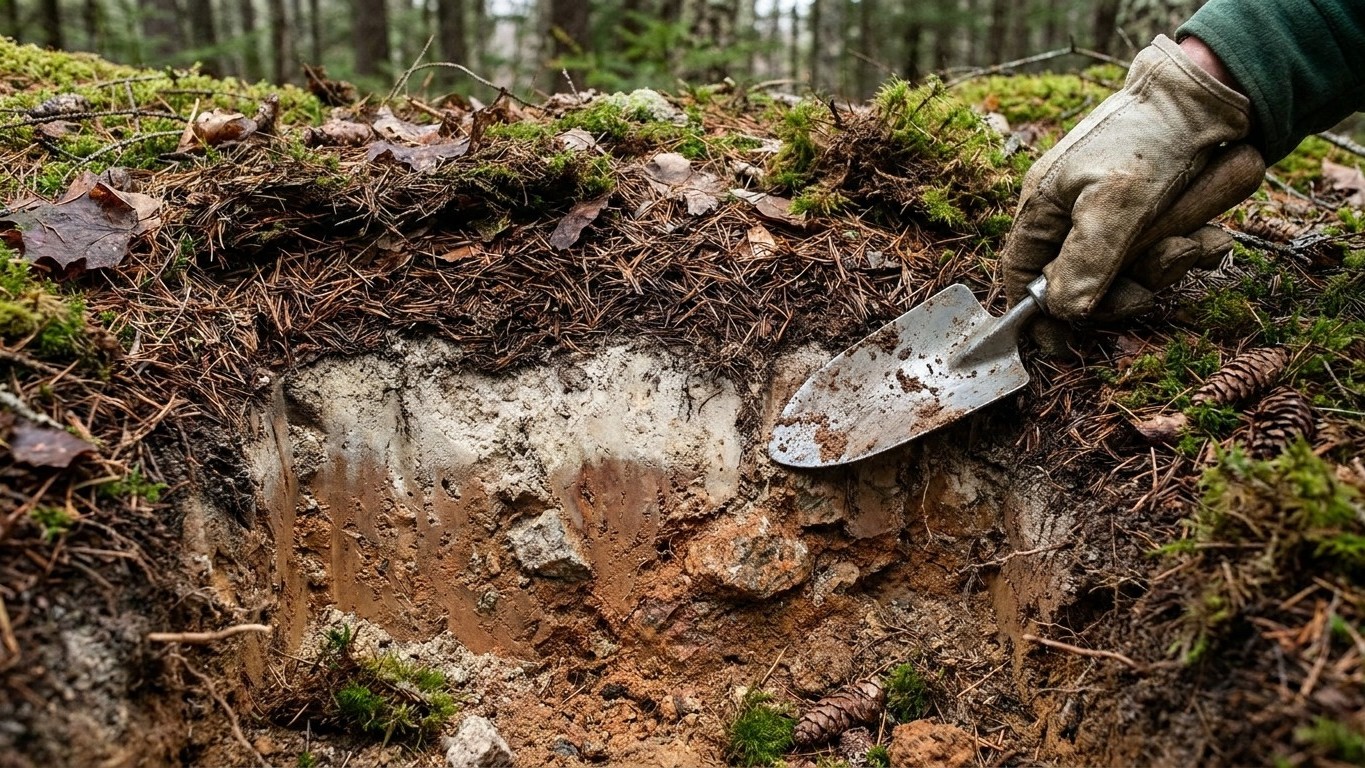

New Hampshire gardeners dig into ground built on granite bedrock, glacial till, and centuries of conifer litter. The state’s representative soil runs strongly acid and drains fast, which explains why lime bags outsell almost everything else at local garden centers and why beds dry out faster than a Vermont or Massachusetts gardener might expect.
What is under your garden

USDA lists the Marlow series as the soil representative of New Hampshire. It’s a Spodosol, the technical name for the sandy, acid, strongly leached soil that forms under conifers over generations, as rain washes minerals downward through the profile and leaves the surface stripped and sour. If you’ve ever dug a hole in the woods and hit a pale, almost bleached layer a few inches down, that’s a Spodosol doing what Spodosols do.
The numbers from USDA’s Soil Survey Geographic Database, drawn from 215 sampled components of the series, are specific:
| Reading | Value |
|---|---|
| Surface pH | about 3.5 (strongly acid) |
| Sand | 57 percent |
| Clay | 5 percent |
| Silt | 38 percent |
| Organic matter | about 85.0 percent |
| Drainage | well drained |
That organic matter figure deserves a pause before you get excited. Eighty-five percent organic matter isn’t garden soil, it’s a natural surface layer of forest litter, needles, and partly decomposed duff sitting on top of mineral soil. No cultivated bed carries that much organic material, and once land is cleared, tilled, and planted, that surface layer is gone within a season or two. Treat the pH and texture figures as a fair picture of the regional parent material, and treat the organic matter number as a snapshot of undisturbed forest floor, not a promise about your raised bed.
None of this describes every backyard in the state. Marlow soil is the series USDA singles out as representative of New Hampshire as a whole, not a survey of your particular lot. River valleys along the Connecticut and Merrimack carry different, often richer alluvial soils. Anything a builder scraped, graded, or backfilled during construction is its own material entirely, usually compacted subsoil with none of the natural layering intact.
Reading your own soil in five minutes
Grab a handful of moist soil from six inches down and squeeze it between finger and thumb, pushing it out into a ribbon. Sandy loam like Marlow’s surface layer barely holds together, breaking off after an inch or less. Clay-rich soil ribbons out two inches or longer and feels slick. For the second test, fill a clear jar a third full of soil, top it with water, shake hard, and let it sit overnight. Sand settles first and forms the bottom layer, silt sits in the middle, and clay clouds the water above, settling last as a thin cap on top. Whatever separates out in your jar is the soil you’re actually gardening, not the state average.
Testing before you amend
Guessing at soil amendments is how gardeners end up with a $40 bag of lime spread over ground that didn’t need it, or worse, sulfur dumped on soil that was already acid enough to stunt vegetables. A lab test tells you the actual pH, the phosphorus and potassium levels, and often organic matter content, none of which you can judge by eye or by how the dirt feels in your hand.
Because the Marlow series runs around pH 3.5, it’s reasonable to expect New Hampshire garden soil to lean acid before you’ve tested anything. But expecting isn’t knowing. Cleared land, old lawns limed for decades, and soil trucked in from elsewhere can all sit well outside that expectation, sometimes dramatically.
Taking a sample correctly matters as much as sending it in:
- Pick a day when the soil is moist but not soaking wet.
- Use a clean trowel to dig eight to ten small cores across the garden bed, avoiding edges near walkways or foundations.
- Dig each core to about six to eight inches, the depth where most vegetable and flower roots actually feed.
- Mix all the cores together in a clean bucket, breaking up clumps and removing rocks, roots, and mulch.
- Let the mixed sample air-dry on a tray for a day or two, then bag about a pint of it for the lab.
- Label the bag with the bed location and what you plan to grow there, since fertilizer recommendations vary by crop.
When results come back, focus on pH first. It governs whether the nutrients already in your soil are available to plant roots at all, no matter how much fertilizer you add on top.
Amending it
With a surface pH around 3.5, New Hampshire’s representative soil sits well below where most vegetables, lawns, and ornamentals thrive, which generally falls between 6.0 and 7.0. That single number should shape almost every amendment decision you make.
Lime, not sulfur
Acid ground this strong needs lime, and elemental sulfur has no place here. Sulfur pushes pH down, which is the opposite of what soil already at 3.5 needs. Ground limestone, applied according to your soil test results, neutralizes acidity over time by raising pH toward the range where nutrients unlock. Acid soil at this level ties up phosphorus so tightly that plants can starve for it even when the raw amount in the soil looks adequate, and it makes life miserable for brassicas like broccoli and cabbage, which are prone to clubroot disease in acid conditions. Lime works over seasons, not weeks. A fall application gives it all winter to react with soil moisture before spring planting, and most gardens need a repeat treatment every two to three years rather than a one-time fix.
Organic matter for a sandy loam surface
At 57 percent sand and only 5 percent clay, this soil’s surface layer drains fast and holds onto nutrients poorly. Compost, aged manure, and shredded leaves worked into the top several inches build the organic reserve that sandy soil naturally lacks once its native forest litter is cleared away. This is a slower fix than liming, typically taking two to three seasons of consistent additions before you notice a real difference in how the bed holds moisture.
Watering on the sand side
Sandy loam doesn’t hold water the way clay does, so plan on shorter, more frequent watering rather than deep, infrequent soaks. A drip line or soaker hose run for shorter stretches two or three times a week generally beats a single long weekend watering, which just runs straight through the profile and out of reach of roots.
Drainage and compaction
USDA classifies the Marlow series as well drained, which tracks with its sandy loam texture and low clay content. Water moves through this kind of ground readily rather than pooling on the surface, so standing water after a rainstorm usually points to compaction or a construction-disturbed subsoil layer rather than the native soil itself.
A percolation test settles the question in under an hour. Dig a hole about a foot deep and a foot wide, fill it with water, and let it drain completely once to saturate the surrounding soil. Fill it a second time and time how fast the water level drops. A drop of one to three inches per hour is normal and workable for most garden plants. Anything slower than half an inch per hour points to a compacted or clay-heavy layer that needs attention before you plant.
Foot traffic and heavy equipment compact soil by crushing the pore spaces that let air and water move through it, and once compacted, that structure doesn’t loosen on its own. Double digging, the old practice of turning soil two spade-depths deep, has fallen out of favor because it disturbs soil biology and structure without fixing the underlying compaction for long. On genuinely compacted or disturbed ground, a raised bed filled with good topsoil and compost is often the honest answer rather than three years of amending soil that a builder’s equipment packed down years ago.
- Do: add organic matter yearly to keep pore structure open on well-drained sandy loam
- Do: build raised beds over any area that stayed compacted after grading or construction
- Avoid: walking or driving equipment on garden beds when the soil is wet
- Avoid: heavy clay amendments or sand added to fix drainage, since neither improves this soil type
- Plant elsewhere: moisture-loving species like most ferns or bog plants belong in a lower, wetter spot, not on well-drained upland ground
Local help
The University of New Hampshire Cooperative Extension runs the state’s soil testing program through its extension service. County offices process samples and can walk you through what the pH, nutrient, and organic matter results mean for whatever you’re planning to grow, which beats guessing every time.
Common questions
Is all New Hampshire soil this acidic?
The Marlow series represents the state’s typical forest-derived soil at a surface pH near 3.5, but river valleys, cleared farmland limed for decades, and fill soil from construction sites can all sit at very different pH levels. A soil test is the only way to know your own number.
How much lime does acid soil like this need?
The amount depends on your current pH, target pH, and soil texture, all of which come back on a lab test report. Applying lime without a test risks over-correcting, which creates its own nutrient problems.
Why does my soil have almost no clay if New Hampshire soil is described as clay-poor?
The Marlow series surface layer runs only 5 percent clay against 57 percent sand, which is why it drains well but also why it needs regular organic matter to hold moisture and nutrients.
Should I add sand to loosen heavy or compacted spots?
No. Mixing sand into compacted or clay-heavy soil often makes the structure worse, closer to concrete than to loam. Organic matter and, where compaction is severe, a raised bed are the more reliable fixes.