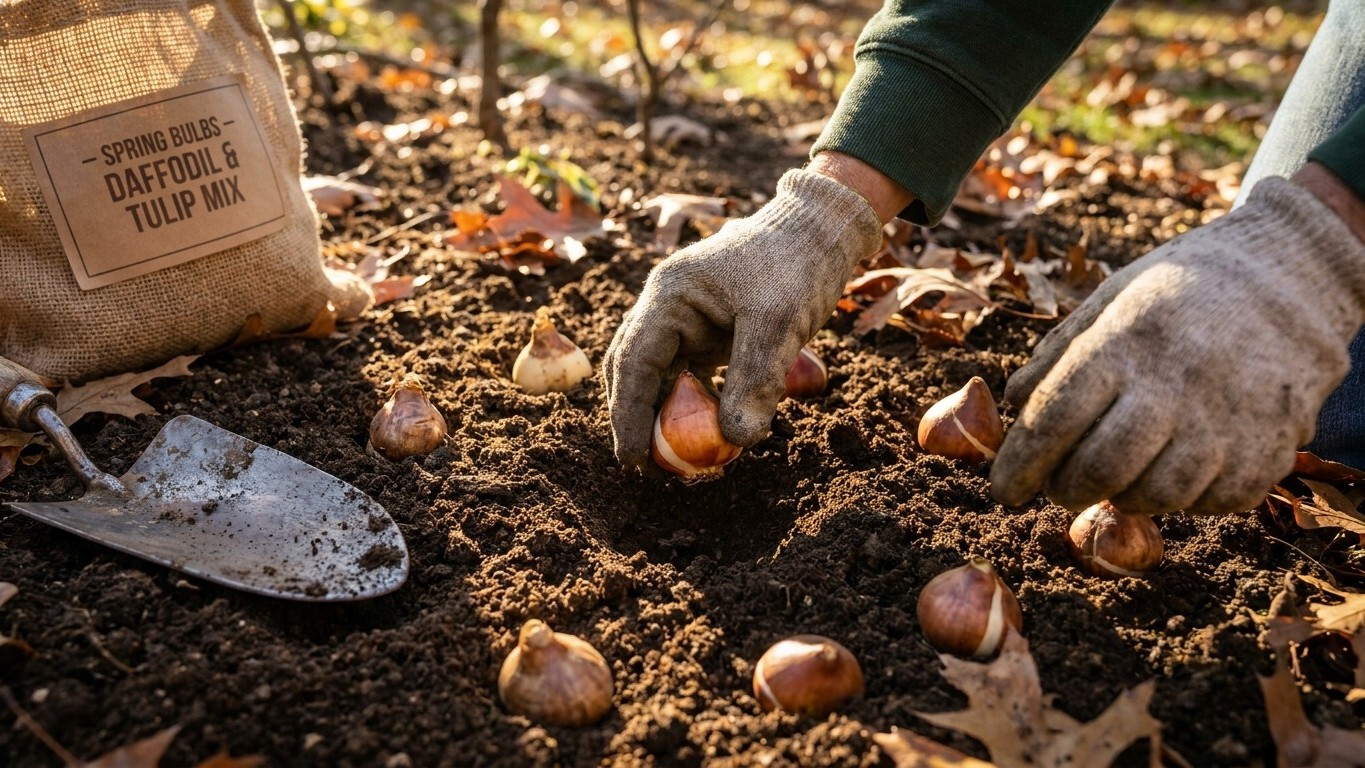

New Jersey’s winters run cold enough to satisfy nearly every classic spring bulb, but the answer changes bulb by bulb. Plant most daffodils, tulips, crocus, and alliums between mid-October and late November, and skip the tender bulbs that never belonged in this ground to begin with. Here’s how to tell which is which.
When to plant bulbs in New Jersey

Spring bulbs need cool soil to root without pushing top growth, and they need enough weeks in the ground before it locks up hard for winter. The rule of thumb is to plant roughly six weeks before the ground freezes solid, and that window is set by the average first fall frost. In New Jersey, based on the reference weather station used by NOAA’s Climate Normals, that date falls between November 4 and November 16.
Working backward from that date gives a practical planting window running from the last two weeks of September through late October, with a hard cutoff before Thanksgiving in most years. Gardeners closer to the coast or in the state’s southern counties often get an extra week or two of workable soil; those in the northern highlands lose it just as fast.
What happens at each end of the window
Plant too early, while soil temperatures still sit in the 60s, and bulbs may send up leaf tips before the first hard freeze. That top growth gets burned back by cold, and while the bulb usually survives, it wastes energy it needed for root development. Plant too late, after the ground has already started to stiffen, and roots never get the six to eight weeks they need to anchor before winter locks everything down. The result is a bulb that sits dormant all winter with no root system, then either fails to emerge in spring or comes up weak, with a short stem and a flower that never fully opens.
One caution worth repeating: November 4 to November 16 is an average, pulled from three decades of data. Roughly half of all years bring the first hard frost earlier than that range, and half bring it later. A gardener who waits until November 15 to start planting is gambling on the late half of that distribution. The safer approach is to treat late September as the start of the window and aim to have bulbs in the ground well before Halloween, leaving November as a buffer rather than a plan.
Whether your winter is cold enough
Spring bulbs are not simply cold-tolerant, they are cold-dependent. A tulip or daffodil bulb needs a sustained stretch of soil temperatures below about 45°F for twelve to fourteen weeks before it can complete the internal process that produces a flower stem. Skip that chilling period, or cut it short, and the bulb typically still produces leaves, but no bloom, or a flower bud so short it never clears the foliage. This same chilling requirement is what gardeners rely on when Forcing Spring Bulbs Indoors in New Jersey, artificially replicating those cold weeks in a refrigerator to bloom bulbs out of season. This chilling requirement is the single number every gardener should know before ordering bulbs, because it’s the yardstick for every variety on a seed catalog, regardless of where you garden.
New Jersey’s cold season answers that requirement with room to spare. The average daily minimum temperature during the coldest month, based on Newark’s climate normals, is 25.5°F, well under the 45°F threshold. Soil temperatures in the state typically stay below that mark from mid-November through early March, a stretch that runs closer to sixteen to eighteen weeks in most years. That margin means gardeners across New Jersey’s USDA hardiness range of zone 6a to 7b can plant the classic spring bulb lineup without any artificial pre-chilling.
Chill requirement versus what New Jersey delivers
| Bulb | Weeks of cold typically required | What New Jersey delivers | Verdict |
|---|---|---|---|
| Tulips (hybrid) | 14-16 weeks below 45°F | ~16-18 weeks, coldest month min 25.5°F | Clears comfortably, no pre-chill needed |
| Daffodils (Narcissus) | 12-15 weeks | ~16-18 weeks | Clears comfortably |
| Hyacinths | 10-12 weeks | ~16-18 weeks | Clears comfortably |
| Crocus | 8-15 weeks (species-dependent) | ~16-18 weeks | Clears comfortably |
| Alliums | 8-10 weeks | ~16-18 weeks | Clears comfortably |
For gardeners in warmer parts of the country where soil rarely drops below 45°F for more than a few weeks, pre-chilling is the only workaround, and it’s worth explaining honestly here even though New Jersey doesn’t need it: bulbs go into a paper bag in the refrigerator for twelve weeks, kept away from apples, pears, and other ripening fruit, because the ethylene gas fruit gives off will kill the flower bud inside a chilling bulb. A gardener in a warm climate who skips that step and plants tulips anyway has spent money on a plant that will show leaves once and nothing more. New Jersey gardeners don’t face that problem, but a bulb ordered from a grower serving a national market may still list generic instructions written for climates that do.
Which bulbs suit New Jersey
The bulbs below are commonly listed with hardiness ranges that comfortably cover New Jersey’s zone 6a to 7b span, and their chilling needs are met by the state’s winter as shown above:
- Daffodils (Narcissus) — hardy zones 3-8
- Tulips (Darwin hybrids and species types) — hardy zones 3-7, some cultivars to zone 8
- Crocus — hardy zones 3-8
- Hyacinths — hardy zones 4-8
- Alliums — hardy zones 3-9
- Snowdrops (Galanthus) — hardy zones 3-7
- Grape hyacinth (Muscari) — hardy zones 3-8
None of these ranges are hard lines. A tulip cultivar rated to zone 7 will often survive an exposed zone 7b garden near the Jersey Shore and struggle in a low-lying, wind-scoured spot in the same county. Microclimate matters as much as the map.
Two categories reliably disappoint here, and it’s worth naming the failure mode rather than just the bulb. Ranunculus and anemone coronaria, hardy only to roughly zone 8 or warmer, rot in New Jersey’s wet winter ground rather than simply failing to bloom, since they’re built for a mild, dry dormancy that this climate doesn’t offer. Freesia and other tender South African bulbs share the same problem: fine in a pot brought indoors, but a total loss left in the ground. Separately, many hybrid tulips, even well within their hardiness range, put on a strong first-spring show and then decline year over year regardless of the cold, since repeat blooming was bred out of many showy cultivars in favor of flower size. That’s a genetics issue, not a climate one, but gardeners often blame the wrong culprit.
What digs them up here
Squirrels and voles don’t raid a bulb bed at random. The bulbs they take and the ones they leave line up almost exactly with which bulbs are toxic or bitter to a rodent’s digestive system.
- Bulbs squirrels and voles typically take: tulips, crocus
- Bulbs they generally leave alone: daffodils, alliums, snowdrops, fritillaria, hyacinths
Daffodils and every bulb in the allium family contain compounds that are unpalatable or mildly toxic to rodents, which is why they’re rarely touched even in a yard with a heavy squirrel population. Tulips and crocus have no such defense, and a newly planted bed of either is often the first thing dug up once the scent of disturbed soil fades.
The one measure that reliably works is laying wire mesh or hardware cloth flat over the planting area, pinned down until the ground freezes. By the time it thaws in spring, the scent trail rodents follow is long gone, and the mesh can be lifted before shoots emerge. Repellent sprays, by contrast, wash off with the first hard rain and need constant reapplication to do anything at all, making them a poor long-term fix for a bed planted once in October and left alone until March.
Where to check for your own county
Every figure above traces back to a single reference station near Newark, and New Jersey stretches across more than three degrees of latitude and two full USDA hardiness zones, from the Skylands region in the north to the Cape May shoreline in the south. A planting window built around Newark’s frost dates can run up to three weeks off at either edge of the state, early for the highlands, late for the coast.
The state’s land-grant extension service, Rutgers Cooperative Extension, publishes county-level guidance that accounts for those differences, and each county office can confirm local frost dates and soil conditions than any statewide average. Before ordering bulbs, a quick call or visit to the county office is the difference between a planting date that works and one borrowed from a city three counties away.