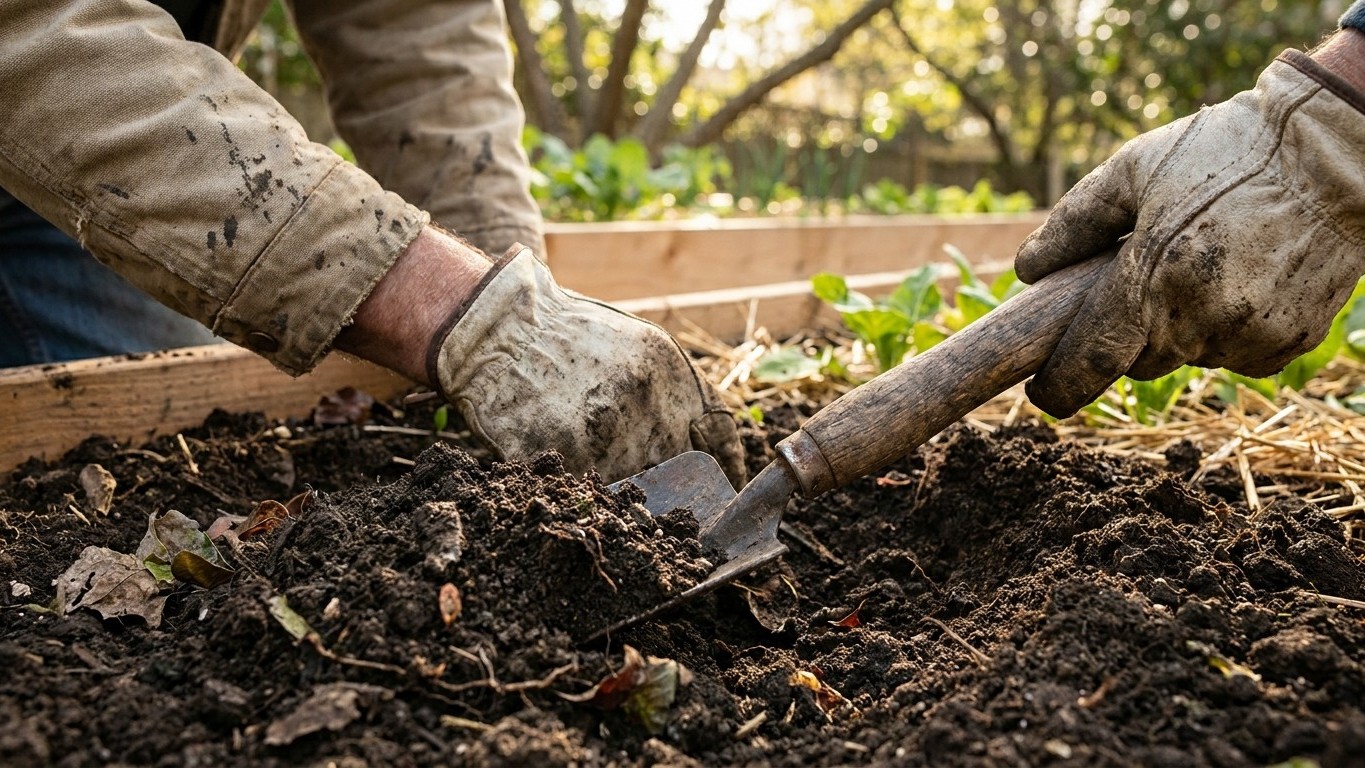

Dig a spade into most New York backyards and you’re standing on the Honeoye series, the soil USDA has designated as representative of the state. It’s a moderately fertile forest soil with a slightly acid surface, a silty loam texture, and decent drainage. Here’s what that actually means once you’re kneeling in the dirt with a trowel.
What is under your garden

The Honeoye series is an Alfisol, the technical term for a forest-derived soil that holds onto nutrients reasonably well compared to soils formed under other conditions. It formed under hardwood forest cover, which explains why it isn’t wildly acidic or nutrient-poor the way some pine-forest soils turn out. The surface horizon runs about 6.3 on the pH scale, which is slightly acid and sits close to what most vegetables and turf grasses actually want. Texturally it’s a loam to silt loam: 26 percent sand, 19 percent clay, and 55 percent silt, with organic matter around 3.0 percent in that top layer.
| Reading | Value |
|---|---|
| Surface pH | about 6.3 (slightly acid) |
| Sand | 26 percent |
| Silt | 55 percent |
| Clay | 19 percent |
| Organic matter | about 3.0 percent |
Those numbers describe silt loam ground, not heavy clay and not sand. Silt-dominant soil like this tends to hold moisture better than sandy ground while draining faster than true clay, which is part of why it made a good candidate to represent the state’s agricultural land.
None of that means it’s your soil. Honeoye is the series USDA mapped as representative across a huge stretch of New York, but the state also holds river-bottom silt, hill-country stone-fragment soils, and glacial till in places the ice sheet dropped it thick. Any lot a builder graded, scraped, or filled during construction is a different animal entirely; construction fill can bury the native profile under a foot or more of subsoil that has none of the organic matter or structure described above. Treat these figures as a starting expectation for the region, not a lab result for your bed.
Reading your own dirt in five minutes
Two quick checks tell you more than staring at the ground ever will. First, the ribbon test: grab a handful of moist soil and squeeze it between thumb and forefinger, pushing it out into a ribbon. Soil that won’t ribbon at all is sandy. A ribbon that holds for an inch or two before breaking is loam. A ribbon that stretches two inches or more without cracking is clay-heavy.
Second, the jar test. Fill a clear quart jar about a third full of soil, top it with water, shake hard, and let it sit overnight. Sand drops first and settles at the bottom within a minute or two. Silt follows over the next few hours. Clay stays suspended longest and forms the topmost, finest layer once everything settles. Measuring the thickness of each band gives you a rough percentage breakdown you can compare against the table above.
Testing before you amend
Guessing at soil amendments is one of the more expensive habits a gardener can pick up. Lime, sulfur, and gypsum all cost money, and applying the wrong one, or the right one in the wrong amount, can set a bed back a full growing season. A lab test tells you the actual pH and nutrient levels in your specific ground, none of which you can judge by eye, by texture, or by how the plant next door is doing.
The Honeoye figure of pH 6.3 lets you expect something close to neutral, slightly on the acid side. That’s a reasonable starting assumption for unworked ground in the region. But expecting isn’t knowing, and plenty of yards run more acidic under old conifer cover or more alkaline near concrete foundations and driveways where lime has leached out of the material for decades.
Taking a sample correctly matters as much as sending it in. Here’s the routine:
- Pick eight to ten spots scattered across the bed or lawn area you’re testing, avoiding spots right next to walls, walkways, or old garden edging.
- At each spot, dig a small core down to about 6 inches, the depth where most root activity happens in vegetable beds and lawns.
- Drop all the cores into a clean plastic bucket and break up any clumps by hand.
- Mix thoroughly and pull about two cups of the combined soil for your sample bag.
- Let the sample air-dry on newspaper for a day if it’s visibly wet, then package and label it with the bed’s location and current use.
The results come back with an actual pH reading, plus phosphorus, potassium, and sometimes organic matter percentages. That’s the number you amend to, not the regional average.
Amending it
Correcting New York ground starts with the pH your own test returns, read against what a slightly acid Alfisol like Honeoye typically needs.
Liming acidic pockets
If your test comes back well below 5.5, meaningfully more acid than the regional 6.3 baseline, lime is the tool, not sulfur. Strongly acid ground locks up phosphorus so plants can’t use it even when it’s present in the soil, and it stresses brassicas like cabbage and broccoli specifically. Ground limestone raises pH slowly, over one to two full seasons, not weeks, because it has to react with soil moisture and microbial activity to take effect. Applying it in fall gives it a head start before spring planting.
Sulfur for alkaline ground
If a test instead comes back above roughly 7.3, which happens near old masonry, concrete slab edges, or ground that’s had wood ash dumped on it repeatedly, lime should never go anywhere near that bed. Elemental sulfur combined with steady additions of organic matter is the slow, honest fix, working over multiple seasons rather than one. High pH locks iron out of reach for plant roots, and that’s exactly what yellowing leaves with dark green veins, especially on blueberries, azaleas, or rhododendrons, are telling you.
Working the silt-and-clay fraction
At 19 percent clay, Honeoye ground isn’t heavy clay, but plenty of New York yards run heavier than that, especially over glacial till. Heavy clay wants organic matter worked in consistently, compost, aged leaf mold, chopped straw, added every season rather than once. Never dump sand into clay hoping to lighten it; the two together behave more like concrete than loam. And never work clay soil while it’s wet, since that’s exactly when compaction does the most lasting damage, squeezing out the pore space roots and water both need.
Working the sandy fraction
Ground running sandier than the 26 percent baseline, common near old lakeshore deposits and outwash plains, needs organic matter for the same reason clay does, just for the opposite problem: nothing stays put in sand, water and nutrients both wash through fast. Shorter, more frequent watering beats a single deep soak, since sandy profiles simply can’t hold a large reserve. Clay corrections and pH corrections both take multiple seasons to show full results; sandy ground responds to added organic matter faster, often within a single growing season, because there’s so little already there to change.
Drainage and compaction
Honeoye carries a well-drained rating in the official survey data, meaning water moves through the profile at a reasonable pace rather than pooling or vanishing instantly. Standing water in a bed 24 hours after a hard rain is a sign your actual plot doesn’t match that baseline, whether from compaction, a clay lens, or grading that channels runoff into one low spot.
The percolation test settles the question directly. Dig a hole about a foot deep and a foot wide, fill it completely with water, and let it drain once to saturate the surrounding soil. Fill it a second time and time how fast the water level drops. An inch or more per hour is workable drainage for most vegetables and ornamentals. Under half an inch an hour signals a real drainage problem worth addressing before planting anything that resents wet feet.
Compaction from foot traffic, wheelbarrows, and heavy equipment squeezes air pockets out of soil and is a separate issue from texture. Double digging used to be the standard fix but has fallen out of favor because it disturbs soil biology and structure that took years to build, often for a benefit that fades within a season or two.
- If drainage tests well: proceed with in-ground beds and standard amendment schedules.
- If drainage is marginal: break up compaction with a broadfork rather than a full till, and add organic matter yearly.
- If drainage fails outright: stop fighting it. A raised bed filled with a purchased blend sidesteps years of amendment and gives roots a working root zone immediately.
On genuinely poor ground, the raised bed isn’t a compromise, it’s the better bet outright, especially for anyone who wants a productive vegetable bed this year rather than in three.
Local help
Cornell Cooperative Extension runs soil testing for New York gardeners through county offices statewide. Submit a sample and a staff member reads the results with you, translating the numbers into an actual amendment plan for your specific plot rather than a generic recommendation. Find your county office through the Cornell Cooperative Extension directory.
Common questions
Is New York soil good for growing vegetables?
The representative Honeoye series, slightly acid, moderate organic matter, well drained, sits close to ideal for most vegetable crops without amendment. Actual results vary widely by yard, especially anywhere fill or heavy clay is involved.
Do I need to lime my New York garden every year?
Not automatically. Lime only makes sense once a soil test confirms pH has dropped meaningfully below the mid-6 range, and even then it’s applied every few years, not annually, since it takes seasons to react fully.
Why is my New York soil sticky and hard to dig?
That points to a clay percentage higher than the state’s 19 percent baseline, common over glacial till. Working in organic matter every season and avoiding digging it while wet are the two most effective long-term fixes.
How much does a soil test cost through Cornell Cooperative Extension?
Costs vary by county office and by which nutrients are tested, so check with your local office directly before submitting a sample.