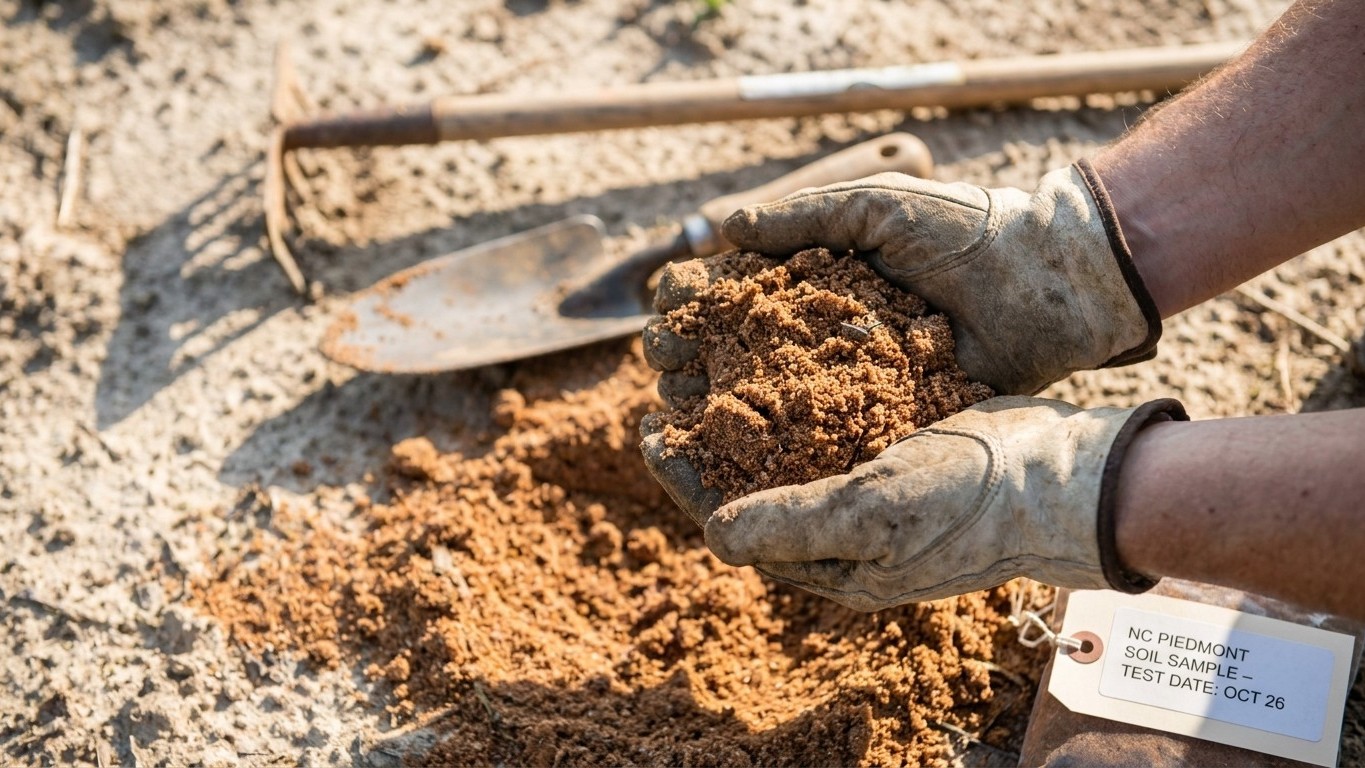

North Carolina’s official state soil is the Cecil series, an old, heavily weathered Ultisol that runs acid, drains fast and holds almost no organic matter near the surface. That single fact explains why lime, mulch and patience show up in nearly every gardening conversation across the Piedmont and beyond. What follows is the actual data behind that soil, how to test your own ground against it, and what to do once you know where you stand.
What is under your garden

The Cecil series is what the USDA lists as representative of North Carolina soil. It formed over millions of years of weathering and leaching in the southern Piedmont, and the result is ground that is old in the geological sense: minerals broken down, nutrients washed downward, structure built by clay rather than by anything a farmer added. USDA NRCS records for the surface horizon of the major components of this series (636 components sampled) give a specific, unromantic picture.
| Reading | Value |
|---|---|
| Surface pH | about 5.5 (slightly acid) |
| Sand | 68 percent |
| Clay | 13 percent |
| Silt | 20 percent |
| Organic matter | about 0.8 percent |
Those numbers describe a sandy, acidic, nutrient-poor surface layer that drains well because there simply isn’t enough clay up top to slow water down. It is a soil that leaches easily, which is part of why acid rain and years of rainfall have pulled the pH down toward 5.5 rather than leaving it neutral.
Here is the honest caveat, and it matters more than the table above: this is the soil that represents North Carolina in a mapping sense, not the soil under your tomatoes. The state runs from coastal sand flats to Piedmont clay to mountain loam, and a lot of Cecil ground carries a much heavier clay subsoil just a shovel’s depth below this sandy surface. Any lot that a builder scraped, filled or graded is its own soil entirely, unrelated to any regional average. Treat the table as a starting expectation, not a diagnosis.
Reading your own dirt in five minutes
Two quick checks tell you more than any guess. For the ribbon test, take a handful of moist soil and squeeze it between thumb and forefinger, pushing it upward into a ribbon. Sand won’t ribbon at all, it just falls apart. Loam forms a short ribbon that breaks. Heavy clay forms a long, shiny ribbon that holds together for two inches or more.
For the jar test, fill a clear jar about a third full of soil, top it off with water, shake hard, and let it sit overnight undisturbed. Sand settles within minutes on the bottom, silt forms a middle layer within a few hours, and clay stays suspended longest, settling into a thin top layer by morning. Measure the layers and you have a rough percentage breakdown of your own ground, no lab required.
Testing before you amend
Guessing at soil amendments is how gardeners end up spending money to correct a problem that never existed, or worse, overcorrecting a real one. Eyes and hands tell you texture. They tell you nothing about pH, phosphorus, potassium or the micronutrients that actually determine whether a plant thrives or sulks. A lab test replaces every one of those guesses with an actual number.
Because the regional Cecil series runs about 5.5, it is reasonable to expect your own soil leans acid too, especially if your property sits on undisturbed Piedmont ground. But expecting is not knowing. Fill dirt, years of wood ash, a septic field, or decades of lawn lime can all push a particular yard well away from the regional norm. The only way to find out is to sample it.
A representative sample means several small cores mixed together, not one scoop from one spot.
- Pick 8 to 10 spots scattered across the bed or lawn area you’re testing, avoiding edges, low spots and anywhere fertilizer was recently piled.
- At each spot, dig a core about 6 inches deep, roughly the depth where most vegetable and lawn roots actually feed.
- Drop each core into a clean bucket, breaking up clumps as you go.
- Mix the combined cores thoroughly and let the soil air-dry on newspaper for a day if it’s wet.
- Pull about a pint of the mixed, dried sample for the test bag or box.
- Label it clearly by garden zone if you’re testing more than one area, since a vegetable bed and a lawn can read very differently.
When results come back, the pH number tells you which direction to correct, and the nutrient levels tell you whether you actually need fertilizer or whether you’d just be feeding weeds.
Amending it
The correction that fits North Carolina’s representative soil is not a generic list pulled from a national gardening guide. It follows directly from that 5.5 pH and that sandy, low-organic-matter texture.
Lime, not sulfur
A reading around 5.5 sits close to the line where most vegetables and lawn grasses start to struggle, and it points toward lime, not sulfur. Acid soil at this level locks up phosphorus so plant roots can’t reach it even when it’s technically present in the ground, and it’s hard on brassicas like broccoli and cabbage, which prefer a more neutral pH and are prone to clubroot disease in acid conditions. Adding sulfur to soil that’s already acid is a mistake gardeners make when they assume all Southern soil needs sulfur; it does not, and it will only push the pH further in the wrong direction. Lime, usually ground limestone applied and worked into the top several inches, is the correct lever here. It works slowly, over a season or two, not in weeks, because the reaction between lime and soil acidity takes time and rainfall to complete. Retest a year after applying before adding more.
Organic matter for sandy ground
At 68 percent sand and only 0.8 percent organic matter, this soil’s biggest weakness isn’t its texture so much as what’s missing from it. Sand alone drains too fast to hold nutrients or moisture near plant roots, and with almost no organic matter to buffer that, fertilizer and rain both pass through quickly. Compost, aged manure, and leaf mold worked into the top 6 to 8 inches build the kind of organic reservoir this soil lacks, and unlike lime, the moisture and nutrient-holding benefit shows up the same season you apply it. Because water moves through fast, sandy beds also need shorter, more frequent watering rather than a deep soak twice a week. If a soil test on your own property comes back heavier in clay than these regional numbers suggest, the guidance flips: add organic matter there too, but never work clay-heavy ground while it’s wet, and never add sand to clay hoping to lighten it, since that combination tends to set up like poor concrete instead.
Drainage and compaction
The Cecil series is classified as well drained, which in plain terms means water moving through the sandy surface layer doesn’t pool for long after a normal rain. Stand in a garden built on this kind of ground twenty minutes after a storm and you should see damp soil, not standing water. That’s a real advantage for root rot prevention, though it comes at the cost of the fast nutrient leaching already covered above.
You can check your own drainage with a simple percolation test. Dig a hole about 12 inches deep and 12 inches across, fill it with water, and let it drain completely once to saturate the surrounding soil. Fill it a second time and time how long it takes to drop. A rate faster than 1 inch per hour into hard clay subsoil suggests slow drainage and standing water risk; a rate of several inches per hour suggests fast, sandy drainage that will need more frequent watering and mulch to hold moisture.
Compaction is a separate problem from drainage class, and it shows up wherever feet, mower wheels or construction equipment have repeatedly pressed on the same ground. Double digging, once the standard fix, has fallen out of favor because it disturbs soil biology and structure more than it helps, and the compacted layer often returns within a season or two once the ground is walked on again. For heavily compacted lots, especially anywhere fill dirt was brought in during construction, a raised bed built on top of the existing ground is frequently the better bet rather than spending three seasons trying to amend soil that was never going to cooperate.
- On well-drained sandy ground: mulch heavily to slow evaporation, and water more often in smaller amounts.
- On compacted or clay-heavy pockets: aerate mechanically rather than digging, and avoid walking the same paths repeatedly.
- On fill dirt or scraped building lots: skip in-ground amendment entirely and build up with a raised bed instead.
Local help
Every county in North Carolina has access to soil testing through NC State Extension, the state’s land-grant extension service. Bring your mixed, labeled sample to the county extension office, and staff there will walk through the lab results with you, translating pH and nutrient numbers into an actual plan for your specific bed rather than a regional average.
Common questions
Is all North Carolina soil sandy?
No. The Cecil series represents the state in USDA records, but the coastal plain runs sandier, the Piedmont often carries heavier clay subsoil beneath a thinner sandy surface, and the mountains run to loam. Local testing beats any statewide generalization.
How often should I retest my soil?
Every two to three years for an established garden, or a year after a significant amendment like a full lime application, so you can confirm the correction actually moved the pH rather than guessing that it did.
Can I skip the lab test and just add lime every spring?
That habit is common and it’s a mistake. Lime raises pH gradually and it doesn’t reverse quickly if you overdo it, so adding it on a schedule rather than in response to an actual reading can push acid-loving plants like blueberries into a pH range where they no longer thrive.
Why does my yard have standing water when the regional soil is described as well drained?
Construction grading, compacted subsoil, or a clay-heavy layer just beneath a sandy surface can all override the regional drainage class on an individual lot. A percolation test on your own ground is the only way to know for certain.