
Nova Scotia gardens want less water than most people think, but it has to land at the right depth and the right time. The short version: soak deeply once or twice a week rather than sprinkling daily, water in the morning at the soil line, and check your local water utility before you set a schedule, because restrictions do exist here. For more detail on adjusting this rhythm when the rain stops, see Watering Through a Dry Spell in Nova Scotia.
How much, how often

A quick daily splash from the hose feels productive. It isn’t. Water that only wets the top inch of soil trains roots to stay shallow, right where they’re exposed to heat and drought stress the moment you skip a day. What a garden actually needs is a deep soak that pushes moisture down six inches or more, then a break long enough for the surface to dry out before you water again.
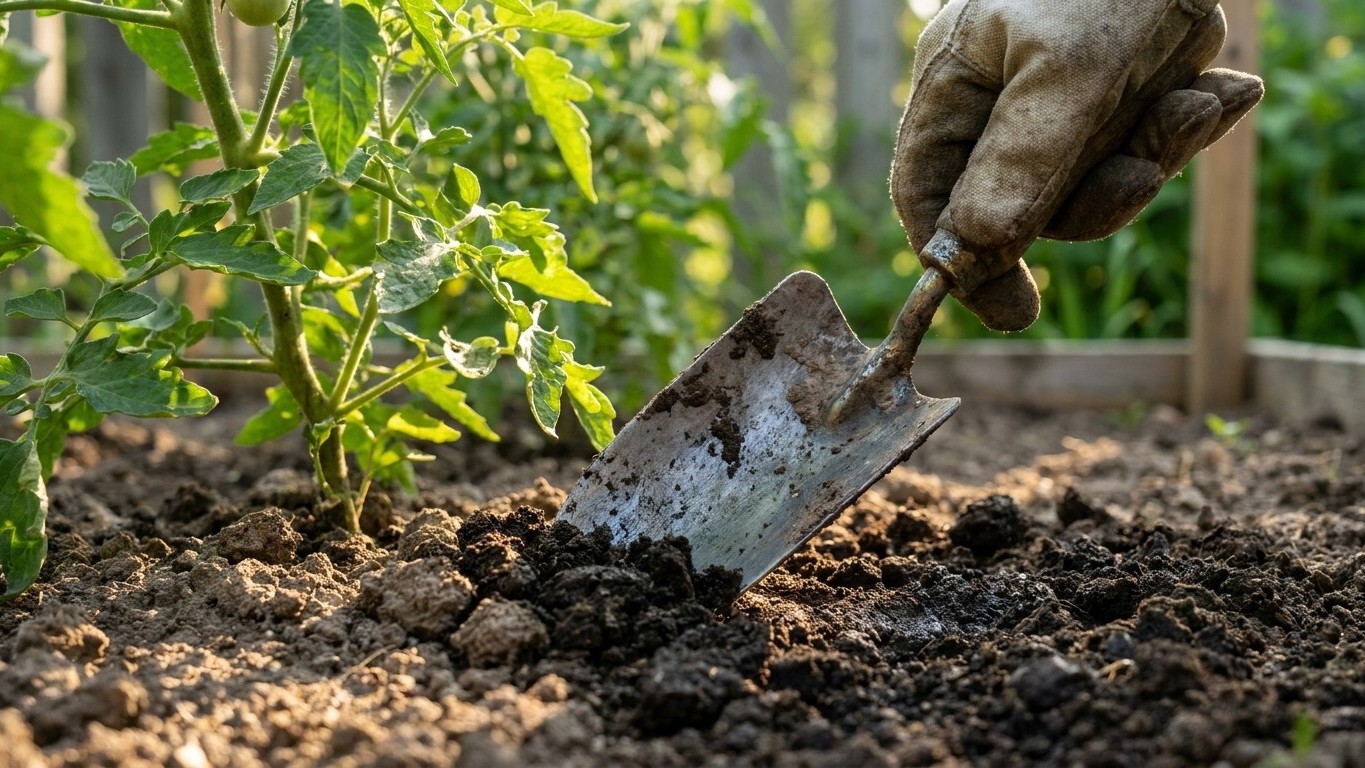
The question is how you know when that break is over. Forget the calendar and check the ground instead. Push a finger or a trowel two inches into the soil near the base of the plant. If it’s still damp down there, wait. If it’s dry, water. This single habit does more for a garden’s health than any fixed schedule, because it adapts to whatever the sky actually did that week.
Nova Scotia’s climate makes that check more forgiving than it would be in a hot, dry province. The reference station at Halifax records an average of 0.0 days a year at 90°F or above, according to Environment and Climate Change Canada’s 1981-2010 normals. That’s not a summer with the occasional hot spell, it’s a summer that essentially never gets there. Evaporation from soil and leaves stays modest most of the season, which means the deep-soak-and-wait rhythm below can often stretch a little longer than it would in a hotter zone, especially in a wet stretch.
Soil texture still decides the details. Sandy, well-drained ground holds onto very little moisture and drains fast, so it asks for shorter, more frequent soakings even in a mild climate. Heavy clay, common in parts of the province, can hold a week’s worth of water in reserve, but it punishes overwatering by drowning roots in waterlogged, oxygen-starved soil. Never work clay soil, and never water it again, while it’s still wet from the last rain or the last soak. Squeeze a handful: if it forms a slick, sticky ball, leave it alone.
Here’s a simple sequence to follow at the base of any bed, lawn, or container (see also Watering Pots and Containers in Nova Scotia for container-specific tips):
- Check the soil two inches down with a finger or trowel before touching the hose.
- If it’s dry, water slowly and deeply until moisture reaches six inches, roughly one inch of water for most garden beds.
- Water at the base of the plant, never overhead onto leaves, to cut down on fungal disease in a naturally humid maritime climate.
- Water in the early morning, so moisture soaks in before the day’s warmth and any evening dampness on foliage doesn’t sit overnight.
- Skip the next scheduled watering if the two-inch check still shows damp soil, and recheck in two or three days.
Restrictions and rules
Watering restrictions aren’t rare in Nova Scotia, and they aren’t fixed. Municipal water utilities and regional water commissions can and do issue outdoor watering rules during dry stretches, usually tied to reservoir levels or demand on the system rather than to a set calendar date. Some years bring no restrictions at all. Other years, a dry June or July triggers limits on lawn sprinklers, odd-even day schedules by street address, or outright bans on daytime watering.
None of that is fixed enough to print here as a fact you can rely on months from now. The safest move is also the simplest: before you set an automatic timer or plan a watering schedule for the season, check with your local water utility or municipality directly. Rules differ from one system to the next, even between neighboring towns, and they can change mid-summer without much warning.
For general growing conditions, planting windows, and seasonal guidance specific to the province, the Nova Scotia Department of Agriculture’s extension resources are a solid starting point: novascotia.ca/agri. They won’t list every municipality’s current watering bylaw, but they’re a reliable anchor for the agricultural and climate context behind any local rule you find.
It’s also worth checking early rather than late. A restriction announced in the middle of a heat wave, when everyone else in town is also reaching for the hose, is a worse time to discover the rule than a quiet morning in May when you’re first mapping out the season. Build the check into your spring routine, right alongside picking out seeds and setting up beds, rather than treating it as an afterthought once the ground has already gone dry.
Using less
Cutting water use in a Nova Scotia garden doesn’t mean watching plants suffer. It mostly means making the water you do use go further, and a handful of separate techniques do most of that work.
- Mulch: a two- to three-inch layer of bark, straw, or shredded leaves over the soil surface slows evaporation dramatically and keeps the top inches from drying out between soakings, which means fewer trips with the hose overall.
- Drip irrigation or soaker hoses: delivering water directly at the root zone instead of spraying it over a whole bed cuts down on the water lost to wind drift and surface evaporation, and it keeps leaves dry in a climate already prone to humidity-driven fungal issues.
- Grouping plants by water need: putting drought-tolerant perennials in one bed and thirstier vegetables or annuals in another means you’re not overwatering the tough plants just to keep the thirsty ones alive.
- Organic matter in the soil: compost worked into sandy soil increases its ability to hold moisture between waterings, while the same compost worked into heavy clay improves drainage so the ground doesn’t stay soggy after a soak.
- Rain barrels, where local rules allow them: a low-cost way to bank rainfall for the exact dry stretches when a garden needs it most.
The math on rain barrels is worth spelling out, because the number surprises most people. An inch of rain falling on a roof with a thousand square feet of surface area works out to roughly 600 gallons of runoff. In a maritime climate like Nova Scotia’s, where rain is spread across the year rather than concentrated into a single wet season, that means a barrel connected to a downspout has a real chance of refilling itself between uses through the growing season, rather than sitting empty and useless the way it might in a genuinely arid climate. It won’t replace a hose for a large vegetable garden, but for containers, a raised bed, or newly planted shrubs, a full barrel can cover several soakings before it needs the sky’s help again.
None of these techniques demand a full garden overhaul. Mulching one bed this season and adding a single rain barrel is enough to notice the difference in how often you’re reaching for the hose by midsummer.
Common questions
Is it safe to plant tender vegetables right after the average last spring frost date?
Not really. The average last spring frost at the Halifax Stanfield reference station is May 7, but that’s a midpoint, not a guarantee. In one year out of two, frost actually arrives later than that date. Treat May 7 as the center of a window, not a safe green light, and hold off on tender transplants until the risk has clearly passed in your own yard.
Does the whole province share the same frost dates?
No. The May 7 and October 18 dates come from one reference station, Halifax Stanfield International Airport. Northern parts of the province and higher-elevation districts routinely run weeks behind that coastal station, with a shorter frost-free season on both ends.
Can I water my lawn during the heat of the day in summer?
It’s not the best use of water even where it’s allowed. Midday watering loses more moisture to evaporation before it reaches the roots, and with essentially no days a year hitting 90°F at the reference station, there’s rarely a heat-stress reason to water at noon anyway. Morning watering does the job better in this climate.
Where do I find out if my area currently has watering restrictions?
Contact your municipal water utility or regional water commission directly. Restrictions in Nova Scotia are typically issued locally, tied to reservoir and demand conditions in a given system, and they can start or end mid-season, so a direct check beats relying on last year’s rule.