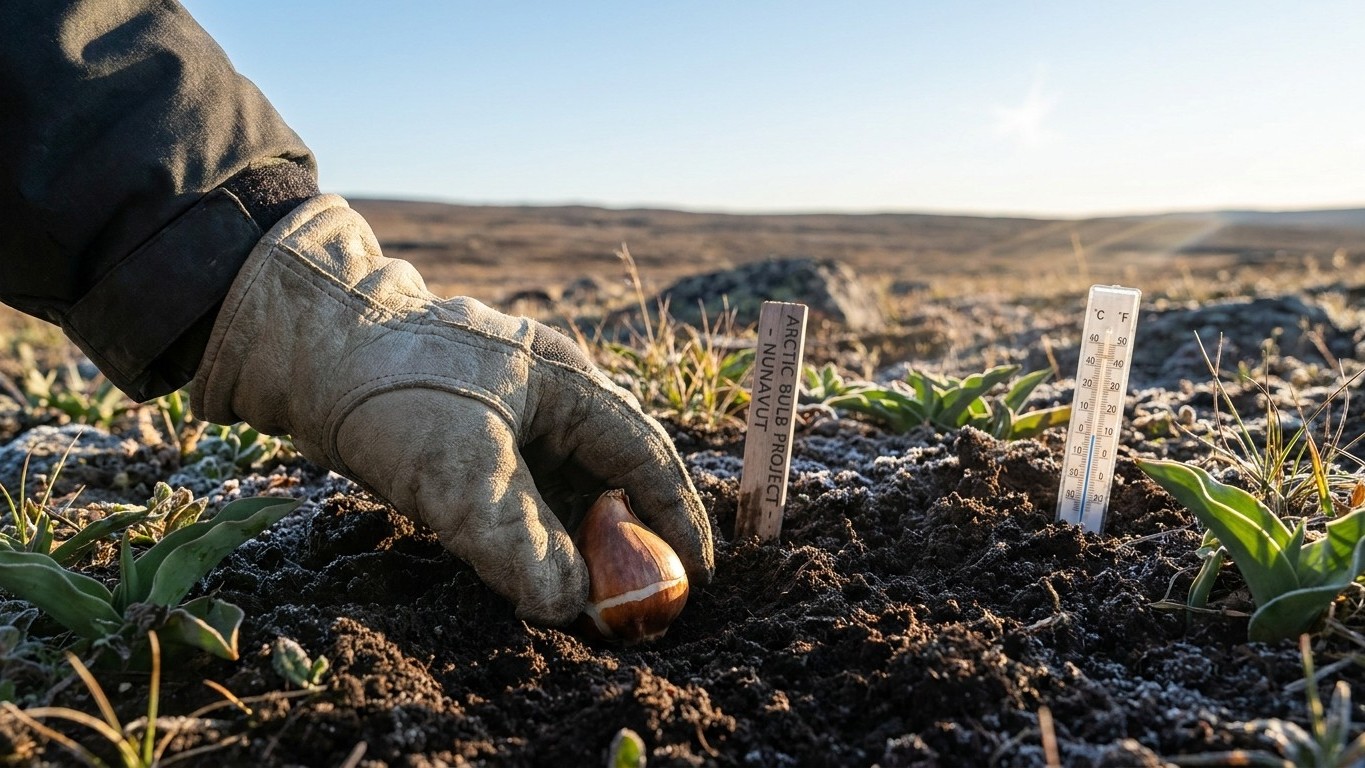

Spring bulbs can go into Nunavut soil, but only a short list of them, and only because the territory’s brutal winter does something warmer places struggle to guarantee: it delivers more cold than any bulb could ask for. The real question isn’t whether it gets cold enough here. It’s whether anything can survive being that cold for that long, and whether the short growing season leaves room to flower at all.
When to plant bulbs in Nunavut

Nunavut’s average first fall frost lands on September 13, recorded at the Rankin Inlet A weather station by Environment and Climate Change Canada. That single date anchors every spring bulb planting calendar in the territory, because bulbs need to go into cooling soil before the ground locks up for winter, not after.
Count back roughly six weeks from that date and you land near the start of August. Count back four weeks and you’re at mid-August. That two-week band, from early to mid-August, is the realistic planting window for most spring bulbs here, closing hard once the frost date passes and the ground begins to freeze in earnest.
Plant too early, while the soil is still holding summer warmth, and a bulb reads that heat as a cue to grow. Shoots that push above ground before the first snow get caught by the next freeze, and top growth killed this way weakens the bulb underneath, sometimes enough that it skips flowering the following spring entirely. For gardeners who want to sidestep this risk altogether, Forcing Spring Bulbs Indoors in Nunavut offers a way to enjoy blooms without gambling on the outdoor planting window, while Growing Spring Bulbs in Containers in Nunavut gives you more control over timing and soil temperature than an in-ground bed allows.
Plant too late, after the ground has already started to freeze, and the bulb never builds the root system it needs before winter shuts everything down. A rootless bulb going into a Nunavut winter tends to surface the next spring, if it surfaces at all, as a stunted shoot with no flower, having spent its stored energy trying to establish rather than blooming.
None of this is exact. September 13 is a mean date built from three decades of records, not a promise. In roughly half of those years, the first frost arrived later than the average, and in the other half, earlier. Treat the date as the middle of a moving target, not a line on a calendar, and lean toward the earlier half of the planting window rather than the later one.
Whether your winter is cold enough
Every spring bulb needs a stretch of real cold before it will flower. Most varieties want twelve to fourteen weeks with the soil below about 45°F. Skip that stretch, or cut it short, and the bulb still grows, it just skips the flower: you get leaves, or a bud so short it never clears the foliage. That threshold, the weeks and the 45°F mark, is the number worth carrying into any decision about which bulbs to plant, wherever you garden.
Nunavut doesn’t come close to falling short on this measure. The coldest month here averages a daily low of -29.8°F, and the ground begins locking up around the September 13 frost date, typically not fully releasing until deep into the following spring. Soil sitting below 45°F for eight months or more is ordinary in this territory. Against a twelve to fourteen week requirement, that’s a margin measured in months, not weeks.
What that margin buys, and what it doesn’t
That surplus buys two things. First, no pre-chilling: gardeners in places where winter doesn’t reliably deliver twelve weeks below 45°F have to fake it, storing bulbs in a refrigerator for about twelve weeks before planting and keeping them well clear of ripening fruit, since the ethylene gas fruit gives off kills the flower bud sitting inside the bulb. Nobody in Nunavut needs to do that. Second, it means chill is never the reason a bulb fails here. If a spring bulb won’t flower in this territory, the fault lies elsewhere, in hardiness, in a growing season too short to let the plant recover after blooming, or in a freeze that reaches roots planted too shallow to escape it.
That distinction flips the usual advice on its head. Anywhere south of the Arctic, a tulip that comes up leafy and flowerless usually has a chill problem. In Nunavut, chill is the one variable that’s never in question.
| Species | Weeks of cold required | What Nunavut delivers | Verdict |
|---|---|---|---|
| Tulips (Tulipa) | 12 to 14 weeks below 45°F | 30+ weeks below 45°F, roughly September through June | Chill requirement met several times over |
| Daffodils (Narcissus) | 12 to 15 weeks below 45°F | 30+ weeks below 45°F | Chill requirement met several times over |
| Crocus | 8 to 10 weeks below 45°F | 30+ weeks below 45°F | Chill requirement met, wide margin |
| Hyacinth | 12 to 14 weeks below 45°F | 30+ weeks below 45°F | Chill met; hardiness, not cold, is the real limit |
| Siberian squill / grape hyacinth | 8 to 10 weeks below 45°F | 30+ weeks below 45°F | Chill requirement met several times over |
Which bulbs suit Nunavut
The reference point for hardiness here is Nunavut’s own community, rated zone 0a under the Canadian Plant Hardiness system, the coldest classification Natural Resources Canada assigns anywhere in the country. That’s a different scale than the USDA zones printed on most seed packets and bulb catalogs, built from seven climate variables rather than one, and the two don’t convert cleanly onto each other. What that zone number signals is that almost nothing sold as an ornamental bulb was bred with a place this cold in mind.
A short list of species bulbs clears the bar anyway, mostly because they were never bred for garden display in the first place. They’re close to their wild form, and wild forms are built for genuine cold:
- Siberian squill (Scilla siberica), rated hardy to zone 2
- Snow crocus (Crocus chrysanthus), rated hardy to zone 3
- Species tulips such as Tulipa tarda, rated hardy to zone 3
- Wild-type daffodils bred for cold climates, rated hardy to zone 3
None of those ratings are a guarantee. A zone 3 bulb tucked against a south-facing foundation, under snow cover that lingers instead of blowing off, often outperforms the same bulb in an exposed bed two properties over. Rated hardiness describes an average, and Nunavut’s wind doesn’t treat every yard the same way.
The bulbs that disappoint are the ones bred for display rather than survival. Hybrid Darwin tulips and most hyacinth cultivars carry ratings that look close enough on paper, zone 3 or 4, but they were selected for flower size and color in nurseries far south of here, not for an eight-month freeze. The failure usually isn’t immediate: the first spring often puts on a decent show, because the bulb arrives already loaded with energy from the grower. The letdown shows up the second year, when the display doesn’t return, or comes back as foliage with no flower at all, the bulb having spent its reserves surviving rather than blooming. Fritillaria behaves the same way, and in a wet spring melt its bulbs are prone to rotting in place before they even get the chance to fail at flowering.
What digs them up here
Squirrels and voles aren’t random about which bulbs they take. The difference comes down to chemistry, not appetite: daffodils and anything in the onion family carry compounds that make them bitter or mildly toxic to rodents, while tulips and crocus have none of that natural defense and read to a hungry vole as food.
Of the bulbs that actually suit this territory, that split holds. Species tulips and snow crocus are worth protecting; wild-type daffodils and Siberian squill, whose chemistry runs close to the onion family, are largely left alone.
- Bulbs squirrels and voles take: species tulips, snow crocus
- Bulbs they leave alone: wild-type daffodils, Siberian squill
The one method that consistently works is physical, not chemical: lay a sheet of wire mesh flat over a new planting, pin down the edges, and leave it in place until the ground freezes solid, usually a few weeks after the September frost date. A vole or squirrel can smell freshly turned soil from a long way off, but it can’t dig through hardware cloth. Repellent sprays are a temporary fix at best. They wash off in the first real rain, and in a territory where fall storms are common, that’s not much protection to count on.
Where to check for your own county
Nunavut stretches across more latitude than most countries, from the tree line near the Manitoba border to islands well above the Arctic Circle, and the figures in this guide describe conditions at Rankin Inlet, the reference station used for the region. A planting window built around that one station can run two or three weeks off in either direction once you move to a different community.
For guidance tuned to your own location, Agriculture and Agri-Food Canada is the federal starting point, since the department maintains current guidance even where a territorial site is harder to reach online. Beyond that, your local hamlet office or the Government of Nunavut’s own agriculture and food programs can usually confirm freeze-up timing for your specific area, which matters more here than almost anywhere else in the country. A community near open water often freezes later than one further inland, even at the same latitude, and that difference is exactly what a territory-wide average can’t capture.