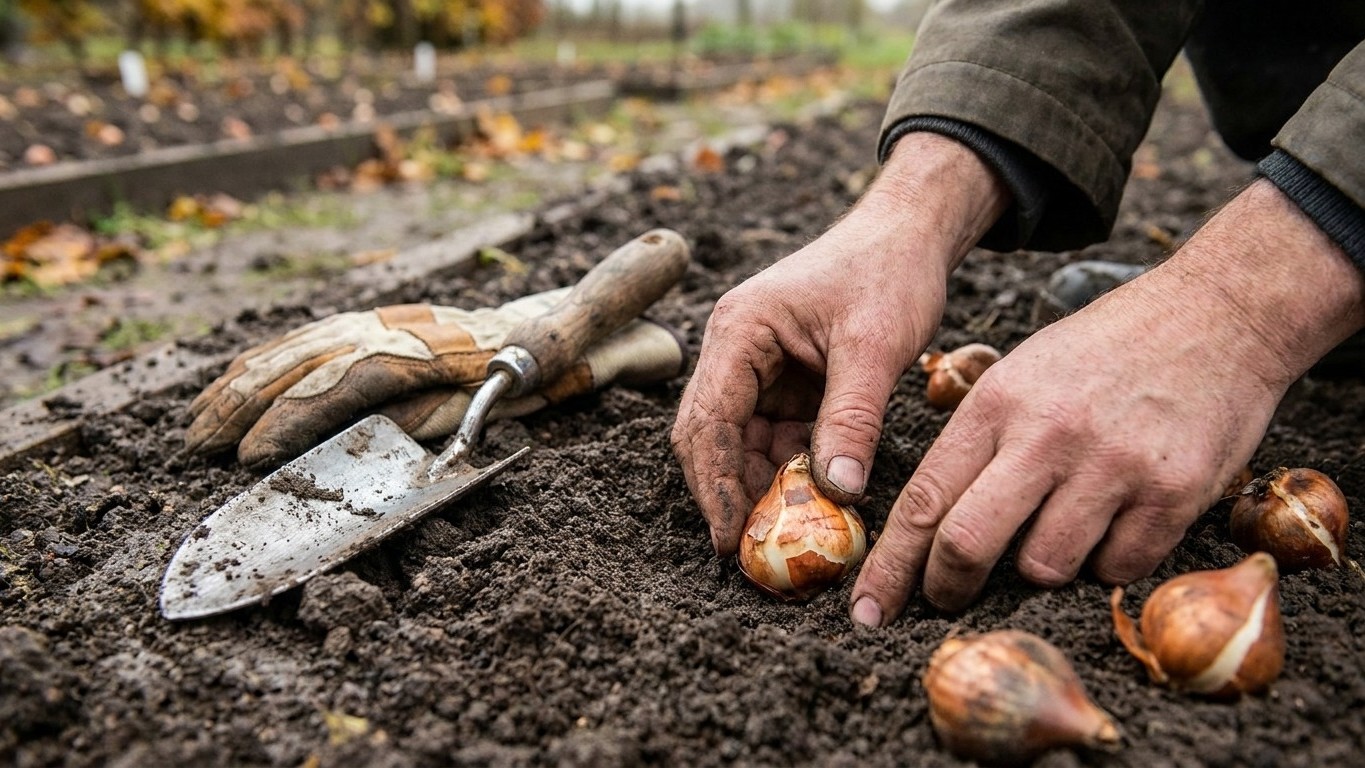

Portland’s cold season is deep enough to satisfy nearly every spring bulb on the market, but the calendar for getting them in the ground runs on a six-week window most Oregon gardeners misjudge. Here’s what the frost dates and winter temperatures actually mean for your bulb order.
When to plant bulbs in Oregon

The target date isn’t a single day, it’s a math problem: count backward about six weeks from the average first fall frost, and that’s your planting window. For the Portland area, NOAA’s 1991-2020 climate normals put that first freeze anywhere from November 11 to November 27, depending on the year. That puts the ideal bulb-planting stretch roughly from late September through the end of October, with some flexibility into early November in mild years.
Plant too early and the soil is still warm enough to coax the bulb into pushing top growth. That green shoot has no chance against a hard freeze in December, and a bulb that spends its stored energy on a shoot that dies back often skips flowering the following spring, or skips it entirely if the growing point rots. Plant too late and the opposite problem shows up: the bulb goes into the ground without enough time to grow roots before the soil locks up cold. Root growth, not top growth, is the whole point of fall planting, and a bulb that doesn’t root well before winter comes up weak, short-stemmed, or not at all the following March.
The frost date is an average, not a promise
That November 11-27 range already tells you something important: it’s a spread, not a fixed date, and it comes from thirty years of records averaged together. Roughly half of all years in that dataset saw the first freeze arrive earlier than the midpoint, and half saw it later. A gardener who plants right up against the late end of that window in a year that turns out to run early has effectively skipped the rooting period altogether. The safer play is to treat late October as the real deadline for most of the Willamette Valley, and to get bulbs in earlier rather than later if the fall has been unusually warm and dry, since dry soil also slows root establishment even when temperatures cooperate.
Soil temperature matters more than the calendar date, technically speaking, but most home gardeners don’t own a soil thermometer, so the frost-date backward count is the practical shortcut. If your property sits in a low-lying frost pocket or up against the coast, adjust a week or two earlier than a neighbor on a warmer south-facing slope. Microclimates inside a single Oregon county can shift the real frost date by more than the statewide average suggests, and gardeners who miss the outdoor window entirely still have the option of Forcing Spring Bulbs Indoors in Oregon to get blooms on a more forgiving timeline.
Whether your winter is cold enough
This is the question that actually decides whether a bulb blooms, and it has nothing to do with the planting date. Spring bulbs are dormancy machines: most varieties need a sustained stretch of cold, roughly twelve to fourteen weeks with soil temperatures below about 45°F, before the internal hormone shift that triggers flowering can happen. Skip that requirement and the bulb doesn’t die, it just misbehaves. It sends up leaves, sometimes a stem, but no flower, or a flower bud so short it never clears the foliage. Gardeners in mild-winter regions who buy tulip bulbs and get nothing but leaves for three years running are usually looking at a chilling failure, not a bad bulb.
Portland’s numbers make this an easy call. The coldest month averages a minimum of 36.2°F, well under the 45°F threshold, and that’s the mean daily minimum for the coldest month, not a record low or a casual average. Because that figure sits comfortably below the trigger point, and because Portland’s cold months, roughly December through February, run consecutively rather than in short cold snaps, the region delivers the chilling window most bulbs ask for without any help from the gardener. No refrigerator, no pre-chilling, no guesswork.
What that margin buys you
Clearing the chilling requirement by a comfortable margin means the full standard catalog of spring bulbs is fair game here: tulips, daffodils, hyacinths, crocus, alliums, and most of the smaller species bulbs sold as naturalizers. It also means Oregon gardeners can skip a step that gardeners in Florida, Texas, or coastal Southern California have to go through every year: buying pre-chilled bulbs or chilling them at home for twelve weeks in a refrigerator, kept away from apples and other ripening fruit because the ethylene gas they release can kill the flower bud forming inside the bulb. If you’ve ever wondered why big-box stores in warm states sell pre-chilled tulip bulbs at a markup, that ethylene-sensitive chilling process is the reason.
| Bulb | Cold required | What Portland delivers | Verdict |
|---|---|---|---|
| Tulip | 12-16 weeks below 45°F | ~3 consecutive cold months, min. 36.2°F | Meets requirement, no chilling needed |
| Daffodil (Narcissus) | 12-14 weeks below 45°F | Same | Meets requirement easily |
| Hyacinth | 12-14 weeks below 45°F | Same | Meets requirement easily |
| Crocus | 8-15 weeks below 45°F | Same | Comfortable margin either way |
| Allium | 8-10 weeks below 45°F | Same | Requirement cleared with room to spare |
A gardener anywhere in this territory who plants tulips or daffodils in a location that never dropped below 45°F for long enough would be wasting the purchase, full stop. Portland isn’t that place, but the table above is the tool to check any bulb, in any territory, before buying it.
Which bulbs suit Oregon
Between the hardiness range for the reference city (USDA zones roughly matching the 4a-9b statewide span, though Portland itself sits in the milder end of that band) and a chilling season that clears every common bulb’s requirement, the practical list of what thrives here is long. None of these hardiness numbers are hard lines, though, a bulb rated for the edge of its range often does fine in a sheltered spot near a south-facing wall and struggles in an exposed, wind-scoured bed just a few miles away.
- Daffodil (Narcissus), hardy zones 3-9: reliable, naturalizes for decades, tolerates Oregon’s wet winters better than most bulbs
- Tulip, hardy zones 3-8: performs well but often treated as a multi-year rather than permanent planting in wetter, heavier soils
- Crocus, hardy zones 3-8: early, low-maintenance, spreads readily in lawns and borders
- Hyacinth, hardy zones 4-8: fragrant and reliable, though bloom size can shrink after the second or third year
- Allium, hardy zones 4-8: excellent drainage tolerance, largely ignored by rodents
- Snowdrop (Galanthus), hardy zones 3-7: one of the earliest bloomers, well suited to Oregon’s mild, damp late winters
The disappointments tend to cluster around bulbs bred for drier, hotter summer dormancy periods, ranunculus and some anemone varieties, for instance, rot in the Willamette Valley’s wet winter soil before they ever get a chance to chill properly. Gardeners who’ve lost a planting to soggy rot rather than cold usually remember it as “the bulbs just disappeared,” which is a drainage failure, not a hardiness failure, and raised beds or amended, gritty soil solve it more often than a change of variety does.
What digs them up here
Squirrels and voles aren’t random about which bulbs they raid, they’re following their own chemistry. Daffodils and other members of the onion family contain compounds that make them bitter or mildly toxic to rodents, so they get left alone almost universally. Tulips and crocus, on the other hand, are essentially rodent candy, sweet, starchy, and undefended.
- Bulbs squirrels and voles take: tulip, crocus, and to a lesser extent hyacinth
- Bulbs squirrels and voles leave alone: daffodil, allium, and snowdrop
For the bulbs on the “take” list, one measure actually holds up under real pressure: laying galvanized wire mesh flat over the planting bed and pinning it down until the ground freezes hard. Rodents can’t dig through it, and it costs less over time than replacing dug-up bulbs every year. Repellent sprays and pepper-based granules get mentioned constantly in garden forums, but they wash off with the first heavy Oregon rain, which is most rains between October and March. If you’re planting tulips anyway, plan on the mesh from day one rather than reacting after the first bed gets raided.
Where to check for your own county
Every figure in this article, the frost window, the coldest-month minimum, comes from data centered on the Portland reference station. Oregon spans several USDA hardiness zones, from the mild coastal strip to the high desert east of the Cascades, where winters run colder and shorter, and the growing season can close weeks earlier than it does in the Willamette Valley. A planting window built around Portland’s dates can be off by three weeks or more at either edge of the state.
The most reliable local check is the Oregon State University Extension Service, which maintains county-level offices with frost date records, soil data, and bulb recommendations tailored to conditions well outside the Portland metro area. Anyone gardening in Bend, Medford, or along the coast should treat this article’s numbers as a statewide baseline, then confirm the local specifics with their county extension office before finalizing a planting date.