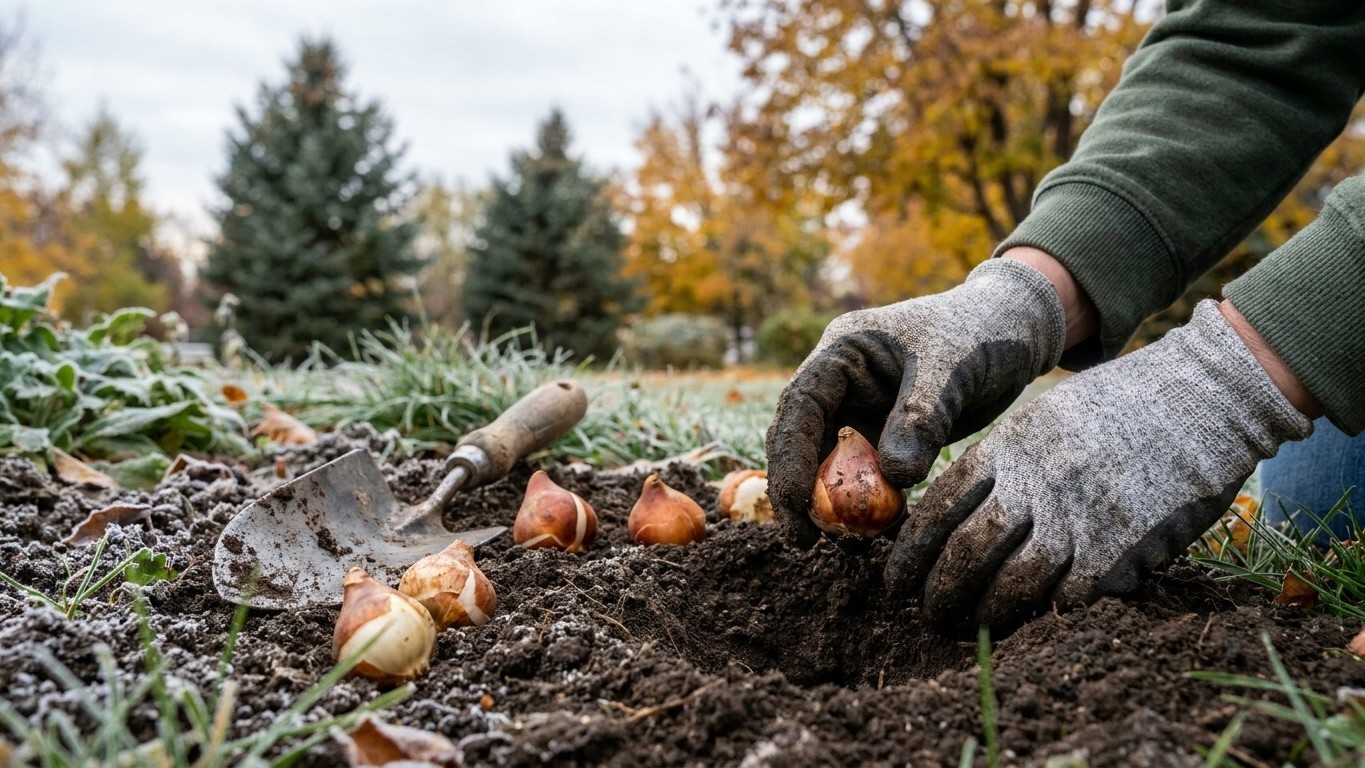

Idaho gardeners can plant spring bulbs from late September through late October, with the safest window closing about six weeks before the ground freezes hard. The bigger question isn’t timing, though. It’s whether the state’s winter delivers enough sustained cold for bulbs like tulips and daffodils to actually flower, not just leaf out.
When to plant bulbs in Idaho

The target date works backward from the first fall frost. In the Boise area, that frost typically lands somewhere between October 7 and October 21, based on NOAA’s 30-year climate normals for the region. Count back roughly six weeks from that window, and you land on a planting period running from early September through mid-October for most of the Boise valley. Higher elevations and northern counties push that window earlier, sometimes by three weeks or more, since cold settles into mountain soil long before it reaches the valley floor.
Plant too early and you invite trouble. Bulbs going into soil that’s still warm from summer will often push green shoots above ground before winter arrives. Those shoots freeze solid on the first hard frost, and while the bulb underneath usually survives, it’s spent energy it needed for spring bloom. The flower that does eventually show up tends to be smaller, later, or missing altogether that first year.
Plant too late and the opposite problem shows up. Bulbs need several weeks of root growth in cool-but-not-frozen soil before winter locks everything down. A bulb dropped into the ground in November, after a hard freeze has already set in, often just sits there. Come spring, it may push up a weak, stunted shoot, or nothing at all. Roots are what anchor the bulb and start pulling in the moisture it needs to fuel that first bloom, and roots don’t grow in frozen ground.
Why the frost date is a coin flip, not a guarantee
Worth saying plainly: that October 7 to October 21 range is an average built from three decades of data, which means roughly half of all years fall outside it in one direction or the other. Some Octobers stay mild well past the 21st. Others deliver a hard freeze in the first week. Treat the frost date as a planning target, not a deadline carved in stone, and lean toward planting on the earlier side if a cold snap is already in the forecast.
Whether your winter is cold enough
This is the question that decides whether a bag of tulip bulbs turns into a spring flower bed or a patch of bare leaves. Spring bulbs aren’t like perennials that simply need to survive winter. They need winter. Most require twelve to fourteen weeks with soil temperatures sitting below about 45°F before the internal signal fires that tells the bulb to build a flower stem instead of just foliage. Skip that cold exposure, and the bulb still comes up green in spring, but the flower is stunted, malformed, or absent entirely. For gardeners in milder pockets of the state who can’t count on that sustained chill, Forcing Spring Bulbs Indoors in Idaho offers a reliable workaround, using a refrigerator to simulate the cold period bulbs need before bringing them in to bloom. This is the exact same mechanism that governs whether an onion bulbs up on schedule, just triggered by cold instead of daylight length.
Idaho, at least in the Boise reference area, clears that bar with room to spare. The coldest month’s average daily low sits at 25.4°F, well under the 45°F threshold, and that temperature holds for considerably longer than the twelve to fourteen weeks bulbs need. Winter in the Boise valley runs cold from roughly mid-November through February, a stretch of chill lasting sixteen weeks or more. Higher elevations across the state chill even harder and longer. The upshot: nobody in Idaho, from the valley floor to the mountain foothills, needs to worry about pre-chilling spring bulbs before planting. The ground does the work.
Pre-chilling exists for gardeners in places where winter never gets cold enough on its own, typically the warmer parts of USDA zones 8 and up. The method involves storing bulbs in a refrigerator for about twelve weeks at temperatures between 35°F and 45°F, kept away from apples, pears, or any ripening fruit, since the ethylene gas they release will kill the flower bud forming inside the bulb. None of that applies here. A gardener in Idaho who pre-chills tulip bulbs before planting them is doing extra, unnecessary work; the state’s own winter already exceeds the requirement.
| Bulb | Chill weeks required (below 45°F) | What Idaho delivers | Verdict |
|---|---|---|---|
| Tulips | 12–16 weeks | 16+ weeks (Boise valley), more at elevation | Meets easily, no pre-chill needed |
| Daffodils | 12–15 weeks | 16+ weeks | Meets easily |
| Hyacinths | 10–12 weeks | 16+ weeks | Meets with margin |
| Crocus | 8–15 weeks | 16+ weeks | Meets easily |
| Alliums | 8–10 weeks | 16+ weeks | Meets with wide margin |
Which bulbs suit Idaho
Idaho spans USDA hardiness zones 3b through 7b, a range wide enough to cover nearly every classic spring bulb sold at garden centers. The bulbs listed below are matched to zones that overlap comfortably with most of the state, and their cold requirement is one Idaho winters meet without any help.
- Tulips (zones 3–8): thrive across nearly the entire state, including the coldest mountain valleys.
- Daffodils (zones 3–9): among the most reliable perennial bloomers in Idaho, often naturalizing for decades.
- Hyacinths (zones 4–9): solid performers in most of the state, though the very coldest pockets near zone 3b should give them a sheltered spot.
- Crocus (zones 3–8): well suited statewide, and often the first bloom to break through late snow.
- Ornamental alliums (zones 3–9): dependable across Idaho’s full hardiness range.
- Grape hyacinth (zones 4–8): performs well outside the coldest mountain zones.
A hardiness range is never a hard line. A hyacinth planted against a south-facing foundation wall in a cold mountain town may sail through winter just fine, while the same bulb in an exposed, wind-scoured bed a mile away struggles. Microclimate matters as much as the zone map.
Some bulbs sold in the same displays as tulips and daffodils simply don’t belong in Idaho soil. Freesia, rated for zones 9 through 10, freezes solid in the ground here and won’t survive a single Idaho winter outdoors. Ranunculus, hardy only to about zone 8, tends to rot in the cold, wet soil common to Idaho winters rather than freeze cleanly, which is worse: the corm turns to mush before spring instead of just failing to sprout. Anemone coronaria, rated zones 7 through 10, shares the same fate. Gardeners who’ve planted these and watched nothing come back in spring aren’t doing anything wrong. The bulb was simply never built for this cold.
What digs them up here
Squirrels and voles raid bulb beds every fall, but they’re not random about it. The difference between a bulb that survives underground and one that gets dug up and eaten comes down to taste and toxicity, not luck. Daffodils and anything in the onion family contain compounds that make them bitter or mildly toxic to rodents, which is exactly why they’re left alone even in yards with heavy squirrel traffic. Tulips and crocus, on the other hand, are essentially rodent candy: starchy, palatable, and worth digging for.
- Bulbs rodents leave alone: daffodils, alliums, hyacinths, grape hyacinth, fritillaria
- Bulbs rodents dig up: tulips, crocus
For the vulnerable bulbs, one method actually works: lay galvanized wire mesh flat over the planting bed and pin it down until the ground freezes solid, usually mid-November in the Boise valley. Squirrels can’t dig through it, and once the soil locks up hard, the bulbs are safe on their own. Repellent sprays and granules sold for this purpose tend to wash off with the first fall rain and need constant reapplication, which makes them a weaker bet than a $10 roll of hardware cloth.
Where to check for your own county
Every figure in this article, the frost dates, the coldest-month temperature, all trace back to Boise as the reference station. Idaho stretches across five degrees of latitude and thousands of feet of elevation change, from the Snake River plain to mountain towns that see their first hard freeze weeks before the capital does. A planting calendar built for Boise can be off by three weeks or more if you’re gardening in Idaho Falls, Coeur d’Alene, or up in the Sawtooth foothills.
The University of Idaho Extension maintains county-level offices across the state, and they’re the most reliable source for a frost date and planting window specific to your exact location. A quick call or visit to your county’s extension office will tell you whether your particular pocket of Idaho needs bulbs in the ground by mid-September or whether you’ve still got until late October to work with.