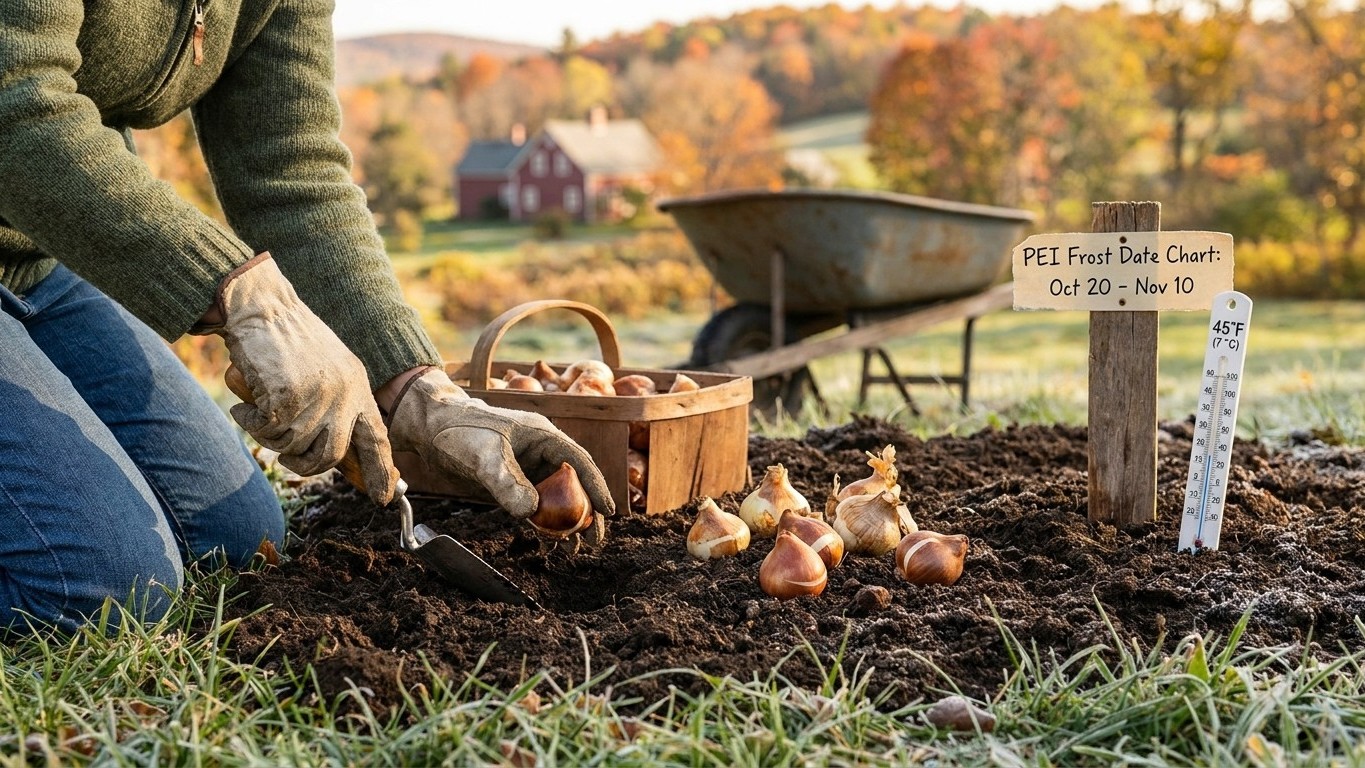

Spring bulbs go into Prince Edward Island soil during a narrow window each fall, and once winter settles in, the Island’s cold does most of the remaining work. Charlottetown sits in Canadian hardiness zone 5b, with average coldest-month lows near 10°F, cold enough and long enough to satisfy nearly every hardy spring bulb’s chilling requirement. The bulbs that disappoint here are the tender, warm-climate kinds that never belonged in this ground to begin with, though gardeners without reliable garden beds can sidestep many of these issues by growing spring bulbs in containers in Prince Edward Island instead, or skip outdoor planting altogether by Forcing Spring Bulbs Indoors in Prince Edward Island.
When to plant bulbs in Prince Edward Island

The average first fall frost at Charlottetown A lands on October 17, according to Environment and Climate Change Canada’s 1981-2010 climate normals for that station. Working back from there, the planting window for spring bulbs runs from roughly early September to mid-to-late October, with the sweet spot landing about six weeks before the ground actually freezes solid, not six weeks before the first light frost in the air.
Those two dates aren’t the same thing. Air frost kills tender foliage on a cold clear night; ground freeze, the point where soil stops being workable, usually follows a few weeks later once the cold has had time to soak downward. That gap matters for bulb planting because a bulb needs weeks of cool soil, not frozen soil, to grow the roots that will anchor it before winter locks everything down.
Too early, too late
Plant too early, while the soil is still warm from summer, and a bulb can be tricked into pushing top growth before winter arrives. That green shoot then gets caught by the first hard freeze and dies back, wasting the energy the bulb needed for spring. Plant too late, after the ground has already gone cold and started to firm up, and the bulb never builds the root system it needs. It may still flower the first spring on stored energy alone, then come up weak or skip a year entirely once that reserve runs out.
Here’s the part worth saying plainly: October 17 is an average, not a promise. Half of all years on record at this station saw frost arrive later than that date, and half saw it earlier. Treat it as the midpoint of a window rather than a deadline circled on the calendar, and lean on soil feel and the weather forecast rather than the date alone when deciding it’s time to plant.
Northern and inland parts of the province, and higher ground away from the moderating effect of the coastline, tend to cool down before Charlottetown does. Gardeners in those pockets should treat the window as opening a week or two earlier, not later, than the dates above suggest.
Whether your winter is cold enough
Every spring-flowering bulb needs a stretch of real cold before it will flower at all. The general rule across tulips, daffodils, hyacinths, and their relatives is twelve to fourteen weeks with soil temperatures below about 45°F. Skip that requirement and a bulb typically responds by growing leaves with no flower, or a flower bud so short and buried it never clears the soil line. This figure is worth knowing even in a place where winter clears it easily, because it’s the number that lets a gardener judge any bulb offered to them, anywhere.
Prince Edward Island clears it with room to spare. The mean daily minimum temperature during the coldest month at the Charlottetown reference station is 10.3°F, a figure that sits far below the 45°F threshold and stays there for months, not weeks. Soil across the Island typically holds below 45°F from around mid-November through late March, an estimated 18 to 20 weeks depending on the exact winter, well past what any common spring bulb asks for.
What that margin buys
That wide margin means gardeners here don’t need to pre-chill bulbs before planting them outdoors, a step that’s unavoidable in warmer parts of the continent where winter never gets cold enough on its own. The one place pre-chilling still matters on the Island is indoors, for anyone forcing bulbs into bloom over the winter in pots rather than planting them in the ground. That process runs about twelve weeks in a refrigerator, kept away from ripening fruit, since the ethylene gas fruit gives off can kill the flower bud hidden inside the bulb before it ever gets planted.
The table below lines up the common spring bulbs against what they need and what this province delivers.
| Bulb | Cold needed to flower | PEI’s cold season | Verdict |
|---|---|---|---|
| Tulips (Tulipa) | 12-14 weeks below 45°F | ~18-20 weeks, mid-Nov to late Mar | Fully met, no pre-chill needed |
| Daffodils (Narcissus) | 12-16 weeks below 45°F | ~18-20 weeks | Fully met |
| Hyacinths | 12-14 weeks below 45°F | ~18-20 weeks | Fully met |
| Crocus | 8-10 weeks below 45°F | ~18-20 weeks | Comfortably exceeded |
| Alliums | 8-10 weeks below 45°F | ~18-20 weeks | Comfortably exceeded |
| Muscari (grape hyacinth) | 8-10 weeks below 45°F | ~18-20 weeks | Comfortably exceeded |
A gardener who buys any of these bulbs and plants them at the right time in fall doesn’t need to think about chilling again. The winter handles it without help.
Which bulbs suit Prince Edward Island
The bulbs that thrive on the Island are the same ones the table above already cleared for cold. Tulips, daffodils, hyacinths, crocus, alliums, and muscari are all commonly rated hardy well into winters far colder than PEI’s coastal average, and none of them ask for anything the Island’s climate doesn’t already provide. Snowdrops and fritillaria, both less common in home gardens but easy to find at fall bulb sales, fall into the same reliable category.
A hardiness rating is never a hard line, though. A tulip near the cold edge of its comfort range often does fine tucked against a south-facing foundation wall where snow cover collects and the soil never fully bares, and struggles in an open, wind-scoured bed where the same bulb sits exposed all winter. Microclimate decides as much as the zone map does.
Bulbs that disappoint here, and how
Tender bulbs bred for warm-winter regions are the ones that let gardeners down, and they fail in fairly predictable ways. Ranunculus and anemone corms, both often shelved near the hardy bulbs at garden centers, are typically rated only to much milder zones; left in PEI ground over winter they freeze and rot rather than resprout. Freesia and ixia behave the same way, offering one good summer of bloom from stored energy and then nothing the following year, because the bulb itself didn’t survive to try again.
Even genuinely hardy bulbs can fail here for a different reason: wet feet, not cold. Clay-heavy garden beds that stay soggy through a thaw-and-freeze cycle in late winter rot bulb bases before spring ever arrives, tulips and hyacinths especially. That’s a drainage problem, not a hardiness problem, and it shows up as bulbs that never emerge at all rather than ones that emerge and fail to flower.
- Tulips, hardy well into cold Canadian winters
- Daffodils, hardy well into cold Canadian winters
- Hyacinths, hardy well into cold Canadian winters
- Crocus, hardy well into cold Canadian winters
- Alliums, hardy well into cold Canadian winters
- Muscari, hardy well into cold Canadian winters
- Snowdrops and fritillaria, hardy well into cold Canadian winters
What digs them up here
Squirrels and voles don’t raid bulb beds at random. What they leave alone or dig up comes down to chemistry more than luck. Daffodils and everything in the onion family carry compounds that make them bitter or mildly toxic to rodents, so they’re routinely passed over. Tulips and crocus contain no such defense and rank among the most reliably raided bulbs in any fall planting.
Of the bulbs recommended above, daffodils, alliums, snowdrops, and fritillaria are the safe bets against digging. Tulips and crocus are the ones that need protection, since nothing about them discourages a hungry squirrel or a tunneling vole.
- Usually left alone: daffodils, alliums, snowdrops, fritillaria
- Frequently dug up or eaten: tulips, crocus, hyacinth bulbs to a lesser degree
The one measure that consistently works is physical, not chemical: lay a sheet of galvanized wire mesh directly over a newly planted bed, pin it down at the edges, and leave it in place until the ground freezes hard. Bulbs still root and sprout through the mesh in spring, but rodents can’t dig through it while the soil is still workable in fall. Repellent sprays and granules, by contrast, wash off with the first good rain and need constant reapplication to do anything at all.
Where to check for your own county
Every figure in this guide, the frost date, the hardiness zone, the coldest-month temperature, comes from the Charlottetown A weather station and the reference city used by Natural Resources Canada’s hardiness mapping. Prince Edward Island is small by Canadian standards, but it still stretches across enough distance that a planting calendar built for Charlottetown can run a couple of weeks off at either end of the province, particularly in higher inland parts of Kings County or the more exposed western reaches of Prince County.
The Prince Edward Island Department of Agriculture keeps current, region-specific guidance for home gardeners across all three counties, Prince, Queens, and Kings, and is the right first stop for anyone planting near the edges of the province rather than in Charlottetown itself. Find it at the PEI Department of Agriculture.
A single provincial average is a starting point, not a final answer, for anyone gardening well outside the capital region.