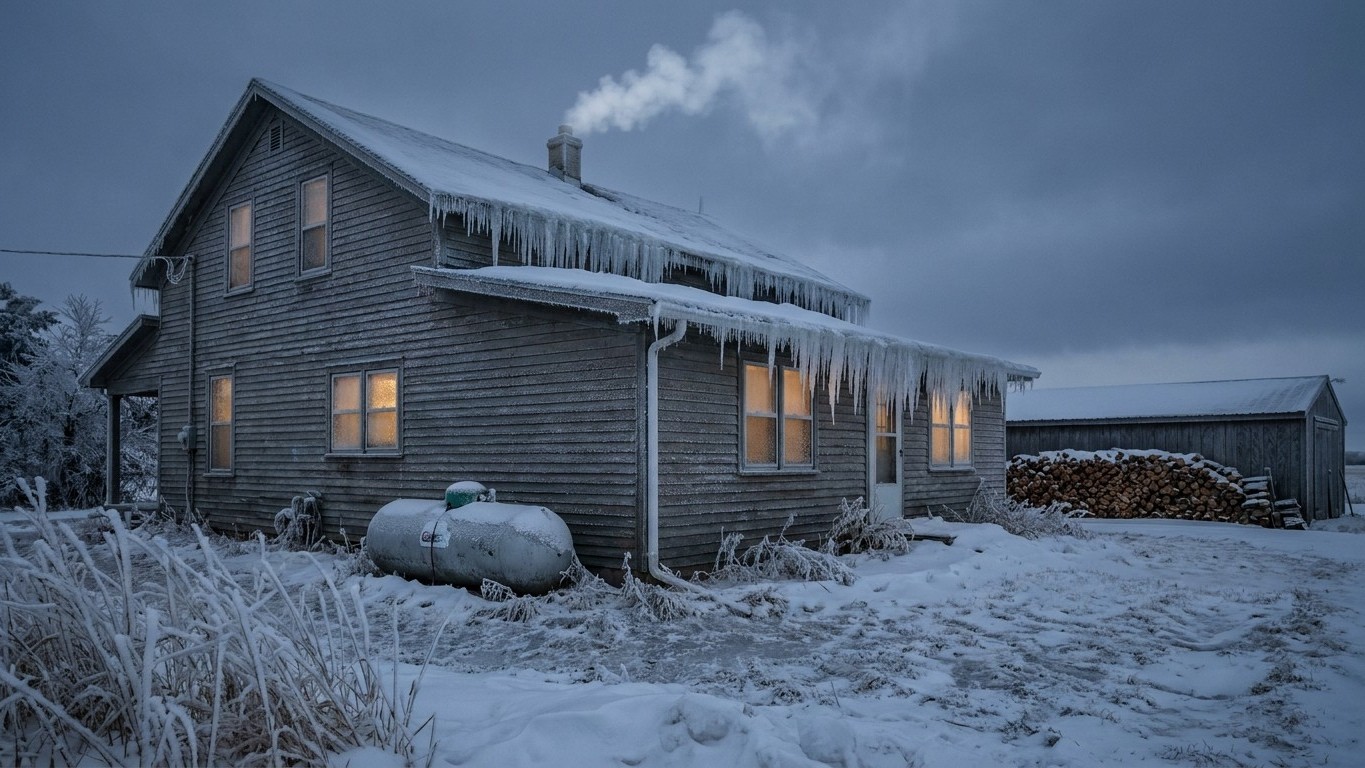

South Dakota winters don’t just dip below freezing, they camp out there for months, and that single fact drives everything about how a house here gets heated: the furnace size, the wood pile, the propane tank refill schedule. Here’s what the season actually demands.
How cold it gets, and for how long

In Sioux Falls, the average daily low during the coldest month sits at 8.5°F, according to NOAA’s 1991-2020 Climate Normals. That’s not the record low that makes the evening news. It’s the mean minimum, the temperature a house has to fight through on an ordinary night, over and over, for weeks at a stretch.
That distinction matters more than it sounds like it should. A single brutal cold snap is a stress test. A mean minimum near 8.5°F is a workload. It tells you the heating system isn’t sprinting, it’s running a marathon, and the furnace or wood stove that handles South Dakota well is the one built for sustained output, not just peak capacity.
What that means for equipment sizing
Compare that to a place where the coldest month bottoms out around 20°F or 25°F. The gap between 8.5°F and 25°F doesn’t sound huge on paper, but it’s the difference between a furnace running six or eight hours a day and one running nearly around the clock through January and February. Homes in South Dakota generally need equipment sized for a longer, colder baseline, not just a occasional deep freeze.
This is also why When Does the Heating Season Start in South Dakota? is a question with a longer answer than people moving in from milder states expect. It’s common for supplemental heat, wood stoves especially, to start in October and run into April. Anyone budgeting for wood, propane, or electricity here should plan around six months of active heating, not the four that might work in a more temperate part of the country, and the flip side of that question, When Can You Turn the Heat Off in South Dakota?, deserves just as much attention when planning a seasonal budget.
What a cord of wood is worth here
A cord of well-seasoned hardwood delivers roughly 20 million BTU, according to Michigan State University Extension. That number only means something once you understand what a cord actually is, because the word “cord” is the single most common way firewood buyers get shortchanged.
A cord is a volume, not a weight, and not a random pile. It’s a stack measuring 4 feet by 4 feet by 8 feet, which works out to 128 cubic feet of space, bark and air gaps included. Buy anything short of that, loosely thrown, oddly stacked, sold as a “truckload,” and you’re very likely paying cord prices for less than a cord of wood.
| Measurement | Value |
|---|---|
| Dimensions | 4 ft x 4 ft x 8 ft |
| Total volume | 128 cubic feet |
| Heat energy (seasoned hardwood) | about 20 million BTU |
MSU frames that 20 million BTU in terms a homeowner can actually use: one cord of well-seasoned hardwood is roughly equivalent to 145 gallons of #2 fuel oil, or 215 gallons of LP gas. Given a South Dakota heating season that runs six months or more, that comparison is worth sitting with when deciding how many cords to lay in before the first snow.
Density does the real work
Because a cord is a fixed volume, the species you stack into it decides how much actual wood mass, and therefore how much heat, you’re getting. Dense hardwoods pack more fiber into the same 128 cubic feet than lighter woods do, which is why two cords from two different species can heat very differently even though they take up identical space in the shed.
How long wood takes to dry in South Dakota
Firewood needs to reach 20 percent moisture or less before it burns efficiently. Green, freshly cut wood can carry more than 60 percent moisture, according to Michigan State University Extension, and that water has to boil off before the wood gives up any usable heat. Burn wood too soon and you’re spending your fire’s early energy just steaming out water, not warming the house.
Split and stacked wood typically reaches that 20 percent threshold after a full summer of seasoning, but that’s conditional, not automatic. The wood has to be split, not left in rounds, and stacked so air moves freely through the pile. Rounds left whole, or wood crammed tight against a wall with no airflow, can take considerably longer regardless of how many months pass.
Red oak is the notable exception MSU flags: its cell structure makes it dry more slowly than most other hardwoods, so it needs more time under the same conditions before it hits that 20 percent mark. Anyone counting on a single season to dry red oak may be disappointed if they cut it late in spring.
Burning wood before it’s ready doesn’t just waste effort. It costs real heat output, since energy that should be warming the house is instead evaporating trapped water. And it builds creosote faster inside the flue, since unseasoned wood burns cooler and dirtier, leaving more residue behind. That means more frequent chimney sweeping and a higher chimney fire risk over a season. None of this is dramatic if you plan for it. It’s just a reason to season a full year ahead when possible, especially in a state where the heating season already runs long.
Where to check before you buy
Everything above describes Sioux Falls, the NOAA reference station for South Dakota’s climate normals. But the state stretches from Black Hills elevation in the west to river-bottom land in the east, and local conditions, wind exposure, elevation, tree cover, shift the practical picture from county to county.
Before buying firewood or planning a heating setup, check with South Dakota State University Extension for guidance specific to your area: which species are locally available and well-seasoned by local sellers, and what burning conditions look like where you actually live.
It’s also worth checking on seasonal burn restrictions directly with local authorities. Open burning rules, and in some cases wood stove advisories during poor air quality days, are set at the county or municipal level in South Dakota and can change from year to year. What was allowed last winter isn’t a guarantee for this one, so a quick check before stacking the wood pile or lighting the first fire of the season saves a headache later.
What each heat source costs to run in South Dakota
At South Dakota’s average residential prices, this is what one million Btu of heat delivered into the house costs with each system. It compares fuels on the same unit: it is not a yearly bill, and it leaves out the price of the equipment.
| System | Cost per million Btu delivered |
|---|---|
| Electric resistance (baseboard, 100% efficient) | $42.50 |
| Heat pump at 8.1 HSPF2 (seasonal COP about 2.4) | $17.90 |
Cheapest to run in South Dakota: heat pump, $24.60 less per million Btu than the electric resistance.
Prices: U.S. Energy Information Administration (EIA), average residential prices. Efficiencies: ENERGY STAR criteria. A heat pump’s figure is a seasonal average; in the coldest weather its efficiency drops.