
In a South Dakota garden, carrots lose more to the ground under them and the weather over them than most gardeners expect: forked roots in heavy soil, thin stands after a hot spell, split roots after uneven watering. This page covers those three. It carries no pest-by-pest calendar for insects or wildlife, and no figures for one, so for that part call your county extension office. Timing starts at the seed packet and the sow date, covered in When to Sow Carrots in South Dakota: Counting Back From the Last Frost.
The short answer
The ground that represents the state
South Dakota’s official state soil is the Houdek series, a Mollisol. That is the deep, dark prairie soil type that helped build the Corn Belt. USDA records for the surface layer of the major components of the series (90 components, from the Soil Data Access database) put it at 38 percent sand, 22 percent clay and 40 percent silt, which classes as loam to silt. Organic matter sits at about 3.0 percent, surface pH at about 6.7 (near neutral), and the drainage class is well drained.
Two cautions come with those numbers. They describe the mapped surface of the series, not a bed you have been amending for years. And the pH belongs to the series. It is not your pH.
Will a carrot fork in it?
Utah State University Extension describes the carrot’s ideal as deep, sandy, well-drained soil rich in organic matter, and it warns that heavy or rocky soil makes the root fork. Set the Houdek numbers against that. Clay at 22 percent is well short of a heavy clay. Drainage is good. Sand at 38 percent is less than a carrot would choose, and the silt makes up the biggest share, but nothing in the profile points to a forking problem. In ground like this, a carrot should grow a straight root, and a few shovelfuls of compost move it closer to the rich, loose soil USU Extension describes.
Your bed is a different question. A state spans hundreds of soil series, and this one is a starting point, not a diagnosis. River bottoms, hill country and any lot a builder scraped or filled can differ completely from the prairie the series represents. Clay-heavy ground, poor drainage or a lot of stone changes the answer.
When it does, the fix is in the soil, not the seed packet. Heavy ground needs plenty of compost and double digging, and ground that stays heavy or stony after that is a case for a raised bed filled with loose, stone-free soil. Choosing a different variety will not fix a forked root. The longer discussion lives in Will Carrots Fork in South Dakota Soil?, and the wider picture is in Growing Carrots in South Dakota.
The test that settles it in your own garden
Your soil is not the state’s. An hour with a spade and a bucket of water will tell you more than any map, and it costs nothing. Do it when the ground is damp but not soggy, since dry soil hides its texture and wet soil smears.
The steps
- Choose the spot where the carrots will go and dig a hole with straight sides. Go as deep as the mature root length printed on your seed packet, plus a little more. Carrots are sown in place and cannot be moved, so the soil has to be right the first time.
- Look at the wall of the hole. Note where the color changes, whether the layers are loose or packed hard, and how many stones or chunks of rubble show up. Every stone is something a growing root must swerve around. A hard layer that resists the spade is a place where roots stop or split.
- Take a handful of damp soil from the bottom and rub it between your fingers. Sand feels gritty, silt feels smooth like flour, and clay feels sticky and polishes into a shiny ribbon when you squeeze it out between thumb and finger. A handful that stays in a tight, slick lump and needs real effort to crumble leans heavy.
- Fill the hole with water and let it soak away. Fill it again and watch. Water that drains steadily says the ground is well drained, as Houdek is. Water that sits, or drains far slower on the second fill than the first, is a warning, and it is the same warning USU Extension gives for heavy soil.
- Repeat in two or three other places along the bed. Builders often leave one end of a yard scraped and the other end fine, and a bed can change character within a few steps.
- Send a sample to a soil lab for your own pH and organic matter numbers. The Houdek figures are not a substitute, and the lab report is the only way to get your bed’s actual values.
Reading what you found
Loose, even-colored soil with few stones and quick drainage means you can sow after working in compost. Sticky texture, slow drainage or a stone every few inches means double digging with plenty of compost, or a raised bed. This page gives no cutoff for how many stones is too many, because the sources behind it publish none. Use your own judgment: if you can’t pull them out by hand while digging, the carrots won’t get past them either.
What goes wrong here
Most carrot failures in this region trace to soil, to weather, or to both at once. Each has a fix you can put in place before the seed goes in.
Trouble from the ground
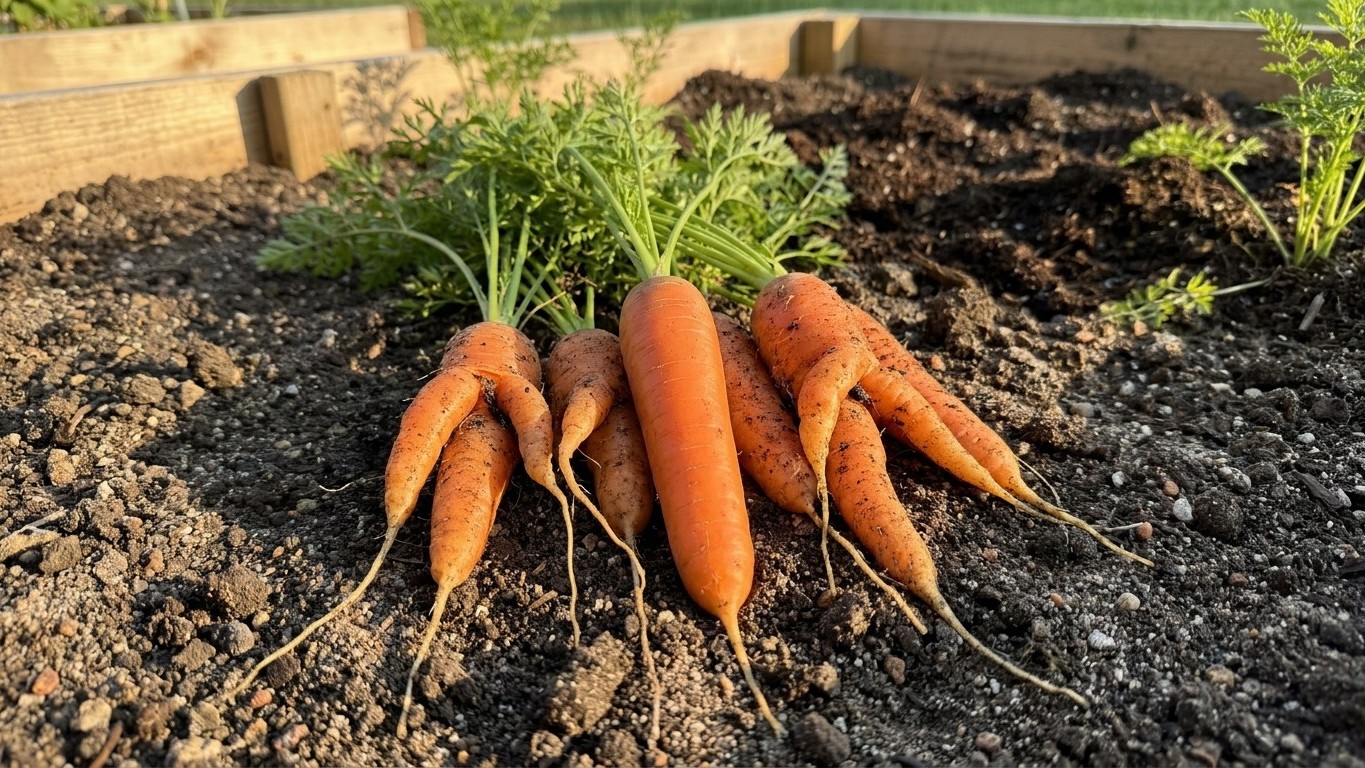
- Forking in heavy or rocky soil. Roots hit clay or stone and split into two or more legs. Dig in plenty of compost, double dig the bed, pick out the stones, and move to a raised bed if the ground stays heavy. Fresh manure and coarse chunks of compost can also make roots branch, so use compost that has finished breaking down.
- Crusting over the seed row. Silt-rich ground can seal on top after a hard rain, and carrot seedlings are small and slow to push through. Cover the row with a thin layer of fine compost and keep the seedbed evenly damp until the seedlings are up.
- Short, stunted roots in compacted ground. Soil walked on or worked when wet packs down, and roots stall where it gets hard. Keep off the bed, and loosen it deeply before sowing.
Trouble from the weather
- Poor germination in a hot spell. Carrot seed takes its time to sprout, and a dry, hot week after sowing can leave a patchy row. Because carrots are sown in place, there is no transplant to fall back on. Keep the seedbed damp, lay a board or light cover over the row until sprouts appear, and resow gaps. If the stand still fails, shift the next sowing to a cooler window using the dates in the sowing guide.
- Splitting from uneven water. A dry stretch followed by a heavy soaking makes the root swell faster than the skin can stretch, and it cracks. Water on a steady schedule, mulch to hold moisture, and keep organic matter up so the bed buffers the swings.
- Roots left in the ground too long. Once a carrot has passed the days to maturity counted from seeding, which run 70 to 100, it gains little and is more likely to crack or turn woody. Pull a test carrot and check.
Common questions
Will carrots fork in South Dakota’s state soil?
Not from texture alone. The Houdek series is loam to silt, with 22 percent clay and well-drained conditions, so it doesn’t match the heavy, rocky ground USU Extension links to forking. Your own bed is what counts, and the digging test above settles it.
Which insects and animals eat carrots here, and when?
The sources behind this page don’t publish a pest calendar for South Dakota, so it names no insects and gives no dates. Your county extension office can tell you which pests are active near you and in which weeks. What this page does cover is the damage that comes from soil, heat and water.
How many days from sowing to harvest?
Count 70 to 100 days from seeding. Carrots are never transplanted, so the clock starts the day the seed goes in the ground. Count back from your last frost date with the sowing dates guide.
How should I store carrots after harvest?
Clemson Cooperative Extension says to store carrots at 33 °F and high humidity to prevent wilting, and that bunched carrots, with the tops on, keep about 10 to 14 days. That temperature is just above freezing, not cellar temperature, and carrots kept much warmer sprout and soften far faster. Cut the tops off first. The leaves keep drawing moisture out of the root, which is why trimmed carrots keep for months while bunched ones last only a couple of weeks.