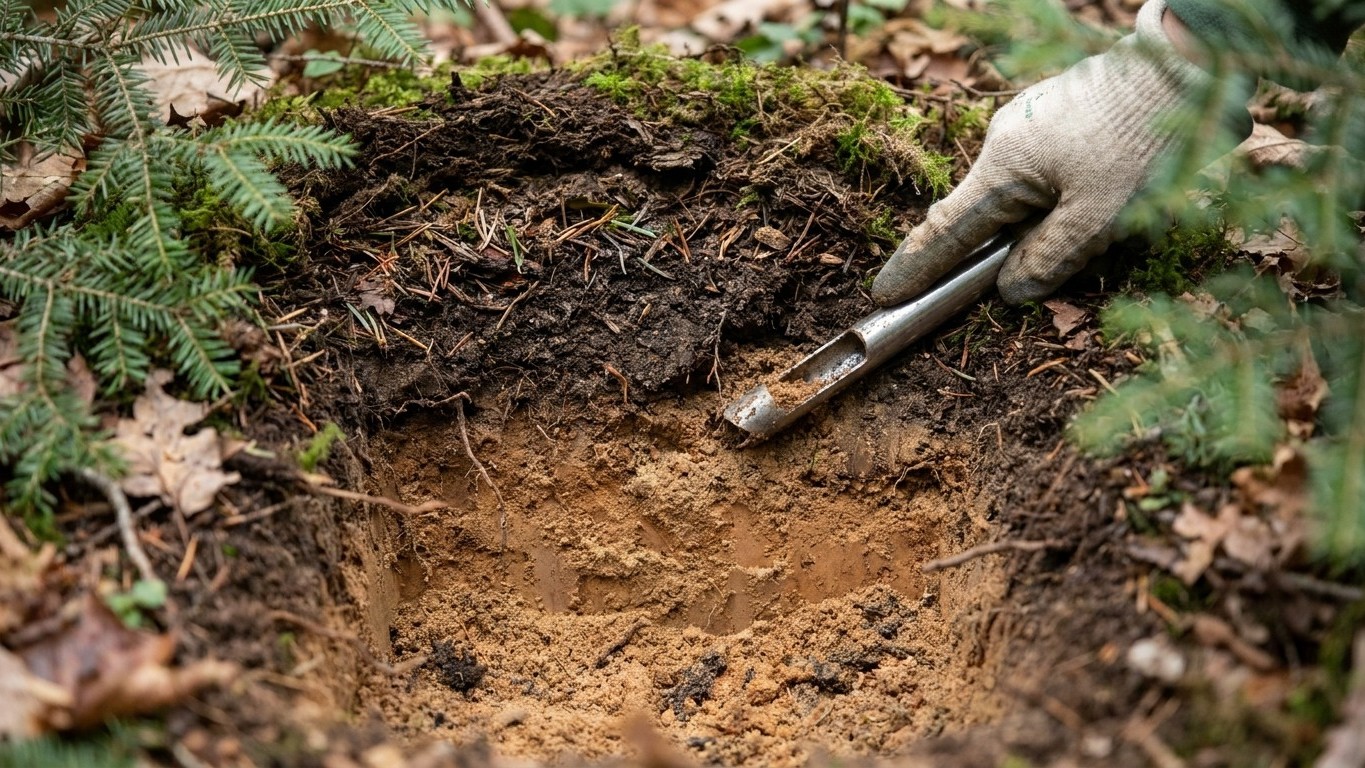

Vermont soil is officially represented by the Tunbridge series, a sandy, strongly acid, well-drained Spodosol formed under conifer forests across the state’s hill country. It’s a useful reference point, but not a stand-in for what’s actually under your own garden beds, which is why testing and reading your own ground still matters more than any state-level number.
What is under your garden

Vermont’s official state soil is the Tunbridge series, named by state law in 1985 through the USDA NRCS State Soils programme. Tunbridge is a Spodosol, a soil order that forms under coniferous forest through centuries of acid leaching, where rainwater strips minerals out of the upper layers and deposits them lower down. Walk through a hillside stand of spruce or hemlock almost anywhere in the state and there’s a decent chance you’re standing on it or something like it.
The USDA’s own data on the surface horizon of Tunbridge’s major components is specific, and worth stating plainly rather than softening into a range. Surface pH runs about 3.5, which is strongly acid. The mineral fraction is 79 percent sand and 21 percent clay, with no measurable silt. Organic matter sits around 75.0 percent. Drainage is classified as well drained.
| Reading | Value |
|---|---|
| Surface pH | About 3.5 (strongly acid) |
| Sand | 79 percent |
| Clay | 21 percent |
| Silt | 0 percent |
| Organic matter | About 75.0 percent |
| Drainage class | Well drained |
Here’s the honest caveat that number-loving readers tend to skip past: an organic-matter figure above roughly 20 percent means the mapped surface is a natural organic layer, forest litter, peat, or muck, not a worked garden bed. A homeowner’s cultivated soil, especially anything a builder graded, scraped, or filled during construction, will not carry anywhere near that figure. The Tunbridge series describes forested hill country as it exists naturally. It’s the state’s representative soil, not your soil, and river-bottom ground, valley farmland, and any lot touched by heavy equipment can be a completely different animal.
Reading your own soil in five minutes
Two quick checks tell you more about your actual yard than any state average. First, the ribbon test: take a pinch of moist soil, roll it between thumb and forefinger, and push it out into a ribbon. Sandy soil won’t hold a ribbon at all and feels gritty. Clay-heavy soil forms a long, slick ribbon over two inches before breaking. Loam falls somewhere in between, forming a short ribbon that breaks easily.
Second, the jar test. Fill a clear jar a third full of soil, top it with water, shake hard, and let it sit overnight. Sand settles first and sits at the bottom within minutes. Silt layers on top of that within an hour or two. Clay stays suspended longest and settles as the top layer, sometimes taking a full day. Measure the layers and you’ve got a rough texture estimate, done in your own kitchen, from your own dirt.
Testing before you amend
Guessing at soil amendments is one of the more expensive habits a gardener can pick up. Lime, sulfur, and compost all cost money and take a season or more to show results, and applying the wrong one, or the right one at the wrong rate, can set a garden back rather than forward. A soil test replaces guesswork with two numbers that actually matter: pH and nutrient levels, specifically phosphorus, potassium, and organic matter content.
Given the region’s tendency toward acid, well-leached ground, it’s reasonable to expect a home garden might test on the acid side too. But expecting is not knowing. A builder’s fill dirt, years of wood-ash disposal, or a previous owner’s heavy liming can all push a yard’s actual number somewhere the regional tendency wouldn’t predict. Only a test settles it.
Taking a sample correctly matters as much as sending it in. Follow these steps standing in the garden with a trowel:
- Pick 8 to 10 spots scattered across the bed or lawn area, avoiding spots right next to walls, driveways, or where fertilizer was recently spilled.
- At each spot, dig a small core 6 to 8 inches deep, which is roughly the depth where vegetable and most perennial roots actually feed.
- Combine all the cores in a clean bucket and mix them thoroughly into one composite sample.
- Remove rocks, roots, and mulch fragments, then let the sample air-dry if it’s very wet.
- Bag about a pint of the mixed soil, label it with the bed name and date, and send it to the extension lab with the submission form.
Results typically arrive with a pH reading, nutrient levels, and a lime or sulfur recommendation stated in pounds per hundred square feet, ready to act on instead of interpret.
Amending it
The Tunbridge series points in one clear direction: acid ground, sandy texture, and a preference for organic matter over any quick mineral fix. If a home garden’s test comes back anywhere near that pH of 3.5, or even in the more common garden range below 5.5, lime is the correct lever to pull, and sulfur would be exactly backwards.
Liming acid soil
Acid soil below about 5.5 locks up phosphorus so plants can’t take it up even when it’s present in the soil, and it makes life hard on brassicas like broccoli and cabbage, which are prone to clubroot disease in acid ground. Ground limestone raises pH by neutralizing that acidity, but it works over seasons, not weeks. Lime needs to react with soil moisture and microbial activity, so a fall application is standard practice, giving it months to shift the number before spring planting. Retesting after a full season, rather than assuming one application solved it, is the safer bet.
Sulfur and organic matter for alkaline soil
If a test instead comes back above about 7.3, an unusual result for this region but not impossible on fill dirt or ground near concrete foundations, lime must never go down. Adding lime to already-alkaline soil pushes pH higher still and locks iron further out of reach, which shows up as yellow leaves with green veins, a classic sign of iron chlorosis. The honest fix here is slow: elemental sulfur, worked in and given time to convert biologically, plus steady additions of organic matter such as compost or leaf mold, which naturally buffers pH downward over repeated seasons.
Working with the clay
At 21 percent clay, Tunbridge-type ground isn’t heavy clay, but plenty of Vermont yards run higher. Organic matter, worked in yearly, is the fix that actually holds. Sand is not: adding sand to clay without enough organic matter to match it can create something closer to concrete than to loam. Never work clay-heavy soil while it’s wet, since doing so compacts it into hard clods that can take a full season to break back down.
Working with the sand
At 79 percent sand, this soil drains fast and holds almost nothing, nutrients or water. Organic matter is again the answer, added generously and often, since sandy ground breaks it down and loses it faster than clay does. Expect to water shorter and more frequently rather than deep and rare, because water simply doesn’t stay put in sand the way it does in denser soil. Texture fixes on sandy or clay ground both take roughly three seasons of consistent organic matter additions to show real structural change; pH fixes with lime or sulfur can shift meaningfully within a single season if applied correctly and retested.
Drainage and compaction
Tunbridge soil is classed as well drained, which in practice means water moves through it steadily after rain rather than pooling on the surface or vanishing instantly. A yard built on similar ground shouldn’t show standing water a day after a storm, but plenty of home lots, especially those with fill dirt or a hardpan layer left by construction equipment, behave nothing like the natural series.
The percolation test settles the question directly. Dig a hole about a foot deep and a foot across, fill it completely with water, and let it drain once to saturate the surrounding soil. Fill it a second time and time how long it takes the water level to drop. An inch or more per hour suggests solid drainage. Well under an inch per hour signals a compacted or clay-heavy layer that’s holding water back.
Compaction is often the real culprit behind poor drainage, more than the base soil texture itself. Foot traffic, parked equipment, and even repeated tilling with heavy machinery all press soil particles together, squeezing out the pore space water and roots both need. Double digging, once the standard fix, has fallen out of favor because it disturbs soil biology and structure built up over years, often doing more harm than the compaction it was meant to solve. On genuinely poor-draining ground, especially where a test shows a slow, sub-inch percolation rate, a raised bed is often the more honest answer than three years of amendment and hoping.
- If drainage tests well (an inch or more per hour): proceed with in-ground beds and standard amendment schedules.
- If drainage is slow: avoid deep tilling when wet, keep heavy equipment and repeated foot traffic off planting beds, and consider a raised bed rather than years of soil rebuilding.
- Plants that struggle in slow-draining spots: most root vegetables and any perennial listed as needing “well-drained soil” are better moved to a raised bed or a naturally drier part of the yard.
Local help
The University of Vermont Extension runs soil testing for state residents and reads results alongside the gardener rather than just mailing back a number. County offices can walk through a report, explain a lime or sulfur recommendation, and answer questions specific to a lot’s history. Details on submitting a sample are available through UVM Extension.
Common questions
Is all Vermont soil acidic like the Tunbridge series?
Much of the state’s forested hill country leans acid, but valley farmland, river bottoms, and any yard built on fill dirt can test very differently. Only a soil test confirms an individual yard’s actual pH.
How often should I retest my soil after amending it?
Once a year is standard for an actively gardened bed, ideally in fall after a growing season, so results reflect how the ground responded to whatever was applied.
Can I fix drainage problems without a raised bed?
Sometimes, through repeated organic matter additions and avoiding compaction from foot traffic or equipment. But on genuinely slow-draining ground, that fix can take several seasons, making a raised bed the faster practical option.
Why shouldn’t I just add lime every year as routine maintenance?
Lime only helps if soil is actually acidic. Applying it without a current test risks pushing pH too high, which locks out iron and other nutrients just as effectively as acidity does, only in the opposite direction.
Related guides
- New Hampshire Soil: What You Are Digging Into, and How to Improve It
- Massachusetts Soil: What You Are Digging Into, and How to Improve It
- Virginia Soil: What You Are Digging Into, and How to Improve It
- Minnesota Soil: What You Are Digging Into, and How to Improve It
- Maine Soil: What You Are Digging Into, and How to Improve It