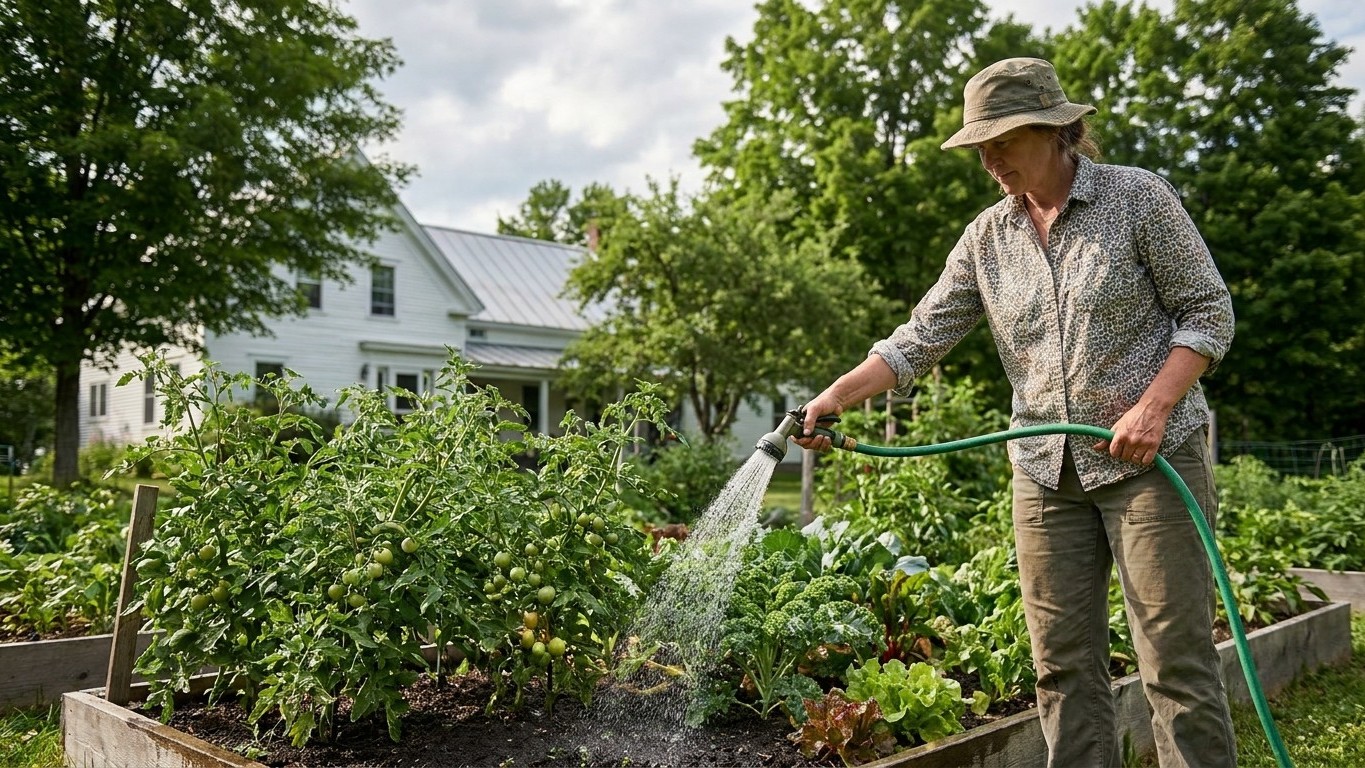

Vermont’s watering math starts with a number most gardeners don’t expect: this is a cool state, with only 5.4 days a year hitting 90F at the Burlington reference station. That single fact changes almost everything else, from how often you’ll need a hose to how strict your town gets in a dry July.
What the climate asks of you

Two numbers set the terms here, and neither one is a guess. The first is 5.4, the average number of days per year that reach 90F or higher at Burlington, per NOAA’s 1991-2020 Climate Normals. The second comes from the frost calendar: the last spring freeze typically falls between April 30 and May 10, and the first fall freeze arrives between October 3 and October 13, also at the Burlington station. Run the subtraction and the growing season lands somewhere between roughly 146 and 166 days, depending on where in that freeze window a given year falls.
The heat number tells you what’s not happening
A state that barely cracks five days above 90F a year isn’t losing water the way Texas or Kansas does. High heat drives evapotranspiration, the combined pull of sun and plant that yanks moisture out of soil. With so few scorching days, Vermont gardens aren’t fighting that relentless daily drawdown. That’s the good news. The catch is that low heat doesn’t mean reliable rain. Vermont’s summer precipitation tends to arrive as scattered thunderstorms and frontal systems rather than steady, even soakings, and totals vary enormously by valley, ridge, and elevation across the state. A garden in the Champlain Valley can sit in a dry pocket while the Northeast Kingdom gets soaked, or the reverse.
A short season with no room for a slow start
Because the frost-free window runs under six months even in the mildest corner of the state, near Lake Champlain, every week of dry soil during that stretch costs a bigger share of the growing season than it would somewhere with an eight-month calendar. The Green Mountains and the Northeast Kingdom run a shorter frost-free window still, so gardeners there have even less slack to make up for a stretch of skipped watering. There’s no single answer for “how much rain falls in July here” that applies from Bennington to Newport, which is exactly why local rain gauge data, not a statewide average, should drive your watering decisions. Your county office of the University of Vermont Extension tracks that kind of hyperlocal data and is worth a call before you assume your garden gets what the next town over gets.
How much, how often
The rule that holds almost everywhere, cool climate or not, is deep and infrequent rather than shallow and daily, a practice detailed in Watering Through a Dry Spell in Vermont. A light daily sprinkle wets only the top inch or two of soil, which trains roots to stay shallow, right where summer heat and wind dry things out fastest. A deep soak, by contrast, pushes moisture down six inches or more and pulls roots down with it, into ground. Container gardens follow a different rhythm than in-ground beds, since pots dry out faster and hold far less reserve moisture, so it’s worth reading up on Watering Pots and Containers in Vermont if a share of your growing space is in pots that stays cooler and damper longer between waterings.
Vermont’s soils run the gamut from sandy river terraces along the Connecticut and Winooski valleys to heavy clay in old lakebed areas near Champlain and in parts of the Champlain Valley lowlands. That matters more than most gardeners realize. Sandy ground drains fast and holds little, so it needs shorter, more frequent soakings even if the total weekly water is the same as a clay bed gets in one dose. Heavy clay holds a week’s worth of water but drowns roots if it’s watered again before it has actually dried out, and working or soaking clay while it’s still wet compacts it into something closer to brick than garden soil.
The way to know which situation you’re in isn’t a calendar, it’s your finger. Push it two inches into the soil near the base of a plant. Dry at that depth, water. Still damp, wait. A garden trowel works even better for raised beds and gives you a clean look at the soil profile.
A watering sequence that works in most Vermont beds
- Check soil moisture two inches down with a finger or trowel before turning on any hose or timer.
- Water early in the morning, before 9 a.m. if possible, so leaves dry before evening and foliar disease has less chance to take hold.
- Aim the water at the base of the plant, at soil level, never at the leaves.
- Apply roughly an inch of water per week to most vegetable and flower beds, delivered in one or two deep sessions rather than several light ones.
- Adjust downward on sandy river-terrace soil with shorter, more frequent sessions, and adjust upward in spacing (longer gaps between waterings) on heavy clay, letting it dry before the next soak.
- Re-check with the finger test 48 to 72 hours later rather than watering on a fixed schedule regardless of soil condition.
Restrictions and rules
Vermont doesn’t run on one statewide watering rulebook. Most towns get their water from small municipal systems, shared wells, or private wells on individual properties, and each of those systems sets its own approach to outdoor watering during dry stretches. A town drawing from a limited reservoir may ask residents to water on alternate days or avoid midday irrigation during a dry summer, while a neighboring town on a larger aquifer may have no restriction at all in the same season.
Check before you set a schedule
Because rainfall totals vary so much by valley and elevation across the state, and because no single average rainfall figure applies evenly from the Champlain Valley to the Northeast Kingdom, the safest move is to call your local water district or check your town’s website before setting up any automated system. Rules also shift year to year with drought conditions, so a restriction that applied last August may not apply this one, or vice versa. If you’re on a private well rather than a municipal system, restrictions typically don’t apply to you directly, but a well running low during a dry spell is its own warning sign worth heeding regardless of what the town requires.
Using less
Cutting water use in a Vermont garden isn’t about exotic gear. It’s mostly about reducing how fast the ground gives up the moisture it already has, and being efficient about how you add more.
- Mulch: A two-to-three-inch layer of bark, straw, or shredded leaves over garden beds slows evaporation dramatically and keeps soil temperature more even, which matters most on the sandy river-terrace soils that dry out fastest.
- Drip irrigation or soaker hoses: Delivering water at soil level instead of through a spray pattern cuts losses to wind drift and evaporation, and it keeps foliage dry, which lowers disease pressure in Vermont’s humid summers.
- Grouping plants by water need: Putting thirsty vegetables like tomatoes and squash together, separate from drought-tolerant perennials, means you’re not overwatering the tough plants just to satisfy the thirsty ones nearby.
- Organic matter in the soil: Compost worked into sandy soil helps it hold water longer between sessions; worked into clay, it improves drainage so water doesn’t pool at the surface and suffocate roots.
- Rain barrels, where local rules allow them: An inch of rain falling on a 1,000-square-foot roof yields roughly 600 gallons of runoff. In a Vermont summer, that math means a barrel can fill fast during an active thunderstorm week and sit nearly empty during a stretch with little rain, so a barrel works best as a supplement to a deep-soak schedule, not a sole water source through a dry spell.
Common questions
Do I need to water every day in Vermont?
No. Daily light watering is generally worse than infrequent deep watering, since it keeps roots shallow. Most beds do better with one or two deep soakings a week, adjusted for how fast your particular soil dries out.
Does Vermont’s short growing season change how I should water?
It raises the stakes. With a frost-free window as short as roughly 146 days in the coolest parts of the state, a stretch of neglected watering during peak summer eats a bigger share of the season than it would somewhere with a longer calendar, so consistency matters more here than volume.
Are there statewide watering bans in Vermont?
Not a single one that applies everywhere. Restrictions are set town by town or system by system, tied to local reservoir levels and drought conditions, so check with your municipal water provider directly.
Is Vermont’s climate too cool to worry about heat stress in the garden?
Mostly, yes, at least compared to hotter states. Averaging only 5.4 days a year above 90F means Vermont gardens face far less evaporative demand than gardens further south or west, but uneven summer rainfall still means dry spells happen and still need attention.