
Vermont’s summers rarely turn into true droughts, but the driest stretches still catch a garden off guard. The fix is deep, infrequent watering at the base of the plant, done in the morning, sized to whatever gap opens between what the sky delivers and the roughly one inch a week most beds need. That gap moves month to month, and the state’s own rainfall numbers show exactly where it opens widest.
What changes here

August is Vermont’s driest summer month, averaging 3.54 inches of rain. The state also logs a mean of 5.4 days a year at 90F or hotter. Put those two together and the picture is clear: the driest month still brings real rain, but only a handful of days each summer push evaporation into overdrive, so the water demand here is gentler than in hotter corners of the Northeast.
Break that 3.54 inches across August’s roughly four and a half weeks and it comes to about 0.8 inches of rain in an average week. A vegetable bed or a stand of perennials wants close to an inch of water a week, rain and hose combined, so the gap a gardener needs to fill in an average August week works out to roughly 0.2 inches, a bit less than a quarter-inch, carried in by hand or by drip line.
That’s an average, not a guarantee. Real weeks in August don’t split their rain evenly. One week might bring a soaking thunderstorm that covers the whole 0.8 inches in twenty minutes, and the next might bring almost nothing, which means that 0.2-inch gap can disappear for a stretch and then jump past a full inch the next week. A rain gauge staked in the bed settles the question faster than any monthly average can.
Soil decides how far that rain actually reaches. On sandy ground, an inch of rain moves through the top layer within a day and roots see it briefly before it’s gone. On heavy clay, the same inch can sit near the surface for a week, which changes not how much water a bed needs over the season but how often that water has to be topped off. June’s 4.26 inches and July’s 4.06 inches both run ahead of August, so the driest pinch of the year, and the moment watering habits matter most, lands squarely in that last month of summer.
How to water when it matters
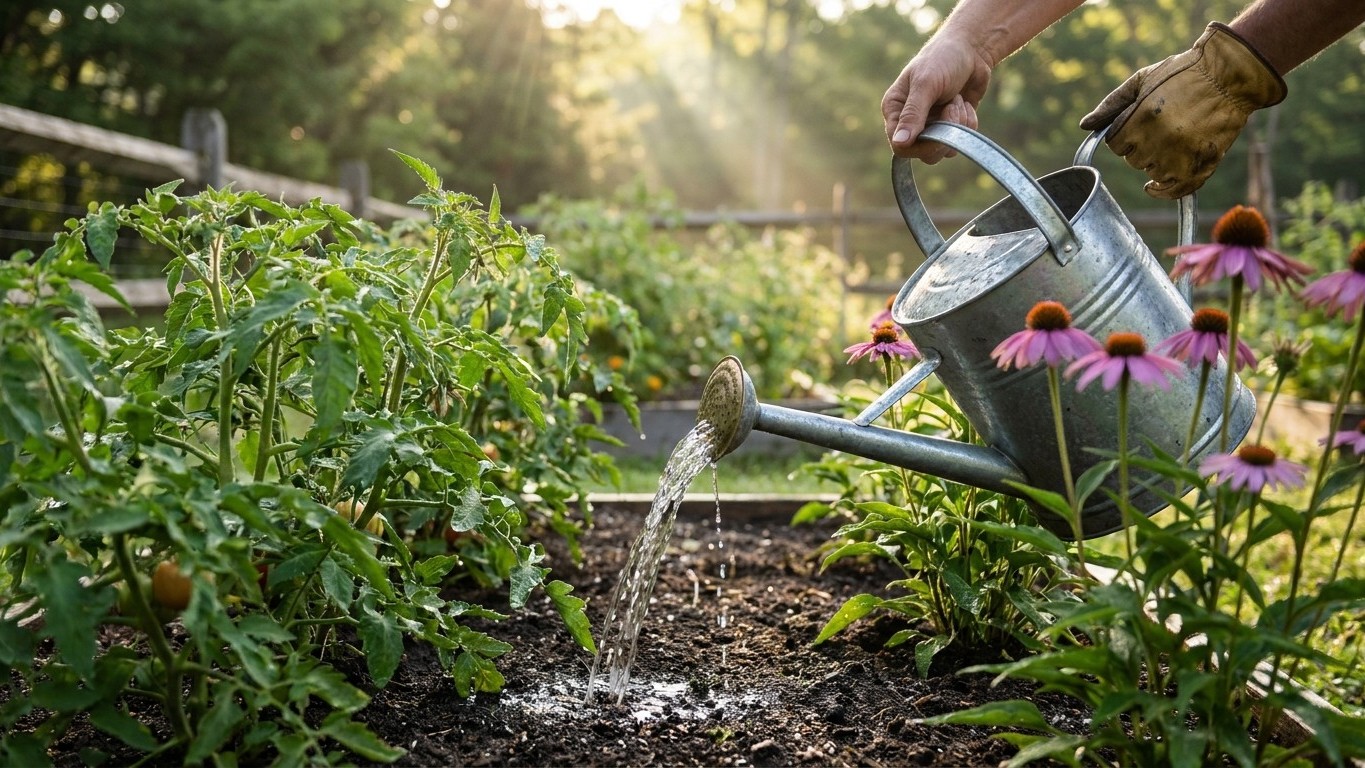
The method that works on Vermont ground is the same one that works almost everywhere, but the timing has to answer to this state’s numbers rather than to a generic gardening rule. Water deeply and less often, right at the base of the plant, in the morning. Deep watering pushes moisture down where roots actually live, instead of wetting only the top inch and training roots to stay shallow and vulnerable. Watering at the base, rather than overhead, keeps foliage dry and keeps that water from evaporating off leaf surfaces before it ever reaches soil. Morning watering gives plants a full day to take up moisture before the cooler night air settles in, which matters because wet foliage sitting overnight is what invites fungal trouble.
Checking the soil beats guessing every time. A finger pushed two inches down, or a trowel turned over near the root zone, tells the real story: if it’s dry at that depth, water; if it’s still cool and damp, wait. Surface soil can look bone-dry an hour after a storm even when the layer roots depend on is still holding moisture, and the reverse happens too during a long dry pull.
Soil texture sets the rhythm, not just the amount. Sandy ground holds little water at a time, so it calls for shorter, more frequent soakings, sometimes every other day during a dry stretch. Heavy clay holds a week’s worth of water in reserve but drowns roots of oxygen if it’s watered again before that reserve has drawn down, so patience matters more than frequency there.
- Start with about 1 inch of water delivered once every 5 to 7 days during August’s driest stretches, adjusting up on sandy soil and down on clay.
- Check soil moisture two inches down with a finger or trowel before every scheduled watering, and skip it if that depth is still damp.
- Water slowly at the base of each plant, giving heavy clay time to absorb rather than run off.
- Water in the early morning, before the day’s heat sets in, so plants take up moisture before evaporation competes for it.
- Recheck after any rain event before resuming the schedule, rather than watering on the calendar alone.
That one-inch, five-to-seven-day starting point is exactly that, a starting point. Every yard’s mix of sun, slope and soil nudges it in one direction or the other, and the only way to know for sure is to watch how long the ground actually stays damp after a soaking.
What goes wrong
The daily light sprinkle
A few minutes with the hose every evening feels responsible, but it wets only the top inch of soil and teaches roots to stay near the surface where summer heat bakes them hardest. Deep, less frequent watering pushes roots down to cooler, steadier moisture instead.
Watering the leaves at night
An evening spray looks refreshing, but wet foliage that sits through a cool Vermont night is an open invitation to fungal disease. Watering the soil, not the leaves, and doing it in the morning, closes that window.
Trusting the rain gauge on the roof, not the bed
A passing shower can look like it solved the problem while only wetting the top half-inch of soil, especially under a heavy leaf canopy that blocks most of the rain from ever reaching the ground. A finger pushed down two inches settles it faster than watching the sky.
Skipping the mulch
Bare soil hands back to the sun almost everything a watering session just gave. A two- to three-inch layer of mulch slows that loss and stretches every inch of water, sky-delivered or hose-delivered, several days further.
Given how modest Vermont’s heat load actually is, at just 5.4 days a year above 90F, the costlier mistake here often runs the other direction from drought states: overwatering a bed that never fully dried, especially on heavy clay ground that was already holding a full week’s worth of moisture when the hose came out again.
Local help
The University of Vermont Extension tracks local growing conditions, soil questions and seasonal advice specific to the state, and it’s worth bookmarking at uvm.edu/extension. Watering restrictions during a dry stretch vary by town and by water district, and none of that is set at the state level, so check with your own water provider before assuming any rule applies to your address.
Common questions
How often should I water my garden during a Vermont dry spell?
Start with one deep watering of about an inch every 5 to 7 days, then adjust based on how quickly your specific soil dries out between sessions.
Is Vermont prone to serious drought?
The state averages only 5.4 days a year above 90F and gets meaningful rain even in its driest month, August, at 3.54 inches, so extended severe drought is less common than in hotter, drier regions, though short dry stretches still happen.
Should I water in the morning or evening?
Morning. It lets plants take up water before the day’s heat arrives and keeps foliage from staying wet overnight, which lowers the risk of fungal disease.
How do I know if a recent rain was enough?
Check with a finger or trowel two inches down. A light or brief shower often wets only the surface, and only a check at root depth confirms whether the plant actually got what it needed.