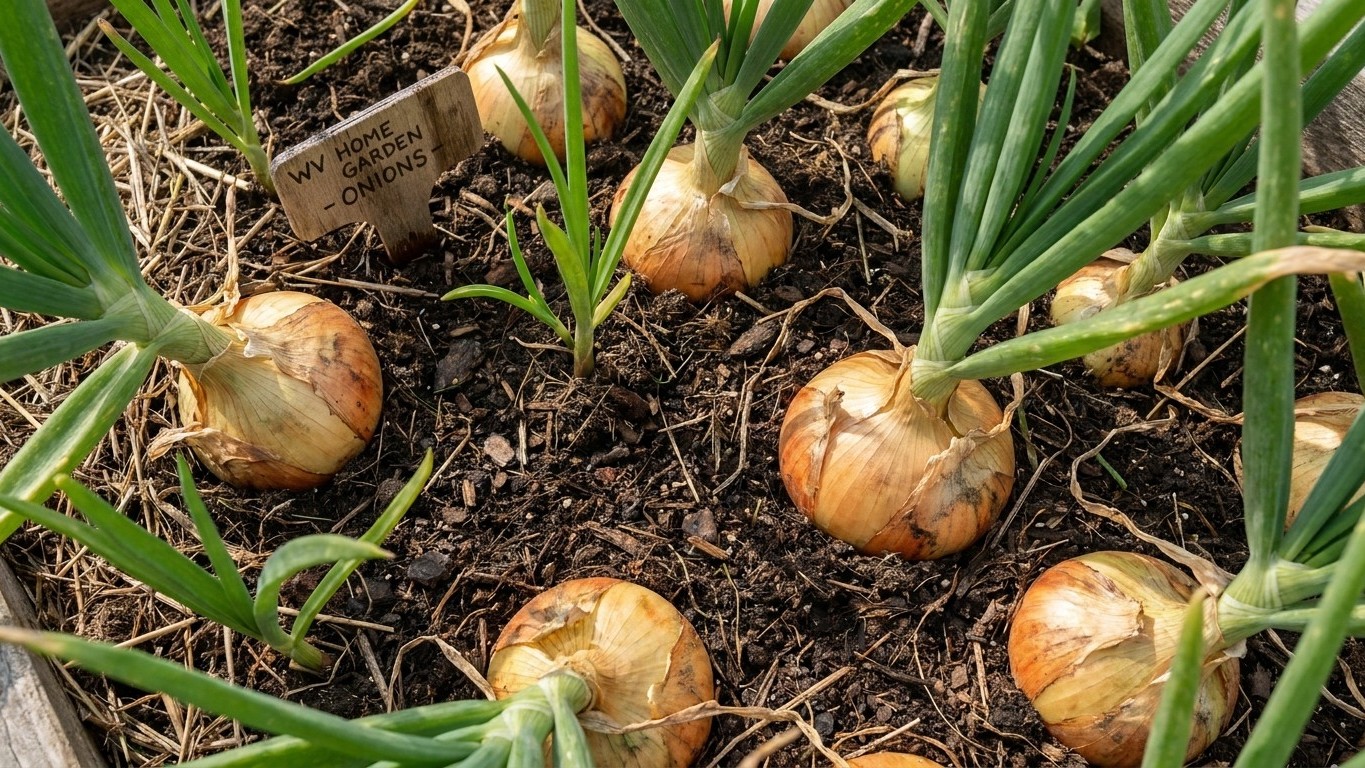

At 38.38 degrees north, Charleston gets 14 hours and 41 minutes of daylight on the longest day of the year. That number decides which onions will actually make a bulb in a West Virginia garden and which ones will just sit there growing leaves. Short-day onions, the kind sold in most supermarket sets, start bulbing at around 12 hours of daylight and are the wrong choice here. Intermediate-day and long-day varieties are the ones that fit, though six popular long-day types still miss the mark. Here’s the breakdown, variety by variety.
How long your longest day is

Charleston sits at 38.38 degrees north latitude, and on the summer solstice its gardens get 14 hours and 41 minutes of daylight, according to a calculation based on NOAA’s coordinates for the weather station there. That single figure matters more than average summer temperature, more than soil type, more than how much compost gets worked into the bed each spring. Onions decide when to stop making leaves and start making a bulb based on day length, not warmth. Clemson Cooperative Extension puts the trigger point for short-day onions at about 12 hours of daylight. Once the days get that long, a short-day bulb starts swelling, whether the plant is six inches tall or two feet tall.
At 14 hours and 41 minutes, West Virginia’s longest days sit well past that 12-hour short-day threshold and land at the lower edge of what long-day varieties need, which typically ranges from 14 to 16 hours. That puts this state in the middle ground: intermediate-day onions fit comfortably, and long-day onions bred for the lower end of their range will work too. Short-day onions, though, will start bulbing far too early here, before the plant has built enough leaf mass to support a full-size onion. Knowing When to Plant Onions in West Virginia is just as important as picking the right day-length type.
Why the edges of the state matter
West Virginia stretches from around 37.2 to just over 40.6 degrees north, a span of more than three degrees of latitude. That’s enough of a difference that a gardener near the Ohio border in the Northern Panhandle gets noticeably more summer daylight than one near the Virginia line in the southern coalfields. The 14-hour-41-minute figure belongs to Charleston specifically. Anyone gardening near the state’s northern or southern edge should look up their own latitude before betting a season on a single variety, especially one whose published range sits close to a boundary.
Which varieties bulb in West Virginia
Eighteen varieties documented in The Best Onion Varieties for West Virginia have a published latitude range that covers 38.38 degrees north, which means they’re built to bulb reliably in a West Virginia garden:
- Ailsa Craig, Barolo, Blush, Bridger, New York Early, Patterson, Red Long of Florence*, Rossa di Milano and Walla Walla Sweet (long-day types)
- Cabernet, Calibra, Candy, Elsye, Expression, Monastrell, Red Long of Tropea, Scout and Sierra Blanca (intermediate-day types)
One more sits close enough to the edge to be worth mentioning: White Castle, a short-day variety rated for 30 to 38 degrees north. At 38.38, Charleston is just past that upper limit, so White Castle is in the blurred zone. It may bulb, especially in the southern part of the state, but it’s not a sure thing the way the varieties above are.
What matters more, though, is the list of onions that will not work here, because that’s the mistake gardeners actually make when they grab whatever bag of sets is on the shelf at the hardware store.
The varieties that will disappoint you
Six short-day varieties are rated for latitudes well south of 38.38 and will fail here in one specific way: they’ll start bulbing while the plant is still small, giving tiny onions instead of full-size ones. That’s a variety mistake, not a feeding or watering mistake, and no amount of fertilizer fixes it.
- Gabriella (20-35N)
- Madalyn (20-35N)
- Red Rock (30-36N)
- Red Sensation (25-35N)
- Texas Grano 1015Y (25-35N)
- Vidora (25-35N)
Six long-day varieties fail in a different, more frustrating way. They’re bred for latitudes above West Virginia, meaning they need more summer daylight than Charleston’s 14 hours and 41 minutes ever provides. Plant them here and the day never gets long enough to flip the switch. The plant keeps making leaves all season, then rots in the ground before winter. Not a small onion. No onion at all.
- Frontier (40-50N)
- Powell (43-47N)
- Red Carpet (40-45N)
- Redwing (43-65N)
- Safrane (42-50N)
- Talon (42-50N)
If a past crop grew tall, leafy tops and never formed a bulb, or bulbed early into something the size of a golf ball, one of these two lists probably explains it.
When to plant onions in West Virginia
Because West Virginia’s daylight favors intermediate-day and long-day varieties rather than short-day ones, the planting calendar here looks different from a mild-winter state where short-day onions get tucked into the ground in fall. Intermediate and long-day onions need a long stretch of cool weather to size up before the days get long enough to trigger bulbing, so the planting window runs from late winter into early spring, timed around the last frost rather than ahead of the first one.
NOAA’s 1991-2020 climate normals for the Charleston station put the last spring frost (32°F) somewhere between April 9 and April 23, in the 30 to 70 percent probability band. The first fall frost falls between October 18 and November 1 on that same measure. Onion sets or transplants generally go in the ground four to six weeks before that last frost date, which for the Charleston area lands sets or transplants sometime in early to mid March, giving the plants time to build leaf mass before the June solstice pushes daylight past the bulbing threshold.
Averages, not guarantees
Those frost dates are averages pulled from three decades of weather data, not a promise about any single year. A 30 to 70 percent probability band means frost is a real possibility on either side of it, and a late cold snap in April has caught plenty of gardeners who planted by the calendar instead of watching the forecast. Elevation complicates things further. Charleston sits in a river valley, and higher ground anywhere in the state, which covers a lot of West Virginia, freezes noticeably earlier in fall and can stay colder longer in spring. A gardener up in the mountains should expect to plant later and harvest sooner than someone down in a valley town, even if both are technically at the same latitude.
Sweet onions or onions that keep
West Virginia’s mix of intermediate-day and long-day varieties gives a gardener a real choice, but not a free lunch. University of Missouri Extension notes that sweet onions do not store as well as the more pungent types, and that’s not a marketing quirk. It’s chemistry. The bite in a pungent onion comes from volatile sulfur compounds, and those same compounds act as a natural preservative, slowing the bulb’s breakdown in storage. A sweet onion has fewer of those compounds. Better on a sandwich in July, but it won’t make it to Thanksgiving in a basket on the counter.
That trade-off lines up with day length across the country. Short-day varieties, grown further south, tend to run sweeter and store for a shorter window. Long-day varieties, grown further north, tend to run sharper and keep for months. West Virginia’s intermediate-day varieties, which make up half the list that bulbs here, land in between: not as sweet as a Southern-grown onion, not as sharp or long-keeping as one grown in Minnesota, but a reasonable middle ground.
A gardener who wants onions to eat fresh through late summer should lean toward the sweeter end of the intermediate-day list, varieties like Candy or Cabernet, and plan to use them up within a couple of months of harvest. A gardener who wants a pantry that lasts into winter should lean toward the long-day varieties on the list, like Patterson or New York Early, and accept a sharper bite in exchange for a bulb that holds up in a mesh bag through January or February. Very few onions grown anywhere will still be good in March. That’s less a West Virginia limitation than a limitation of onions in general, and the sharper long-day varieties on this state’s list are about as close as it gets.