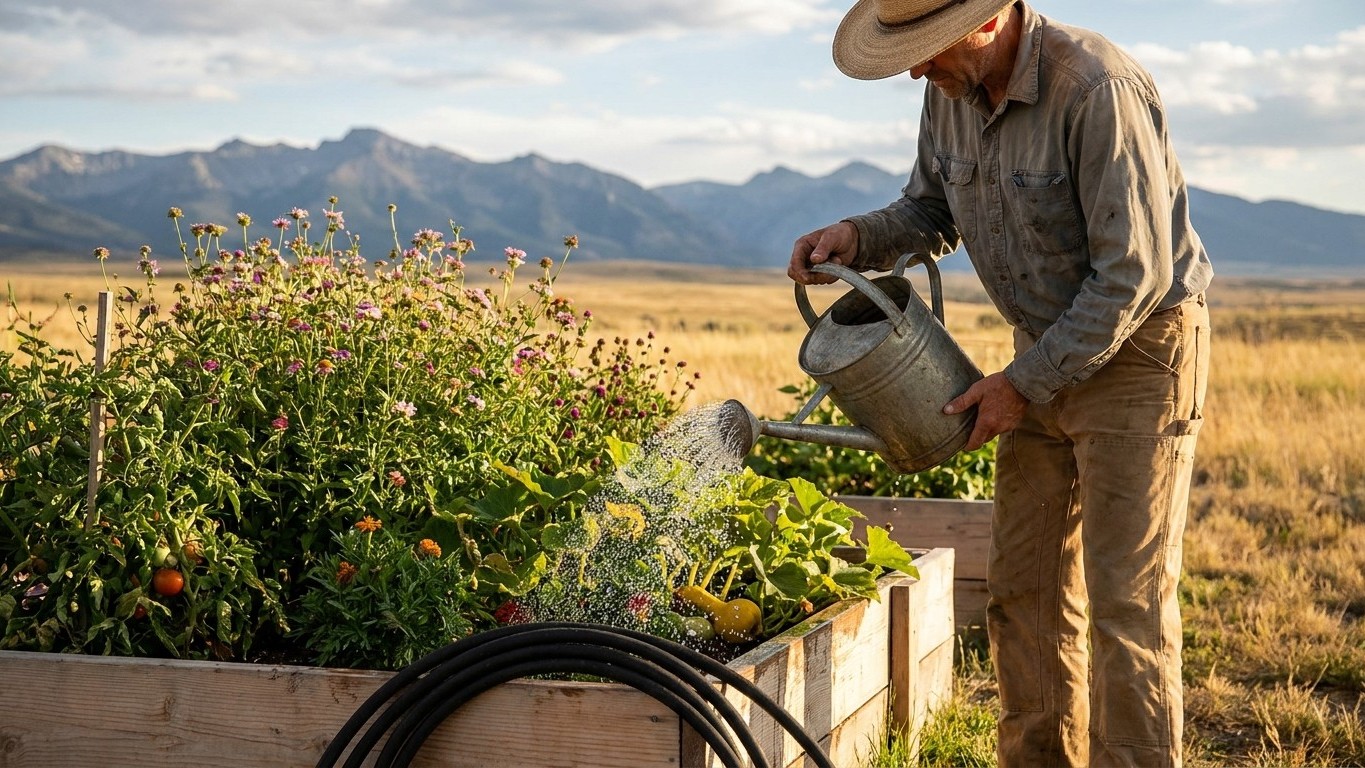

Wyoming gardens live and die on two numbers: how many days a year climb past 90F, and how little rain shows up to help. The state’s high plains and mountain valleys mean watering here isn’t optional extra credit, it’s the whole assignment, and the rules for doing it right start with the climate itself.
What the climate asks of you

Start with the one figure that’s actually measured and sourced for this state: the reference station at Cheyenne averages 10.4 days a year at 90F or hotter, according to NOAA’s 1991-2020 Climate Normals. That’s not a brutal desert number, but it’s enough heat stress to rule out a cool-season lawn or a shallow-rooted bed left to fend for itself through July and August.
Rainfall is the harder story to pin down statewide, because Wyoming’s precipitation is patchy and local, arriving less as steady summer soakers and more as scattered thunderstorms that can dump on one side of town and skip the other entirely. The safe planning assumption for most of the growing season is that the sky is not doing the heavy lifting, which is exactly why Watering Through a Dry Spell in Wyoming is worth planning for before it happens. A garden bed generally wants around an inch of water a week, and across most of a Wyoming summer, the gardener should expect to supply the bulk of that inch themselves, not count on it falling reliably from above.
Elevation complicates things further. At around 6,000 feet, which describes a lot of inhabited Wyoming, the frost-free window runs roughly 130 days, and frost is possible in any month at higher elevations. That short season means every watering decision also has to respect a compressed calendar.
Reference numbers for the high plains
| Metric | Value | Source |
|---|---|---|
| Days per year at 90F+ | 10.4 (Cheyenne) | NOAA NCEI Climate Normals 1991-2020 |
| USDA Hardiness Zones | 3a to 6a (statewide range) | USDA Plant Hardiness Zone Map, 2023 |
| Last spring frost | May 7 to May 18 | NOAA NCEI, station USW00024018 |
| First fall frost | September 24 to October 5 | NOAA NCEI, station USW00024018 |
Soil texture matters just as much as rainfall, and it varies wildly across the state, from sandy basin bottoms to heavy clay in some valley soils. The same inch of water that soaks straight through a sandy plot sits and lingers in clay, so two Wyoming gardens twenty miles apart can need completely different watering schedules even under identical weather. Testing your own soil, rather than assuming, is the first real step. The University of Wyoming Extension can help identify what you’re actually working with, and gardeners relying on pots or raised containers instead of in-ground beds should look at Watering Pots and Containers in Wyoming for guidance suited to those faster-drying setups.
How much, how often
Deep and infrequent beats shallow and daily, every time, in this climate. A quick daily sprinkle wets only the top inch or two of soil, and roots follow the water, staying shallow and close to the surface where midsummer heat bakes them. A deep soak that reaches six to eight inches down pushes roots downward, chasing moisture, which makes the whole plant more resilient during that stretch of 90-degree days.
The test for whether it’s time to water isn’t the calendar, it’s the soil. Push a finger, or better, a garden trowel, about two inches into the bed near the root zone. If it comes out dry and crumbly, it’s time. If it’s still cool and slightly damp, wait. This single habit does more to prevent both over- and under-watering than any fixed schedule ever will.
Texture changes the math directly. Sandy ground, common in parts of the Wyoming basin, drains fast and holds little, so it typically needs shorter, more frequent soakings to keep up. Heavy clay holds a week’s worth of water in reserve but drowns roots if it’s watered again before it’s had the chance to dry out, and it should never be worked or soaked while it’s already wet, since compacted clay loses structure fast. Given how little rain the driest stretch of a Wyoming summer typically delivers, most beds here are effectively on irrigation rather than rainfall, and the schedule needs to reflect that rather than hoping for a wet week that may not come.
A watering sequence that works here
- Check soil moisture two inches down with a finger or trowel before touching the hose, rather than watering on a fixed day of the week.
- Water early morning, ideally before 9 a.m., so moisture soaks in before midday heat and evaporation take over.
- Apply water directly at the base of the plant, never overhead onto leaves, which wastes water to evaporation and invites fungal issues.
- Give sandy soil shorter, more frequent soakings, roughly every two to three days during hot stretches.
- Give clay soil a deep soak roughly once a week, then let it dry before watering again, checking moisture rather than assuming.
- Increase frequency during any run of days at or above 90F, since evaporative demand climbs fast in dry heat.
Restrictions and rules
Watering restrictions in Wyoming are set at the local and municipal level, not statewide, and they change from year to year depending on snowpack, reservoir levels, and drought conditions. Some towns run voluntary conservation requests most summers and only move to mandatory limits, like odd-even day watering or banned midday sprinklers, during officially declared drought years. Others may have standing seasonal schedules that kick in every summer regardless of conditions.
Because rules like these are drawn from local water boards and municipal ordinances that shift often, the only reliable move is to check directly with your city or county water provider before setting an automatic timer. Many Wyoming municipalities post current watering schedules and restriction status on their utility billing pages or town websites, updated as conditions change through the season.
Given how little cushion the driest part of a Wyoming summer typically leaves, and how dependent much of the state is on limited surface water and groundwater supplies, restrictions here are a real possibility most years, not a rare emergency measure. Treat checking local rules as a spring task, done before planting decisions are finalized, rather than something to look up after a timer’s already set. The University of Wyoming Extension office in your county is also a solid starting point if the municipal information is hard to track down.
Using less
Cutting water use in a Wyoming garden isn’t about sacrificing plant health, it’s about plugging the leaks where water is currently being wasted to sun, wind, and gravity. A few changes do most of the work.
- Mulch, two to three inches deep: cuts surface evaporation dramatically and keeps soil temperature steadier during those 90-degree stretches, meaning less frequent watering overall.
- Drip irrigation or soaker hoses: deliver water straight to the root zone instead of spraying it into dry air, which matters a lot in a state where wind is nearly constant and speeds evaporation from overhead sprinklers.
- Grouping plants by water need: keeps thirsty vegetables separate from drought-tolerant natives, so nobody gets over- or under-watered just because they share a zone with mismatched neighbors.
- Organic matter worked into the soil: improves both sandy soil’s water retention and clay soil’s drainage, meaning either type holds a usable amount of moisture longer between waterings.
- Rain barrels, where local code allows them: an inch of rain falling on a thousand square feet of roof yields roughly 600 gallons of runoff. Given how unevenly Wyoming’s summer storms distribute rainfall, a barrel can fill fast during one heavy thunderstorm and then sit empty for weeks through a dry stretch, so it’s a useful supplement rather than a primary water source here.
None of these techniques require replacing an entire garden layout. Mulch and drip lines can be added to an existing bed in an afternoon, and the water savings show up within the first hot week.
Common questions
What USDA zone is Wyoming in for planting?
Wyoming spans USDA zones 3a to 6a statewide, a wide range driven by elevation and latitude differences. Cheyenne, a common reference point, sits in the milder end of that range, but gardeners elsewhere in the state should check their specific location rather than assume Cheyenne’s dates apply.
When is it safe to plant after the last frost?
The last spring frost typically falls between May 7 and May 18 depending on location, based on NOAA’s 30-70% freeze probability band. At higher elevations, frost risk can linger later or return earlier, so local timing matters more than a statewide average.
How long is the Wyoming growing season?
Roughly 130 frost-free days at around 6,000 feet elevation, running from the last spring frost in mid-May to the first fall frost, which typically arrives between September 24 and October 5. That’s a tight window that rewards early starts and season-extension tools like row covers.
Who do I contact about local watering restrictions?
Municipal water providers and local water boards set and change these rules, not the state as a whole. Check your city or county utility website first, and the University of Wyoming Extension can help point toward the right local office if that information is hard to find.