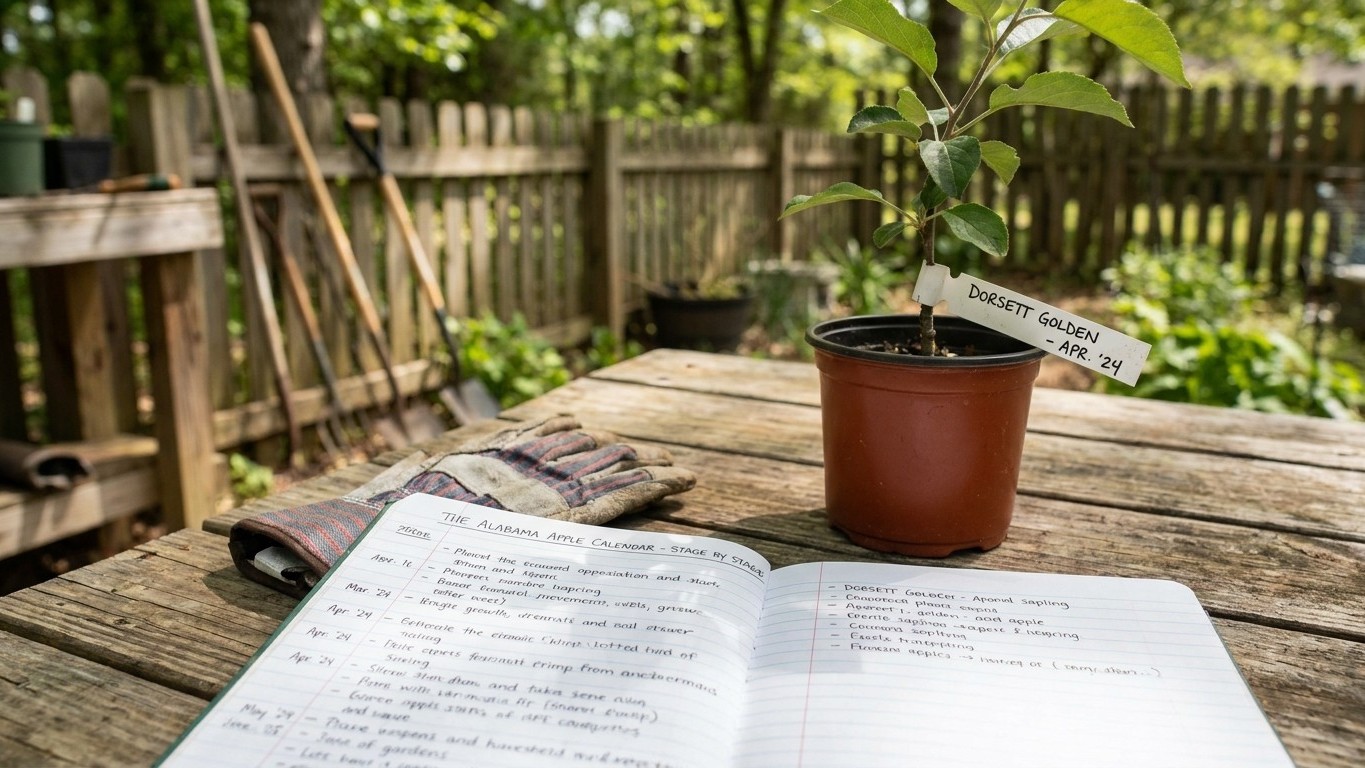

Alabama’s apple calendar runs off two frost windows measured at the Huntsville airport station. NOAA NCEI’s 1991-2020 climate normals put the last spring frost there between March 19 and April 3, and the first fall frost between November 2 and November 16. Every stage between dormancy and harvest gets timed against those windows rather than against a fixed month, because it’s the blossom, not the calendar, that a late freeze actually kills. Check your own county’s frost history against the Huntsville range before you decide your trees are safe to bloom.
The short answer for Alabama
Alabama’s apple trees don’t answer to the calendar on your wall — they answer to whichever stage they’re sitting in when a frost rolls through, and Huntsville’s last freeze can land anywhere from March 19 to April 3. A tree at green tip shrugs off cold that would gut an open bloom, so the date means nothing without the stage attached to it. Walk out today and check your buds against that window before you assume they’re safe.
Two filters, not one: hardiness and chill
What the answer depends on is that hardiness and winter chill are separate questions, and a site has to pass both. Huntsville’s coldest month, usually January, averages a daily minimum temperature of 31.8°F under NOAA NCEI’s 1991-2020 normals, cold enough for real freezes but far short of a brutal northern winter. That’s mild enough that a high-chill northern cultivar can sit in ground that never kills it outright, yet still fail to accumulate the cold hours it needs to break dormancy cleanly and bloom on schedule.
This calendar assumes trees are already in the ground. If they aren’t yet, the site and planting steps come first, and they’re covered in Growing Apples in Alabama. Once a tree is established, chill and hardiness decide which cultivars are worth carrying through a full Alabama winter at all, and that’s the choice that determines everything downstream in the calendar.
Working through it

An apple tree moves through seven recognizable stages between winter rest and harvest, and each stage tells you something the date on the wall cannot.
- Dormancy
- Green tip
- Pink
- Bloom
- Petal fall
- Fruit set
- Harvest
Dormancy

Trees sit dormant from leaf drop through the coldest weeks of winter, the same span when Huntsville’s coldest-month minimum runs 31.8°F under NOAA NCEI’s normals. This is the only stage of the year when a hard freeze does essentially no harm, and it’s the window for dormant pruning and bare-root planting. Chill accumulates across the whole dormant span, so a mild afternoon in February doesn’t erase weeks of accumulated cold from December and January.
Green tip

Green tip is the first visible break from dormancy: a fleck of green leaf tissue shows through the bud scales, usually well ahead of Huntsville’s last-frost window of March 19 to April 3. Wood and buds at this stage tolerate a light freeze with little injury. It’s the stage, not the month, that tells you how much risk the coming weeks carry, since a warm spell can push a tree to green tip weeks earlier than in a cold year.
Pink

By pink, flower buds have swollen and colored but stay closed, and the tree is now noticeably more frost-tender than it was at green tip. If pink lands inside or after the March 19 to April 3 window NOAA NCEI records at Huntsville, a freeze event can damage a meaningful share of the crop before a single blossom opens. Once buds show color, check them daily rather than by the forecast alone, because pink can flip to open bloom in a matter of days once temperatures climb.
Bloom

Open bloom, white five-petaled flowers with visible yellow stamens, is the single most frost-vulnerable stage in the calendar. A freeze at bloom can kill the flower’s reproductive parts outright even when the surrounding wood is untouched, and since Huntsville’s last spring frost can run as late as April 3 under NOAA’s normals, a tree that blooms early in a warm year carries real exposure. A later, more compressed bloom window in a Southern-adapted cultivar cuts that risk, which is one reason cultivar choice matters as much as timing.
Petal fall

Petals brown and drop within days of pollination, scattering under the tree. Frost risk has usually dropped sharply by this point, but a late freeze arriving right at petal fall can still abort newly set fruit, and some years still see frost after petals have fallen since NOAA’s 30 to 70 percent freeze-probability band for Huntsville doesn’t close until April 3.
Fruit set

Fruit set is confirmed once pea-sized green fruitlets swell at the base of the old blossom, calyx still attached. This is when thinning happens, and by now the spring frost risk from NOAA’s window is typically behind the tree. From here on, growth is a matter of a full season rather than frost management.
Harvest
Harvest timing follows the cultivar’s own days-to-maturity rating, counted from bloom, rather than a fixed calendar date, and it needs to land well ahead of Huntsville’s first-fall-frost window of November 2 to November 16. Catalog maturity figures shift by a week or two with the season’s actual weather, so color, firmness and how easily the fruit separates from the spur are the real signal, not a count of days on a calendar.
What changes across Alabama
North Alabama’s valleys and uplands
Huntsville sits in the Tennessee Valley in the far north of the state, where cold air draining off higher ground nearby pushes both frost dates in directions that don’t always match warmer parts of the state. Sand Mountain and the higher terrain of northeast Alabama run colder still. Cold air pools in low valleys on clear, still nights, so a frost can settle into one hollow while a ridge two miles off stays clear, and a single weather station reading cannot capture that kind of local pooling.
The Gulf Coastal Plain
Move south into the Black Belt and central Alabama and the frost-free season stretches longer on both ends. Push on to the Gulf Coastal Plain around Mobile and a different problem takes over: winters there run mild enough that many mid- and high-chill cultivars never accumulate the cold hours needed to break dormancy cleanly, which shows up as patchy, drawn-out bloom and weak fruit set even in a year with no frost damage at all. This is where cultivar choice matters more than the calendar, and the low-chill options in The Best Apple Varieties for Alabama earn their place on the coastal plain specifically because the standard chill filter rules out so much else there.
None of the figures above cover a county-by-county breakdown of frost dates or chill hours for the whole state. Treat Huntsville’s NOAA NCEI figures as the reference point, and adjust toward more cold in the uplands and cold-air valleys, or less cold moving south toward the coastal plain, based on your own site’s history and elevation.
The mistakes this climate punishes
Planting a high-chill variety for a mild winter
Northern apples bred for New England or the upper Midwest often need far more accumulated chill than a typical Alabama winter delivers, and the mismatch doesn’t show up as a dead tree. It shows as blossoms opening over three or four weeks instead of a tight window, weaker pollen viability, and a scattered, light fruit set in a year when the weather did nothing wrong. It shows up worst in the mildest winters, and on the Gulf Coastal Plain it can happen most years, not only the occasional warm one.
Trusting an early bloomer against a late frost
A cultivar chosen for an early, showy bloom can open its flowers during a mild March stretch, only to sit exposed when a freeze arrives inside Huntsville’s own last-frost window of March 19 to April 3. The damage shows immediately as blackened blossom centers, and the real cost shows up weeks later as a far lighter crop than the bloom promised.
Feeding nitrogen too late in the season
A feeding pushed past midsummer keeps a tree producing soft new leaf and shoot growth right when it should be hardening off for winter. That soft tissue is the first thing hurt when the first fall freeze arrives, and at Huntsville that window can open as early as November 2 under NOAA NCEI’s normals, leaving very little cushion for growth that’s still tender in late October.
Pruning after the tree has already left dormancy
Dormant pruning cuts made after green tip has already shown remove wood the tree has already invested spring energy into, and fresh cuts made while sap is moving invite disease entry in a way the same cut made in January would not. Once green shows at the buds, that year’s pruning window is effectively closed.
Checking this against your county
Alabama’s frost dates and chill accumulation shift enough across the state that Huntsville’s figures are a starting point, not a verdict on your own yard. The Alabama Cooperative Extension System tracks local conditions county by county and is the right first call before committing to a cultivar list or a bloom-time strategy. A short call to your county extension office, or a look at their published local data, tells you whether your site runs ahead of or behind the Huntsville reference figures used throughout this calendar.
Common questions
How can I tell green tip from pink stage on my own tree?
Green tip shows as a small fleck of green leaf tissue at the tip of an otherwise closed, scaly bud. Pink stage comes later, once the flower buds inside have swollen and turned visibly pink while still closed into a tight cluster, not yet open into flowers.
Does one frosty night after bloom ruin the whole crop?
Usually not entirely. Most apple trees open blossoms over several days rather than all at once, so a single freeze night typically damages the flowers open at that moment rather than every flower on the tree. A crop reduction is common after a bloom-time freeze, but a total loss is less so unless the freeze is severe and the tree was in full, uniform bloom.
Do I need two different apple trees to get any fruit?
Most apple cultivars need pollen from a different variety blooming at the same time to set fruit reliably, so a single isolated tree often blooms with little to show for it. Check the specific cultivar’s pollination needs before you plant just one.
Will a late-ripening variety have time to mature before frost in north Alabama?
It depends on the cultivar’s days-to-maturity rating counted from bloom, weighed against Huntsville’s first-fall-frost window of November 2 to November 16 under NOAA NCEI’s normals. A long-season cultivar that blooms late or ripens close to that window carries more risk of an early freeze catching unpicked fruit than one with an earlier harvest rating.