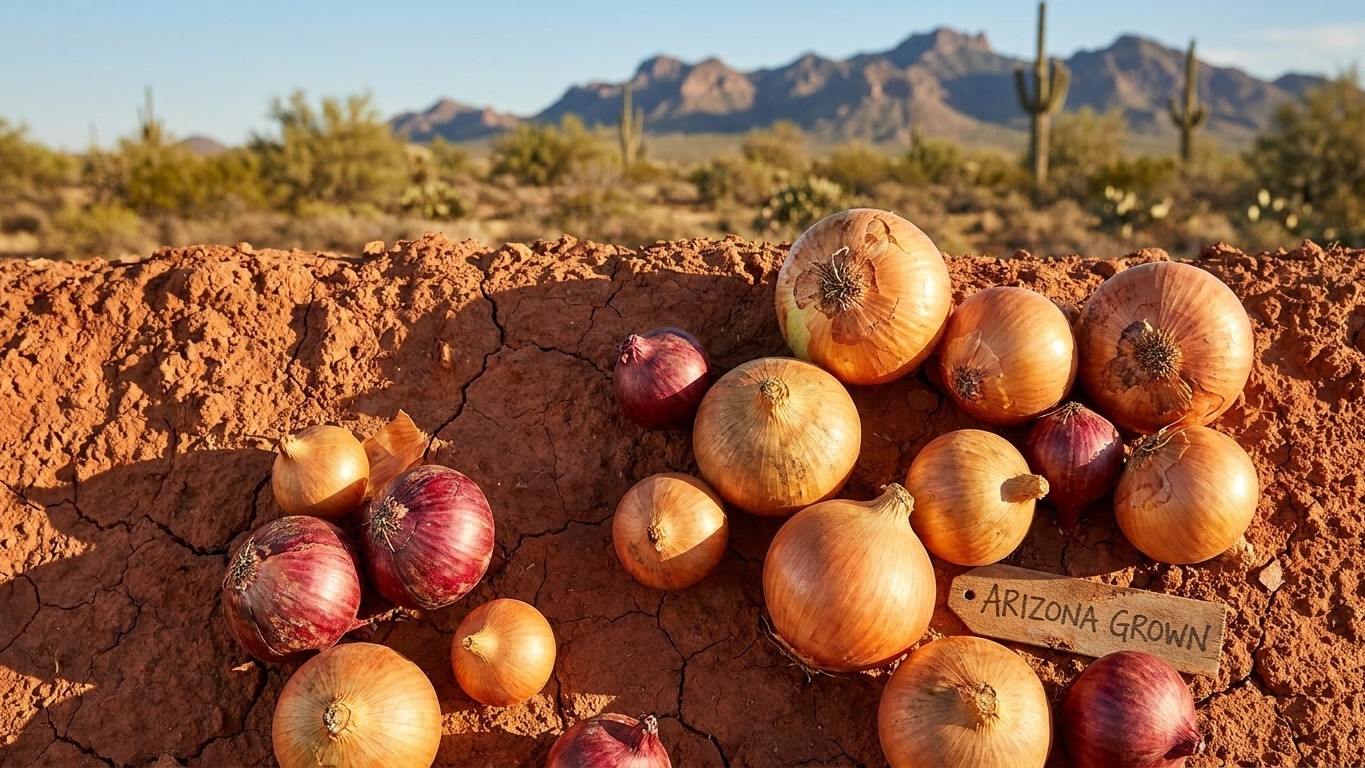

Arizona sits at a latitude where short-day and intermediate-day onions bulb reliably, while long-day onions never will. Phoenix, the reference point for the state’s growing conditions, sits at 33.43 degrees north and gets 14 hours and 13 minutes of daylight on the summer solstice. That number is the whole story: it decides which onion varieties make bulbs here and which ones just sit in the ground making leaves.
The short answer for Arizona

Onions don’t bulb because of heat. They bulb because of day length, and each variety is bred to respond to a specific threshold. Short-day types start bulbing once the day reaches about 12 hours, according to Clemson Cooperative Extension’s guidance on onion growing. Intermediate-day types wait longer, needing something closer to 13 to 14 hours before they switch from leaf production to bulb production. At 14 hours 13 minutes on the longest day of the year, Phoenix comfortably clears both thresholds, which is why both groups work in most of the state.
Twelve documented varieties have a published latitude range that covers 33.43N, and they split cleanly into two camps. On the short-day side: Gabriella, Madalyn, Red Rock, Red Sensation, Texas Grano 1015Y, Vidora, and White Castle. On the intermediate-day side: Candy, Elsye, Expression, Scout, and Sierra Blanca.
Some of those names, like Gabriella, Madalyn, Red Rock, and White Castle, don’t have a dedicated page on this site yet, but their catalogue-published ranges (20-35N, 20-35N, 30-36N, and 30-38N respectively) still put Phoenix squarely inside the zone where they bulb properly. The short-day group tends to bulb earlier in the season and skews sweeter. The intermediate-day group takes a bit longer to size up and tends to store a little better. Which one a gardener picks often comes down to whether they want onions to eat in June or onions to still have in the pantry come fall.
What will not work here
This is the part most seed racks and garden center displays won’t tell you. A long-day onion variety needs 14 to 16 hours of daylight to trigger bulbing, and much of that threshold simply doesn’t exist in Arizona’s sky, even on the longest day of the year. Plant a long-day onion in Phoenix, Tucson, or almost anywhere in the state, and it won’t grow a small bulb instead of a big one. It won’t grow a bulb at all. The plant keeps making leaves all season because the signal that tells it to stop never arrives. Eventually the top dies back, and what’s left in the ground rots.
Nineteen varieties documented on this site fall into that category for Arizona, either because they’re long-day types outright or because their intermediate-day range starts north of Phoenix’s latitude:
- Ailsa Craig — long-day, needs 38-60N
- Barolo — long-day, needs 38-55N
- Blush — long-day, needs 38-55N
- Bridger — long-day, needs 35-50N
- Cabernet — intermediate-day, but range starts at 35N
- Calibra — intermediate-day, but range starts at 35N
- Frontier — long-day, needs 40-50N
- Monastrell — intermediate-day, but range starts at 35N
- New York Early — long-day, needs 38-50N
- Patterson — long-day, needs 38-55N
- Powell — long-day, needs 43-47N
- Red Carpet — long-day, needs 40-45N
- Red Long of Florence — intermediate-day, but range starts at 38N
- Red Long of Tropea — intermediate-day, but range starts at 35N
- Redwing — long-day, needs 43-65N
- Rossa di Milano — long-day, needs 38-50N
- Safrane — long-day, needs 42-50N
- Talon — long-day, needs 42-50N
- Walla Walla Sweet — long-day, needs 35-55N
Notice that even some intermediate-day varieties, like Cabernet or Red Long of Tropea, don’t work here. Their published range starts a couple of degrees north of Phoenix, which is enough to keep the trigger out of reach through most of Arizona’s growing season.
What changes across Arizona
Arizona is a tall state, geographically speaking. It runs from around 31.3 degrees north at the Mexican border near Nogales up to roughly 37 degrees north along the Utah line near the Arizona Strip. Phoenix, at 33.43N, sits closer to the southern half of that span, which means the daylight and variety guidance above applies most cleanly to the low desert and much of the Sonoran and lower Colorado River valleys, not to the entire state.
| Region | Approximate latitude | What changes |
|---|---|---|
| Yuma / southwestern border | ~32.7N | Slightly south of Phoenix; short-day varieties bulb a touch earlier in the season |
| Phoenix (reference city) | 33.43N | Baseline for the figures on this page |
| Flagstaff / northern plateau | ~35.2N | Enough farther north that some intermediate-day varieties, still excluded from the reference figure, may edge toward workable, though cold nights and short growing seasons matter more here than day length |
| Arizona Strip (near Utah line) | ~36.9N | Closer to the day-length behavior of intermediate to long-day territory further north |
A gardener in Yuma is essentially in the same daylight world as Phoenix. A gardener near Flagstaff or the Arizona Strip is not, and elevation adds another layer entirely: those areas also see hard freezes and a much shorter frost-free window, which affects planting timing independent of the bulbing math. If you garden north of the Mogollon Rim, treat the Phoenix-based guidance here as a starting point, not a guarantee, and check your own latitude before committing to a full bed of any single variety.
Sweet now, or onions that last
Every onion gardener in Arizona eventually runs into the same trade-off, and it isn’t bad luck. It’s chemistry. The compounds that give an onion its bite are volatile sulfur compounds, and those same compounds are what protect the bulb once it’s out of the ground. University of Missouri Extension puts it plainly: as a rule, sweet onions do not store as well as the more pungent types, because pungency comes from those sulfur compounds in the first place.
Arizona’s short-day, high-daylight environment favors varieties that run mild and sweet, the kind you’d slice raw for a burger the same week you pull them. That’s a real advantage in July. It’s a real limitation in December. A short-day onion harvested in early summer typically isn’t built to last through winter storage the way a long-day onion grown in a northern climate would be. Southern-leaning gardens are essentially getting onions calibrated for immediate eating, not for the root cellar.
Practically, that means a pantry stocked entirely from an Arizona onion patch probably won’t have much left by March. The bulbs that store better among the varieties suited here, generally the intermediate-day types like Candy or Scout, will hold longer than the short-day sweet types, but none of them are bred for the months-long keeping that a long-day storage onion offers further north. If a steady supply through winter matters more than sweetness on the cutting board, lean toward the intermediate-day side of the list and plan to use the short-day bulbs first.
Checking this against your own garden
Every figure on this page comes from Phoenix’s coordinates and the daylight math tied to them. That’s a solid reference for most of the low desert, but it isn’t a substitute for knowing your own numbers, especially if you garden anywhere near the edges of the state.
- Look up your own latitude if you’re gardening well north of Phoenix, particularly above the Mogollon Rim or near the Arizona Strip
- Check your local average last and first frost dates, since they vary by elevation far more than by latitude in Arizona
- Contact your county’s Cooperative Extension office (University of Arizona Cooperative Extension operates in every county) for planting windows calibrated to your specific area
- Confirm the day-length group printed on any seed packet or transplant label against the short-day and intermediate-day lists above before you plant
- Note your garden’s elevation, since high-desert and mountain gardens face a shorter frost-free season regardless of what the daylight math says about bulbing