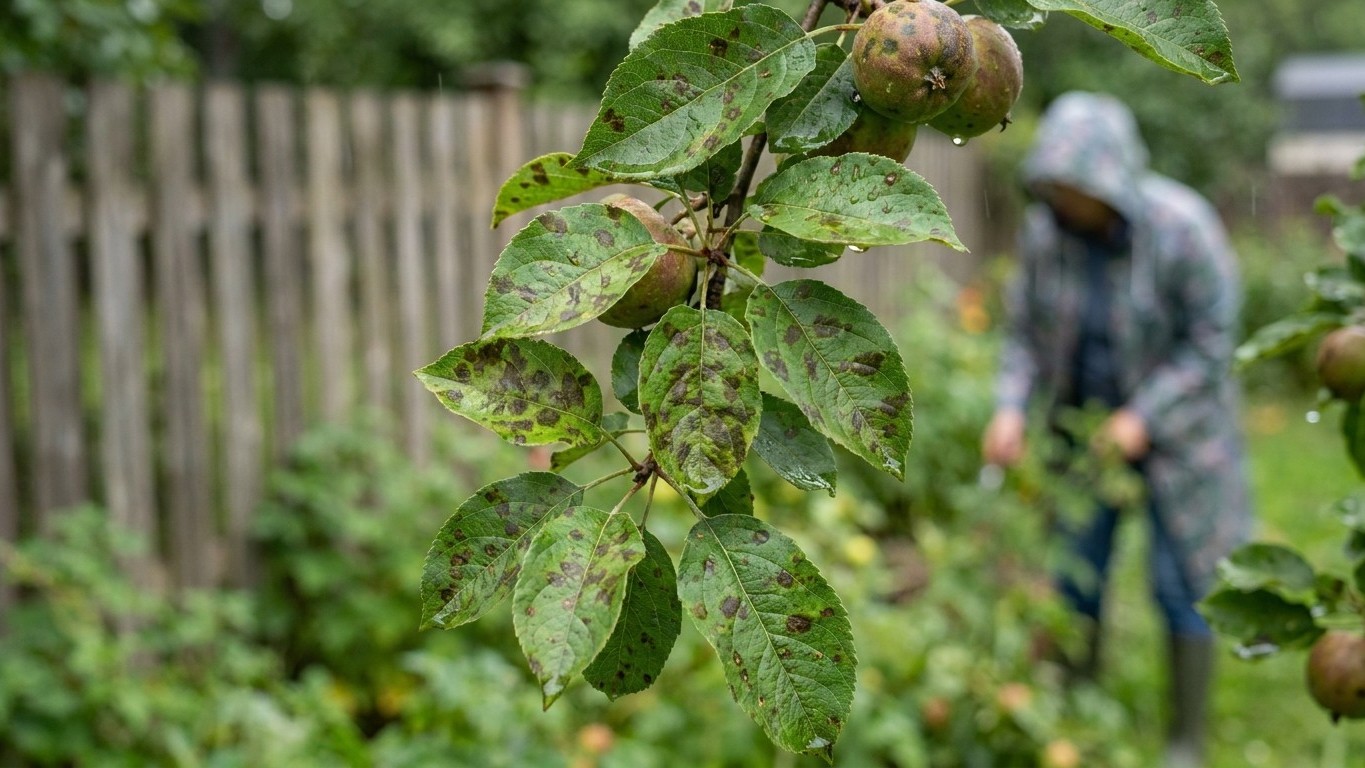

Apple scab shows up as olive-green to black velvety blotches, usually on the undersides of the first leaves to unfurl, spreading to the fruit as the season goes on. It is caused by the fungus Venturia inaequalis and it thrives in cool, wet spring weather, exactly the stretch when the tree is pushing new growth and can least afford to lose leaves. Check the youngest leaves right after a rainy spell around green tip and pink stage. If the spots are there, treat the tree now rather than waiting for fruit symptoms to confirm it.
What you are looking at

On the leaves
The first sign is usually a scatter of small, dark olive-green spots on the underside of young leaves, often before the upper surface shows anything at all. Run a finger over one and it feels slightly velvety, not smooth, because the spot is a mat of fungal growth sitting on the leaf tissue rather than a discoloration inside it. As the spot ages it darkens toward black and the edges stay fuzzy rather than sharp. Badly affected leaves curl, turn yellow around the lesions, and drop early, sometimes by midsummer on a tree that had a wet spring.
On the fruit
On fruit the same olive-black spots appear first as pinpoints, then widen into rough, corky patches with a defined dark rim. Early infections, the ones that take hold at bloom or shortly after, often leave a hard, cracked, star-shaped scar as the apple grows around the lesion, sometimes splitting the skin open. Infections that arrive later in the season look more like small dark freckles scattered over otherwise sound fruit, sometimes not obvious until the apples are in storage. Both versions are edible once the corky tissue is cut away, but they will not hold in storage as well as clean fruit.
What it is not
How they differ
A grower’s first instinct on seeing dark marks on fruit is to assume the worst, and scab gets blamed for damage it did not cause. The detail that separates it from its two most common look-alikes is texture and depth: scab sits on the surface and feels rough, while the others sink into the flesh or sit on top of it without roughening the skin.
| Disease | Color and shape | Where it sits | Timing |
|---|---|---|---|
| Apple scab | Olive-green to black, velvety, irregular edge | On the surface, raised and corky | Cool wet spring, worsens through summer |
| Bitter rot | Brown, sunken, concentric rings | Depressed into the flesh | Warm, rainy weather, mid to late summer |
| Sooty blotch and fly speck | Smoky gray smudges or tiny black dots | Sits on top of the skin, wipes off partially | Humid stretches later in the season |
Sunken, ring-marked rot that spreads fast in a warm rain is more likely Bitter Rot: Sunken Circles That Spread in Warm Rain than scab, and it calls for a different response since it moves through the fruit rather than sitting on the surface. Scorched-looking, blackened shoot tips near the blossoms are a separate problem entirely, covered on the page about Fire Blight: Shoots That Look Scorched in Midsummer, and treating one as the other wastes the narrow window either disease gives you to act.
The conditions that bring it on
What makes a bad year
Apple scab needs moisture on the leaf surface to infect, so a spring with frequent rain, heavy dew, or long overcast stretches with high humidity sets up the worst years. The fungus overwinters in fallen leaves on the ground, and its spores are released and carried by rain splash and wind right around the time the buds are breaking, which is why a wet green tip to pink stretch matters more than a wet week in June. A tree standing over last year’s leaf litter going into spring is starting the season with the infection already loaded and waiting.
Weather that keeps it going
Once the first leaf infections take hold, they produce a second wave of spores that spread the disease further up the tree with every subsequent rain, so one wet week can seed problems that show up for the rest of the season. Warm, humid nights after a wet day speed this along, since the fungus grows fastest when the leaf surface stays damp for an extended stretch rather than drying between showers. The same wet spring weather that favors scab also opens blossoms up to fire blight infection, so it pays to check for shoots that look scorched in those same weeks rather than assuming every problem on the tree is scab.
A nearby untended apple tree, a hedgerow crab apple, or a pile of unraked leaves under the canopy all act as a local spore source, and an orchard with several of these nearby will see heavier pressure than an isolated tree even in an identical spring. Wind direction and how sheltered the site is change how much of that spore load actually lands on a given tree, which is part of why two trees a few yards apart can come through the same spring looking very different.
What to do now
This season
Once you see the olive spots on unfurled leaves, the infection that produced them is already established and nothing applied after the fact will erase it. What you can still influence is whether it spreads further. Raking up and removing any leaves that have already dropped, rather than leaving them at the base of the tree, cuts down the spore supply feeding new infections on the leaves still on the branch. Pruning out any water sprouts or crowded interior growth opens the canopy so leaves dry faster after rain, which slows the fungus even without any spray at all.
What a spray can and cannot do
Fungicide applications, where labeled products exist for home orchards, work by protecting healthy tissue before infection, not by curing tissue already showing spots. Timing them to the tree’s growth stage, not the calendar, is what makes them effective, and the specific active ingredients registered for home apple growers, along with the rates and intervals allowed, vary by state. Your state land-grant extension service is the right place to check what is currently labeled and legal to use where you garden, since a product sold two states over may not be registered for the same use where you live. This same wet-weather pressure affects several other fungal and bacterial problems at once, which is why it is worth reading through the broader page on Apple Diseases before deciding what, if anything, to spray this season.
Thinning fruit clusters on a heavily infected tree does not treat the scab directly, but it does concentrate the tree’s energy on fewer, sounder apples and reduces the crowding that keeps fruit surfaces damp longer after rain.
Preventing it next season
Sanitation and pruning
Most of next year’s scab starts in this year’s fallen leaves, so a thorough fall or early-spring cleanup under the canopy, removing leaf litter rather than leaving it to break down in place, is the single change that does the most for the least effort. Follow it with dormant-season pruning aimed at an open center and well-spaced branches, since a canopy that dries out quickly after rain gives the fungus a much shorter window to establish each time the weather turns wet.
Resistant varieties
Some apple cultivars were bred specifically for resistance to this fungus and hold up in a wet spring that would badly scar a susceptible tree. Liberty, Enterprise, Freedom, William’s Pride and Redfree all carry scab resistance bred into them and are worth considering for a new planting in a site with a history of bad scab years. Resistance is not the same as immunity in every case, and a resistant cultivar planted next to a heavily infected old tree still benefits from the same sanitation routine, but it starts the season with far less pressure to fight off.
- Clear fallen leaves from under the canopy every fall
- Prune for an open center that dries quickly after rain
- Space new plantings for airflow rather than crowding them for shade
- Choose a resistant cultivar where a site has a history of bad scab years
Common questions
Will apple scab kill my tree?
Rarely on its own. It weakens the tree by causing early leaf drop and reduces fruit quality, but a mature tree usually survives even a bad scab year. Repeated severe defoliation over several seasons in a row is what does lasting damage, since the tree has less stored energy going into each following winter.
Can I still eat apples with scab on them?
Yes, once you cut away the corky, scarred tissue. The rest of the fruit is unaffected and the flavor is normal, though scabbed apples do not keep as well in storage as clean ones and are best used relatively soon after picking.
Does scab spread to other fruit trees, like pears?
The fungus that causes apple scab is specific to apples and closely related crabapples. Pears can get their own scab disease caused by a different but related fungus, so treating one does not protect the other, and each needs to be scouted on its own tree.
Why does scab keep coming back even after I spray?
Usually because the timing missed the infection window, the leaf litter underneath the tree was never cleared, or a nearby untended apple or crabapple tree is reseeding the orchard every spring regardless of what is done to the tree itself. Sanitation and spray timing work together. Neither one alone solves a persistent problem.