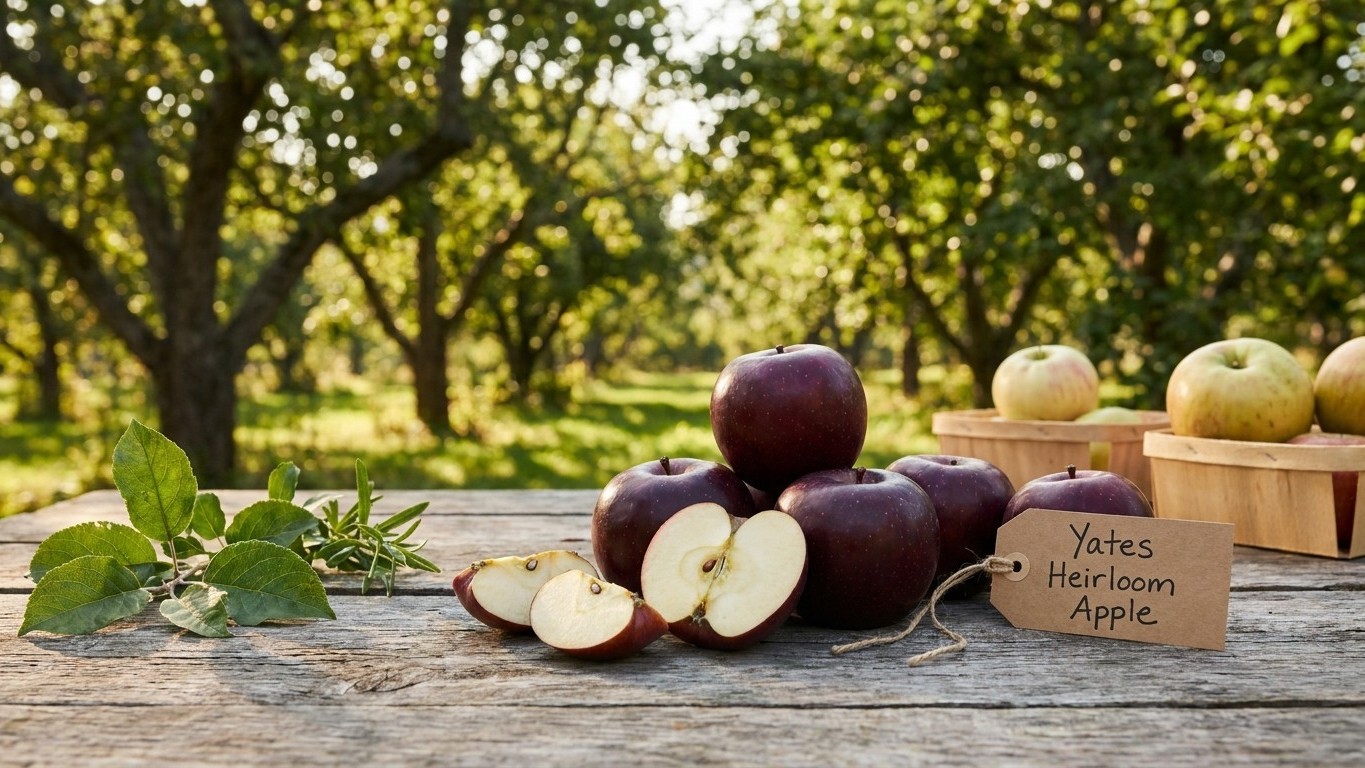

Yates is a small, richly flavored Southern heirloom apple documented by Clemson and University of Georgia extension services, and it needs a pollinator partner to produce well — but not just any partner. Some flowering-time matches, like the one with Mutsu, still leave the tree fruitless. Here’s what the tree actually gives you, and exactly which varieties belong beside it in the orchard.
What Yates actually is

Yates isn’t sold under an alias the way Mutsu goes by Crispin or Cripps Pink wears the Pink Lady name at the grocery store. What you get with Yates is what’s on the label: a Southern heirloom apple that Clemson Cooperative Extension’s HGIC 1350 variety table and the University of Georgia’s C740 publication both track as a garden and orchard variety with a distinct flavor profile rather than a marketing rebrand.
The eating quality, according to that same Clemson table, is juicy; mellow, sub-acid. That’s a middle-ground apple — not the sharp bite of a Granny Smith, not the flat sweetness some modern varieties lean into, but a rounded, gentle tartness that a lot of older Southern recipes were built around. Sub-acid apples like this tend to please people who find high-acid varieties too sharp for eating out of hand, while still holding enough tang to keep the flavor from going one-note.
Where Yates earns its keep, literally, is in storage. The Clemson HGIC 1350 table notes that it keeps exceptionally well in storage, which is a bigger deal than it sounds. Plenty of apples taste great off the tree and go mealy or bland within a few weeks in the crisper drawer. An apple rated for exceptional keeping holds its texture and flavor over a much longer stretch, which matters if you’re growing your own and don’t want to process the whole harvest into sauce and pie filling in a single weekend. It’s also the reason a dessert apple and a baking apple aren’t interchangeable in the first place: what determines whether an apple is worth stashing away for months is largely about how the flesh structure and acid level resist breakdown over time, not just how it tastes the day you pick it.
Will it grow where you are
This is where a lot of variety pages get sloppy, and it’s worth being direct about what’s actually documented. The Clemson HGIC 1350 and UGA C740 sources cited for Yates’s bloom group and pollination behavior do not publish a USDA hardiness zone range for this variety, and they don’t list a chill-hour requirement either. So rather than hand you a zone number that isn’t backed by those sources, the honest answer is: that figure is not published in the extension data this page draws from.
What the sourcing does tell you, indirectly, is which region this apple was bred for and is still recommended in. Both Clemson and the University of Georgia are Southeastern land-grant extension services, and their variety tables are built for growers in South Carolina, Georgia, and neighboring states with hot, humid summers and comparatively mild winters. A heirloom apple that shows up in that regional literature, rather than in Cornell’s or Michigan State’s cold-climate variety guides, is a strong signal that Yates belongs on the warmer, milder end of American apple country rather than the harsh-winter North.
Why chill hours matter even without a published number
Chill hours (the accumulated time a tree spends below roughly 45°F each winter) determine whether an apple variety will break dormancy and bloom properly in spring. Apples bred or long-grown in the Southeast generally need fewer chill hours than Northern varieties, because Southern winters simply don’t deliver as many cold hours to begin with. Without a published number for Yates, the practical move for a homeowner in the Deep South or mid-South is to treat it as a variety already proven in that climate by decades of extension-documented growing, and for a homeowner farther north to check with a local extension office before assuming it will perform the same way it does in Georgia or South Carolina.
What to plant beside it
Nearly all apple varieties crop better with a compatible partner nearby, and Yates is no exception. Clemson’s HGIC 1350 places Yates in bloom group B, meaning it flowers in the earlier-to-mid part of the bloom sequence relative to other apples in the same table. Remember that bloom group is a relative order, not a calendar date: in a warm Georgia spring, group B might bloom in late March, while the same group blooms weeks later in a cooler pocket of the same state. What stays fixed is the order in which varieties open their flowers relative to each other.
According to the same source, Yates can be pollinated by:
- Fuji
- Gala
- Ginger Gold
- Granny Smith
- Jerseymac
- Mollie’s Delicious
- Red Delicious
Plant any one of those within bee-flying distance (a nearby yard often counts, but the same property is more reliable) and you’ve got the makings of a fruitful pair.
The Mutsu trap
Here’s the exclusion that catches people out. Mutsu flowers at the same time as Yates, matching it in bloom timing well enough that a grower might assume the two will pollinate each other. They won’t. Mutsu produces sterile pollen, which means it can accept pollen from a compatible partner and set its own fruit, but it cannot supply usable pollen to any other tree, Yates included. Plant only these two together and you’ll get a lovely, synchronized bloom and no apples on either tree. If Mutsu is already in the yard, it needs its own separate pollinator, and Yates still needs one of the seven varieties listed above, which is why a three-variety planting (or a neighbor’s tree covering the gap) solves the problem that two varieties alone cannot. For the fuller mechanics of bloom groups, self-fertility, and which pairings actually work across different apples, see our guide to apple pollination.
| Variety | Blooms with Yates | Can pollinate Yates |
|---|---|---|
| Mutsu | Yes | No (sterile pollen) |
| Fuji, Gala, Ginger Gold, Granny Smith, Jerseymac, Mollie’s Delicious, Red Delicious | Compatible timing | Yes |
Growing it well
The Clemson and UGA sourcing used for Yates’s pollination and eating-quality data doesn’t include a fire blight rating for this variety, so rather than assign one, it’s worth saying plainly: that specific rating is not published in the sources this page relies on. What that means in practice for a grower is that fire blight risk should be managed the way it’s managed for any apple in a warm, humid climate, since fire blight is a bacterial disease that thrives in exactly the wet spring conditions common across the Southeast where Yates is typically grown.
That general management looks the same no matter the variety’s specific susceptibility: prune out and destroy any blackened, wilted “shepherd’s crook” shoots as soon as they appear, disinfect pruning tools between cuts during an active outbreak, and avoid heavy nitrogen fertilization, which pushes the soft, vulnerable new growth that fire blight bacteria infect most easily.
Habit, bearing pattern, and thinning
The sourced extension tables don’t rate Yates for biennial bearing tendency (the habit some apple varieties have of producing a heavy crop one year and almost nothing the next) or spell out a specific thinning schedule for this variety. Since that data isn’t published here, the safer approach for a home grower is the standard practice recommended for apples generally: thin developing fruit clusters down to one or two apples per cluster once they’re roughly the size of a marble, spacing remaining fruit about 6 inches apart along the branch. This reduces the physical strain of a heavy crop, which is one of the mechanical triggers that can push a tree toward biennial bearing in the first place, and it also produces larger, better-formed fruit at harvest.
One more variable that shapes how a Yates tree behaves in the landscape has nothing to do with the variety itself: rootstock. The scion (the Yates variety grafted onto the roots) determines flavor, bloom timing, and pollination needs, but the rootstock determines how tall and wide the mature tree gets, from dwarf trees that top out under 10 feet to full-size standards that can reach well over 20. Any nursery or extension source should specify the rootstock alongside the variety, since a mature height claim without a named rootstock isn’t a useful number.
Picking it and keeping it
The cited sources for this page don’t give a specific calendar harvest window for Yates, so instead of guessing at a date, lean on the methods that work across nearly all apple varieties to tell you the fruit is actually ready, regardless of what the calendar says. The most reliable is the lift-and-twist test: cup the apple in your palm, lift it gently upward, and give it a slight twist. A ripe apple separates from the spur with almost no resistance. If you have to tug or pull, it isn’t ready yet.
Two other signals back that up. Cut open a sample apple and check the seeds: pale or greenish seeds mean the fruit is still immature, while brown to dark-brown seeds signal the apple has finished ripening. Ground color (the base color of the skin, visible under any red blush) shifting from a hard green to a softer yellow-green is another cue that the fruit is nearing peak ripeness, since the base color change reflects the breakdown of chlorophyll that happens as an apple matures.
Once picked, the payoff is exactly what the Clemson table promises: Yates keeps exceptionally well in storage. For a homeowner without commercial cold storage, that generally translates to the apple holding up longer than average in a refrigerator’s crisper drawer or a cool basement or root cellar, since a home grower rarely has access to the precise temperature and humidity control described in academic storage trials. The exact number of storage months isn’t specified in the sourced material, but “exceptionally well” placed on a table alongside other, less durable varieties is a meaningful distinction for anyone planning to stretch a home harvest across the winter rather than eating it all in the first few weeks.
Common questions
Can a single Yates tree produce apples on its own?
Nearly all apple varieties, Yates included, crop far better with a compatible pollinator nearby. A lone tree may set a light, unreliable crop at best.
Is Yates the same apple as Crispin or Cripps Pink?
No. Unlike Mutsu (also sold as Crispin) or Pink Lady (also sold as Cripps Pink), Yates is not documented under an alternate market name in the extension sources cited here.
Does planting Mutsu next to Yates solve the pollination problem?
No. Mutsu blooms at the same time as Yates but produces sterile pollen, so it cannot pollinate Yates or any other variety. A third, pollen-producing variety is needed.
What does bloom group B actually tell me?
It places Yates in the earlier-to-mid part of the relative flowering sequence compared with other apple varieties in the same table, not a fixed calendar date.
Why does Yates store better than some other apples?
The Clemson HGIC 1350 table rates its storage as exceptional, which reflects flesh and acid characteristics that resist the softening and flavor loss that shorter-keeping varieties show within weeks.