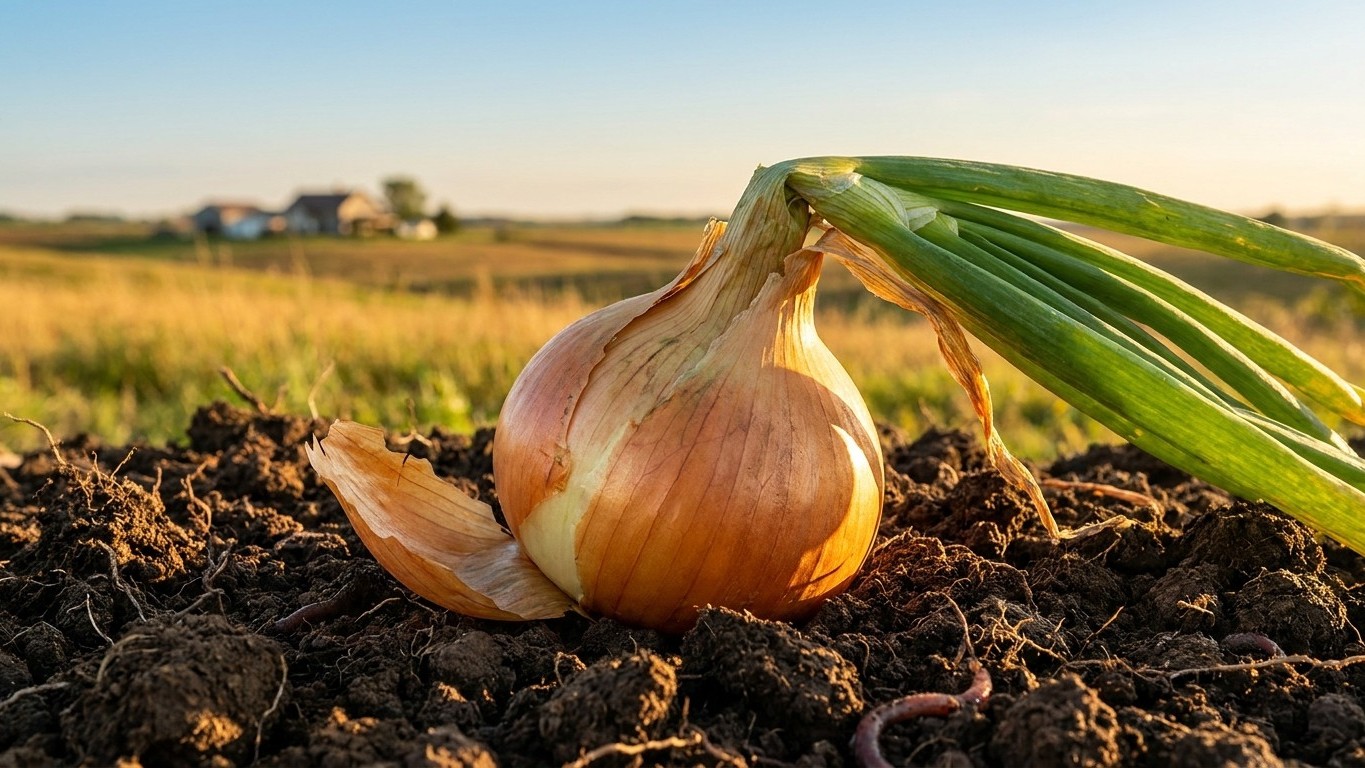

Patterson is a long-day onion, which means it only forms a proper bulb north of roughly the 38th parallel. Plant it in the wrong region and you get healthy green tops all season long, then a soft, rotten mess where a bulb should be. Here’s what decides whether this variety belongs in your garden, and what to expect if it does.
Will Patterson bulb where you are

Patterson falls into the long-day group, and that single fact matters more than soil type, fertilizer schedule, or planting date combined. Long-day onions need somewhere between 14 and 16 hours of daylight to trigger bulb formation, and that kind of daylight only shows up in northern latitudes during the growing season. The catalogue range for Patterson runs from 38 to 55 degrees north latitude, which covers a broad swath of the northern United States: think Kansas, Nebraska, Iowa, Ohio, Pennsylvania, and up through the northern tier into Minnesota, Wisconsin, Michigan, and New England.
Here’s the part that trips up a lot of home gardeners: bulbing has nothing to do with heat. It’s triggered by hours of daylight, not by warm soil or a stretch of 90-degree afternoons. That’s counterintuitive because we tend to associate onions, like most vegetables, with summer warmth. But an onion plant is reading the calendar through its leaves, measuring how long the sun stays up, and it doesn’t start swelling a bulb until that daylight threshold is crossed. The far north actually gets more summer daylight than the south, which is exactly why long-day varieties like Patterson are built for northern gardens and short-day varieties are built for the Gulf Coast and the Deep South.
Plant Patterson in Georgia or South Louisiana and the plant will grow lush, healthy foliage right up until fall, because the days there never stretch long enough to flip the bulbing switch. No small bulb forms as a consolation prize. No bulb forms at all. What you’re left with is a thickened stem, watery tissue, and a plant that either bolts or simply sits there until it succumbs to rot in storage, because there was never a bulb to store in the first place.
If your garden sits close to that 38-degree line, southern Virginia, southern Missouri, northern Oklahoma, you’re in a blurred zone rather than a clear yes or no. The variety may bulb, but results can be inconsistent from year to year depending on how the season’s daylight and weather line up. Gardeners in that in-between band should treat Patterson as an experiment worth trying in a small bed first, not a variety to bet the whole onion patch on.
What Patterson is like
Assuming your latitude checks out, here’s what you’re actually growing. Patterson produces a yellow-skinned bulb, the classic storage-onion look most home cooks picture when they hear the word “onion.” The details worth knowing at a glance:
- Color: Yellow
- Days to maturity from transplant: 104
- Flavor: Sharp
- Keeping time: 6+ months
That 104-day window from transplant to maturity puts Patterson solidly in the mid-to-late season category, so gardeners need to plan planting dates with that full stretch of time in mind, not just count from seed.
The flavor and storage trade-off
Patterson is sharp, not sweet, and that’s not an accident of breeding, it’s chemistry. The same sulfur compounds that make an onion bite your tongue and sting your eyes are the compounds that protect the bulb’s cell structure once it’s sitting in a basket in your pantry. Sweet onions, the ones bred to be mild enough for raw slices on a burger, carry less of those sulfur compounds, and that’s precisely why they go soft and start sprouting within a few weeks of harvest.
Patterson sits at the other end of that spectrum. It won’t be the onion you want raw in a summer salad, but it’s the onion still solid on your counter in February when the sweet varieties from the same garden are long gone. There’s no version of this variety that gives you both a mild raw bite and a six-month shelf life. The chemistry doesn’t allow for a sweet onion that also keeps, and no seed catalogue can breed around it, at least not without giving up one trait for the other.
When to plant it
Planting timing follows directly from that day-length group, and it’s one of the most misunderstood parts of onion growing. Short-day onions, the varieties suited to the Deep South, actually go into the ground in autumn, overwinter as small plants, and get harvested the following late spring. That schedule works because short-day types only need about 10 to 12 hours of daylight to bulb, a threshold the South reaches early in the growing season.
Patterson, as a long-day variety, runs on the opposite calendar. It gets planted in late winter to early spring, timed so the plant has a full stretch of the growing season to build size before the long days of early summer arrive and flip the bulbing switch. Gardeners in the northern half of the country should be starting transplants or setting sets in the ground as soon as soil is workable, often while there’s still frost risk overnight, because onion seedlings tolerate cold far better than heat.
The size test that matters more than the calendar
A specific planting date matters less than a specific condition: the plant needs enough leaf growth before day length triggers bulbing. Here’s why that detail overrides everything else. Once the daylight threshold hits, the plant essentially decides “it’s time” and starts diverting its energy from growing more leaves into swelling the bulb. Whatever size the top growth has reached at that exact moment is roughly what determines final bulb size, because each leaf corresponds to a ring in the mature onion.
A plant that’s still small and spindly when the trigger hits will make a small onion, full stop, no matter how much you fertilize or water it afterward. That’s why the real planting goal for Patterson isn’t hitting a specific date on a calendar, it’s getting seedlings or sets into the ground early enough that they’ve built substantial leaf growth before the long days of June arrive. Gardeners who plant late and expect a normal harvest are often disappointed by undersized bulbs, and this size-before-trigger mechanism is almost always the reason.
Growing it well
Onions have a shallow, sparse root system, and that single fact explains most of what goes wrong in an onion bed. Because the roots don’t reach deep or spread wide, onions are lousy competitors against weeds. A patch that gets weedy in June won’t necessarily look stressed above ground, but the bulbs coming out of the ground in August will be noticeably smaller, because every bit of water and nutrient a weed pulls from that shallow root zone is water and nutrient the onion never gets.
The same shallow-root problem applies to moisture. Onions can’t send roots down to chase water the way a tomato or a squash plant can, so dry stretches during bulb formation show up directly as smaller bulbs, not as wilted leaves you’d notice and correct in time. Consistent soil moisture through the bulbing stage isn’t a nicety, it’s the difference between the mature-size bulb the catalogue promises and a fist-sized disappointment.
Watch for bolting
Bolting is the other thing to watch closely. A stressed onion plant, whether from a cold snap, a dry spell, or crowding, can respond by sending up a flower stalk instead of putting that energy into the bulb. Once a plant bolts, the bulb underneath it is essentially finished growing and won’t cure or store properly; the core tends to turn woody and the neck stays thick and green rather than drying down. Any bolted plants in the row should be pulled and used first, right away, rather than tossed into the storage basket with the rest of the harvest, because they’ll be the first to spoil and can bring rot to bulbs stored alongside them.
Harvesting and keeping it
The onion tells you when it’s ready, no calendar required. Tops fall over on their own, flopping down from the neck as the plant shifts out of active growth and into dormancy. That collapse is the signal to harvest, not a date circled weeks in advance. Pulling bulbs before the tops fall usually means bulbs that haven’t finished sizing up; letting them sit for weeks after the fall-over doesn’t gain much and can invite rot from wet soil.
Curing is the step that separates onions that make it to spring from onions that turn to mush in the pantry by Thanksgiving, and it’s the step most home gardeners skip or rush. The bulb’s neck needs to dry down completely, from a thick, moist tube into a papery, tissue-thin seal, before the onion goes into long-term storage. Skip that drying period and moisture stays trapped right where bacteria and rot organisms get their foothold.
The sequence, from field to pantry, runs like this:
- Watch the tops. When they fall over on their own, the bulbs are mature and it’s time to lift them.
- Pull or dig the bulbs carefully, avoiding bruises or cuts to the skin.
- Lay bulbs out in a warm, dry, well-ventilated spot, out of direct rain, for one to two weeks.
- Check the necks. They should be dry and papery, not soft or green, before moving on.
- Trim tops and roots once cured, then store in a cool, dry space with good airflow.
Given Patterson’s 6+ month keeping time, a properly cured harvest bought in late summer should still be sound going into the following spring. That’s a meaningful difference from onions that keep three months and get eaten in the fall, right through the season they’re picked. A six-month keeper means the household is still cooking off last summer’s onion patch when the seed catalogues for next year start arriving in the mailbox.