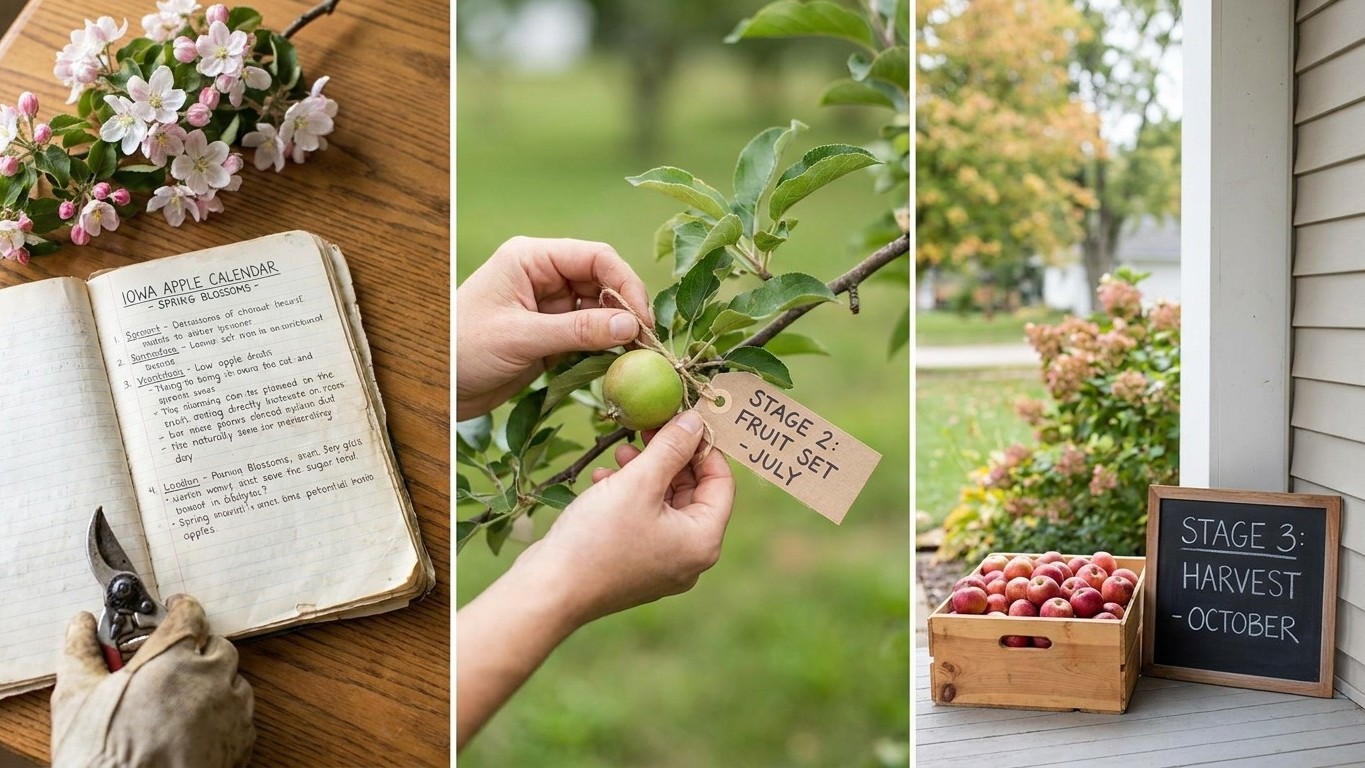

Iowa’s apple calendar runs on frost, not on the month printed on a seed catalog. At the Des Moines reference station, NOAA’s 1991-2020 climate normals put the last spring freeze between April 12 and April 24 and the first fall freeze between October 14 and October 25, and every pruning, spraying, and picking decision in between hangs off those two windows. Check your tree’s bud stage against the calendar below before you spray, feed, or prune, rather than going by a date on the wall.
The short answer for Iowa
You’re standing there wondering when it’s actually safe to prune, spray, or pick — and the answer isn’t a date on the wall, it’s what your tree’s buds are doing right now. In central Iowa, that means working around two fixed points: a last spring freeze that typically falls between April 12 and April 24, and a first fall freeze between October 14 and October 25. Go out and check your tree’s bud stage today — dormant, green tip, pink, or bloom — before you touch it with a pruning saw, a sprayer, or a picking bag.
What that answer depends on is where you garden relative to Des Moines. The NOAA figures come from one airport station, and Iowa State Extension’s longer county-level record, built from 1950-2021 data, runs about four days later in spring and ten days earlier in fall than that station. That means a grower outside the Des Moines metro should treat the airport dates as the optimistic edge of the window, not the middle of it, and lean toward the later spring date and the earlier fall date when deciding whether it is safe to act.
The other variable is the tree itself. Winter survival and flowering are governed by two separate things: cold hardiness, which is whether the wood and buds survive the coldest night of the year, and chill accumulation, which is whether the tree has banked enough cold hours to break dormancy and bloom evenly. Des Moines averages a mean daily minimum of 14.3°F in its coldest month, per NOAA’s 1991-2020 climate normals, which is cold enough to rule out apple cultivars bred for mild-winter regions regardless of how well they’d handle the chill side of the equation.
Working through it

The calendar below moves stage by stage, because the stage is what decides the risk on any given day, not the date on the wall. A warm March can push a tree to green tip two weeks ahead of a cold one, and the tree does not know or care what the calendar says. What it cares about is whether a freeze arrives while it is at a tender stage.
Dormancy

This is the safest stage for the tree and the only stage that tolerates real cold. Des Moines’ coldest month averages a mean daily minimum of 14.3°F, per NOAA’s 1991-2020 normals, and dormant wood on a hardy cultivar shrugs that off without injury. This is the window for structural pruning: remove crossing limbs, open the center for light, and cut out any wood damaged the previous winter. Prune here, not later, because a cut made once sap is moving invites disease and slows healing.
Green tip

Bud scales split and a sliver of green shows through. The tree has started spending stored energy and can no longer shrug off a hard freeze the way it could a month earlier. If green tip arrives before the April 12 to April 24 window has closed at the Des Moines reference point, the tree is exposed to frost risk earlier than the normal calendar would suggest, and a grower elsewhere in the state should assume that exposure lasts even longer given Iowa State Extension’s later spring figure.
Pink

Flower buds show full color before opening. This stage still tolerates more cold than an open bloom does, but a freeze that would leave dormant wood untouched can now damage the developing flower parts inside. It is also the last practical point to apply a dormant-style disease spray before bloom draws pollinators.
Bloom

Open flowers are the least frost-tolerant stage in the whole calendar, and bloom for most apple cultivars in central Iowa tends to land inside or just after the NOAA last-frost window. A freeze that arrives during open bloom can wipe out the flowers a tree needs to set that year’s crop entirely, which is why the spring frost date matters more here than in almost any other stage.
| Stage | Frost sensitivity | What to do |
|---|---|---|
| Dormancy | Low, tolerates hard cold | Structural pruning |
| Green tip | Rising | Watch forecasts, hold off feeding |
| Pink | Moderate | Last window for pre-bloom disease spray |
| Bloom | Highest | Protect if a late freeze is forecast |
| Petal fall | Still elevated | Thin if fruit set is heavy |
| Fruit set | Low | Support heavy limbs, monitor for pests |
| Harvest | Rising again toward fall freeze | Pick before the first fall freeze window |
Petal fall and fruit set


Petals brown and drop, leaving a small green fruitlet behind. Natural thinning, often called June drop, follows a few weeks later as the tree sheds fruit it cannot support. By full fruit set the frost risk has largely passed for the season, and the work shifts to thinning overloaded clusters and watching for the first pest and disease pressure of the growing season, a topic covered in full in Growing Apples in Iowa.
Harvest
Maturity timing depends entirely on the cultivar, not on a fixed date, and ranges from late summer types to ones that hang into mid-fall. The hard limit is the first fall freeze, which NOAA’s 1991-2020 normals put between October 14 and October 25 at Des Moines, and growers further from that station should plan on the earlier end given Iowa State Extension’s finding that county freeze dates run about ten days earlier than the airport figure. Fruit still on the tree when a hard freeze hits can be damaged for storage even if it looks fine on the branch.
What changes across Iowa
The NOAA figures above come from one station near Des Moines, and Iowa is wide enough that conditions elsewhere run noticeably different. Northern Iowa counties along the Minnesota border sit at a higher latitude and, per Iowa State Extension’s longer county record, see a growing season that starts later in spring and ends earlier in fall than the Des Moines figures suggest, shortening the whole calendar by roughly two weeks at each end.
The Driftless Area in the northeast corner of the state, the unglaciated hill country along the Mississippi River, adds another layer on top of latitude. Its steep valleys let cold night air pool at the bottom of slopes while the ridges above stay several degrees warmer, so a tree planted low in one of those valleys can take frost damage on a night when a tree on the ridge above it does not. This is a site issue as much as a regional one, and it shows up on a much smaller scale than county lines.
Southern Iowa, closer to the Missouri border, generally trends milder than the statewide average and closer to the Des Moines figures than the northern counties do, though still subject to the same later-spring, earlier-fall adjustment Iowa State Extension’s data applies statewide relative to the airport station. Low ground anywhere in the state, along the Des Moines River, the Iowa River, or the Missouri River bottoms, collects cold air overnight the same way the Driftless valleys do, so a bottomland orchard can run colder on a still, clear night than a hillside orchard a mile away regardless of which part of the state it’s in.
None of this means apples can’t be grown in the colder parts of Iowa. It means the grower there should treat the Des Moines dates as a starting point, shift both frost windows toward the extension service’s wider figure, and choose a planting site on a slope rather than in a low pocket wherever the land allows it.
The mistakes this climate punishes
Iowa’s calendar leaves a narrow enough margin that a handful of specific mistakes show up as a lost crop rather than a minor setback.
- Blooming into the frost window. A cultivar that flowers early can open its blossoms before the last spring freeze has cleared, and Iowa State Extension’s county data suggest that window can run later than the Des Moines airport dates imply. When it does, an open bloom takes the full force of a freeze that a still-closed pink bud would have shrugged off.
- Pruning after growth starts. Cuts made once a tree has moved past dormancy into green tip heal more slowly and push the tree into a more vulnerable state right as frost risk is still on the table. This shows up as dieback around the cut and a burst of over-vigorous water sprouts by early summer.
- Feeding too late in the season. Nitrogen applied in mid or late summer pushes soft new growth that has not hardened off by the time the first fall freeze arrives between October 14 and October 25 at Des Moines, per NOAA’s normals. That soft growth is the first tissue to die back, and the damage often isn’t visible until the following spring when those shoots fail to leaf out.
- Choosing hardiness on faith instead of checking it. A cultivar bred for a milder winter than Des Moines’ 14.3°F mean daily minimum in the coldest month, per NOAA’s 1991-2020 normals, risks trunk and bud damage in an ordinary Iowa winter, not just an unusually hard one. The gap between what a catalog calls “cold hardy” in a mild-winter nursery region and what survives here is exactly where this mistake shows up, and it’s worth checking the realistic options laid out in The Best Apple Varieties for Iowa before planting.
Checking this against your county
Every date on this page is measured at one station near Des Moines, and NOAA’s own caution notes that Iowa State Extension’s county-level record, built from 1950 through 2021, runs about four days later in spring and ten days earlier in fall than that station. A grower elsewhere in the state should not assume the Des Moines dates apply directly.
Iowa State University Extension and Outreach maintains county-specific offices and horticulture staff who can supply the frost record for the exact county an orchard sits in, along with soil and pest information specific to that area. That local figure, not the statewide average, is the one worth planning a spray or harvest schedule around.
Common questions
Does an apple tree in Iowa need a second tree nearby to set fruit?
Most apple cultivars need pollen from a different variety to set a full crop, so a single isolated tree often blooms well but sets little fruit. Planting two different cultivars that bloom at overlapping times, or having a neighbor’s tree or a wild crabapple within bee range, usually solves it.
What happens if my tree blooms before the frost is done?
Open blossoms hit by a freeze can be damaged enough to prevent fruit set on that flush, though a tree in full bloom rarely loses every flower cluster at once, especially if some buds are still at the pink stage and haven’t opened yet. A light crop the following fall is more common than a total loss, but it depends on how hard and how long the freeze runs.
Is it too late to prune if the buds have already started swelling?
Light pruning, like removing a damaged or crossing limb, is still fine at green tip. Heavy structural pruning is better done earlier, while the tree is fully dormant, because the tree is now spending energy on new growth and larger wounds heal more slowly once that has started.
Why are my apples dropping before I even get to harvest?
Some fruit drop a few weeks after fruit set is normal. This natural thinning removes fruit the tree cannot support and is not a sign of disease or poor care on its own. Heavy drop right before harvest is different and usually points to a stress like drought or a pest problem rather than normal thinning.