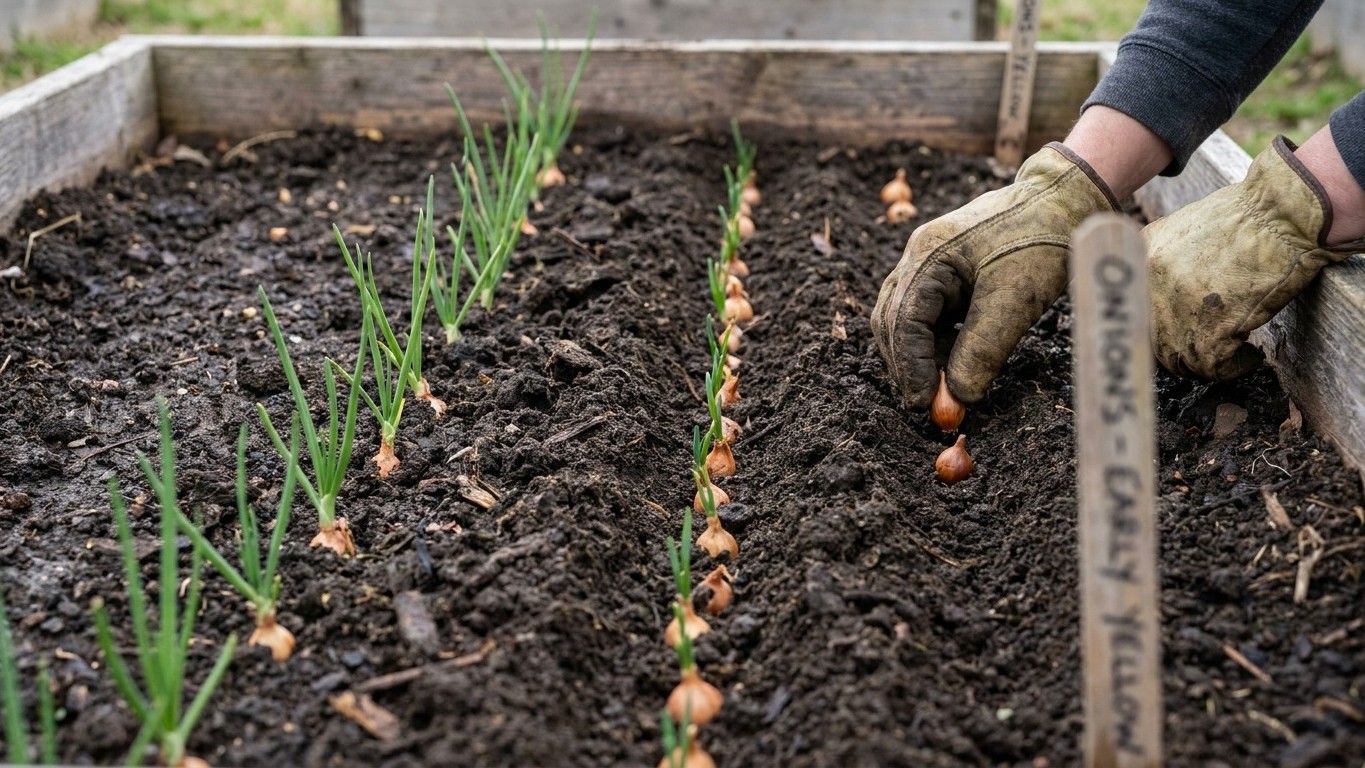

Maryland gardeners get two different answers depending on where they live: fall planting for overwintering onions near the Chesapeake, and a late-winter-to-early-spring window inland and to the west. The dividing line isn’t the calendar. It’s day length, measured against the state’s own latitude of 39.17 degrees north, where the longest day of the year runs 14 hours and 45 minutes.
The short answer for Maryland

Start with what the sun is doing over Maryland, because onions don’t count days on a calendar the way tomatoes do. They count hours of daylight. At 39.17 degrees north, the summer solstice delivers 14 hours 45 minutes of daylight, a figure calculated from the same coordinates used for this page’s climate data. That number is the trigger. Once day length crosses a variety’s bulbing threshold, the plant stops building leaves and starts building a bulb, whether or not it’s ready.
For most of Maryland, that means planting onion transplants or sets in late winter to early spring, roughly February into April depending on how far inland or upland you sit. The goal is to get as much leafy growth as possible into the plant before the days get long enough to flip the switch to bulbing. In the milder, more coastal corners of the state, especially near the Chesapeake Bay and the Eastern Shore, gardeners can also plant certain onions in fall, letting them overwinter as small plants and resume growth in spring with a head start nobody further inland gets.
Why does the same state need two different answers? Because winter severity varies more across Maryland than most residents assume, and an onion planted in October needs mild enough conditions to survive as a juvenile plant rather than freezing out. Western Maryland’s mountain counties see harder freezes and later thaws than the tidewater counties two hours away by car. That’s a climate difference, not a day-length difference. Day length at the solstice barely moves across the state. But whether a fall-planted onion lives through January is a completely separate question, and it’s the one that decides whether fall planting is even on the table where you live.
So the short answer splits in two: fall planting for overwintering, where winters allow it, and late-winter-to-early-spring planting everywhere else, timed so the plant has bulked up as much as possible before the 14-hour-45-minute mark arrives in June. Get the timing wrong in either direction and the plant pays for it, which is exactly what the next section covers.
What will not work here
Planting an onion transplant too late in Maryland does not delay the harvest. It shrinks it. Whatever size the plant has reached when day length crosses its bulbing threshold is roughly the size of bulb you’ll get, permanently. A transplant that goes into the ground in May instead of March doesn’t catch up later in the season. It simply arrives at bulbing time smaller, and a small plant makes a small bulb, full stop. There’s no second window, no do-over once the daylight clock trips the switch.
The same mechanism rules out entire varieties regardless of when you plant them, because Maryland’s day length either never triggers their bulbing or triggers it while the plant is still tiny. These are documented mismatches for a latitude of 39.17 degrees north:
- Powell (long-day, rated for 43-47°N): the day here never gets long enough to trigger bulbing; the plant makes leaves, then rots, with no bulb at all.
- Redwing (long-day, rated for 43-65°N): same failure, day length tops out too far short of what this variety needs.
- Safrane (long-day, rated for 42-50°N): built for latitudes north of Maryland’s; it will not receive the trigger it needs here.
- Talon (long-day, rated for 42-50°N): another northern long-day variety that simply never bulbs at 39.17°N.
- Gabriella (short-day, rated for 20-35°N): triggers bulbing here while the plant is still small, giving tiny onions rather than no onions.
- Madalyn (short-day, rated for 20-35°N): same short-day mismatch, bulbs too early on a plant that hasn’t finished growing.
- Red Rock (short-day, rated for 30-36°N): built for latitudes south of Maryland; bulbing kicks in prematurely.
Notice the difference between the two failure modes. Plant a long-day variety rated for the far north and you get healthy-looking foliage all summer, then nothing where a bulb should be, sometimes followed by rot as the plant finally gives up. Plant a short-day variety meant for the Deep South and you get an actual bulb, just a small one, because the plant barely got started before day length told it to stop growing leaves. Neither is a feeding problem or a watering problem. It’s a variety mismatch that no amount of fertilizer fixes.
What changes across Maryland
Maryland is not one latitude, and the 39.17-degree figure driving the calculations above belongs to a single reference station, not to the whole state. Maryland runs from roughly 37.9 degrees north at its southern tip near the Virginia line to about 39.7 degrees north along the Pennsylvania border, a spread of nearly two full degrees. That’s enough to shift both the planting window and, at the margins, which onion varieties make sense.
| Location | Approximate latitude | What it changes |
|---|---|---|
| Northern Maryland (near the PA line) | ~39.7°N | Slightly longer solstice daylight than the reference figure; plant transplants toward the later end of the spring window, and fall overwintering becomes riskier. |
| Southern Maryland / Eastern Shore | ~38.0°N | Slightly shorter solstice daylight; milder winters extend the fall-planting option and can shift the whole spring calendar up to two weeks earlier than the reference station. |
A gardener in Garrett County, up in the state’s mountainous panhandle, is dealing with a different growing season than one in St. Mary’s County near the water, even though both are technically “Maryland.” The panhandle sees harder frosts and a shorter frost-free stretch, which argues for spring planting only and a later start than the reference figures suggest. The southern counties, buffered by the Chesapeake and the Atlantic, can push both ends of the calendar, planting earlier in spring and, in some years, getting away with fall planting that would fail further inland. None of this changes the day-length trigger much. It changes the survivable window around it.
Sweet now, or onions that last
Maryland’s day length lands it in intermediate-day territory rather than firmly in the sweet, short-day camp or the pungent, long-day camp, and that’s not a small distinction. According to University of Missouri Extension, sweet onions do not store as well as more pungent types, because the same volatile sulfur compounds that give an onion its sharp bite are also what protect the bulb during storage. Fewer sulfur compounds means a milder onion on the cutting board today and a softer, shorter shelf life in the pantry.
That chemistry lines up with day length. Short-day varieties, built for the South, tend to run sweeter and store the shortest. Long-day varieties, built for the North, run more pungent and keep for months. Maryland’s intermediate position means most of its documented, viable varieties split the difference: onions like Cabernet, Candy, Scout, and Elsye trade some sweetness for better keeping than a true Southern sweet onion, without matching the storage life of a hard Northern keeper like Ailsa Craig or Patterson.
What that means for a Maryland pantry in March depends on what you planted. A bed of Candy or Sierra Blanca eaten fresh through late summer and fall won’t still be sitting on the shelf come winter, and that’s fine if fresh eating was the point. A bed of long-day keepers like Rossa di Milano or New York Early, both viable at this latitude, gives you the opposite deal: less sweetness in July, but onions still sound in March. There’s no variety that gives both. The trade is built into the chemistry, not the marketing on the label.
Checking this against your own garden
Every figure above comes from a single reference point at 39.17 degrees north, and Maryland’s real gardens sit anywhere from roughly 37.9 to 39.7 degrees. Before locking in a planting date or a variety, a few checks take less than an hour and matter more than anything in this article:
- Look up your own latitude if you’re near either edge of the state, since a degree or more of difference shifts both the planting window and which day-length group makes sense.
- Confirm your local average last frost date, which varies by weeks between the mountains and the coast even within Maryland.
- Call or check the website of your county’s Cooperative Extension office, which tracks local frost data and variety performance far than any statewide figure can.
- Check the day-length rating printed on any onion transplants or sets before buying, comparing it against the varieties named above rather than assuming any onion works anywhere.
- If you’re considering fall planting, ask your extension office whether overwintering onions has a track record in your specific county, since that’s a climate question, not a day-length one.