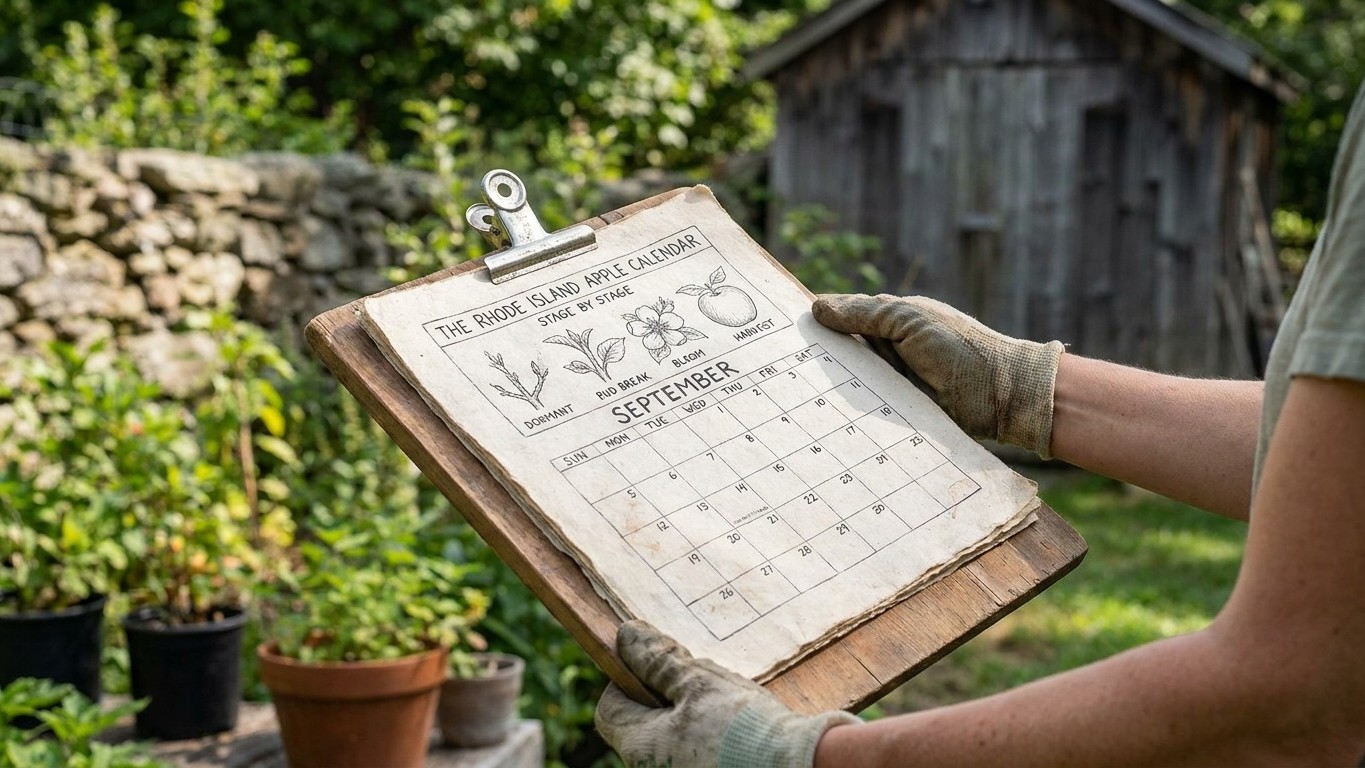

Rhode Island’s apple calendar runs on the tree’s own growth stages, not a fixed date on the wall. The frost windows that bracket the whole season come from NOAA’s 1991-2020 climate normals for the Providence reference station: last spring frost April 7 to April 17, first fall frost October 24 to November 3. Check your tree’s bud stage against that window before you spray, prune hard, or plan a pick date, rather than trusting the calendar month.
The short answer for Rhode Island
Twenty-one degrees Fahrenheit is the average January low in Providence, and it’s tempting to treat that single number as the whole answer to when apples are safe here. It isn’t. A tree’s bud stage, not the thermometer and not the date circled on a nursery tag, decides whether a given cold snap does damage. Dormant wood shrugs off cold that would blacken an open blossom outright, so the real calendar lives on the branch, one swelling bud at a time.
That short answer depends on three things: which cultivar is in the ground, how far the orchard sits from Providence, and how cold that particular winter runs. Rhode Island’s coldest month averages a mean daily minimum of 21°F at the Providence station, per NOAA’s normals, cold enough to rule out any cultivar bred for mild-winter regions, but comfortably within range for the mid- and high-chill apples sold through Northeast nurseries. The bud stage on the tree, not the date on the calendar, is what should drive every decision from here. If you’re still deciding what to plant, growing apples in Rhode Island starts with matching a cultivar’s bloom timing to this frost window before the tree goes in the ground, not after the first frost has already made the decision for you.
Working through it

Each stage carries its own frost tolerance, and that tolerance is what should set your calendar, not the month printed on a seed catalog.
Dormancy through green tip
Dormant wood is the toughest the tree will be all year. This is the stage for structural pruning, before sap starts moving and before green tip appears at the bud. Green tip itself, the first flush of visible green at the tip of the bud, usually shows up well ahead of Providence’s April 7 to April 17 frost window, and buds at this stage still shrug off temperatures well below freezing. Dormant oil or copper applications, where used, are timed to land at or just before green tip, while the canopy is still open enough for the spray to reach the bark.
Pink through petal fall
Pink is the stage where blossom color becomes visible before the petals actually separate, and it’s the stage where Rhode Island’s spring frost window starts to matter most. In many years pink and full bloom land right inside or just after Providence’s April 7 to April 17 window, which makes open blossoms the single most frost-sensitive point in the whole calendar. Petal fall, when the spent petals drop and tiny fruitlets appear, brings some relief: the fruitlets tolerate more cold than the open flower did, though a hard freeze can still knock a portion of the set on the ground.
Fruit set through harvest
Once fruitlets swell and the tree sheds its excess in the natural June drop, frost risk is effectively over for the season and the calendar shifts to fruit development and, later, to the fall frost window on the other end. Harvest timing depends entirely on the cultivar, and needs to finish before the first fall frost window opens on October 24 to November 3 in Providence, since fruit left hanging through a hard freeze softens and bruises fast.
| Stage | Signal on the tree | Frost exposure | What to do |
|---|---|---|---|
| Dormancy | Buds tight, wood fully hardened | None | Prune structure |
| Green tip | First green visible at bud tip | Very low | Last window for dormant sprays |
| Pink | Blossom color visible, petals still closed | Rising fast | Watch the forecast daily |
| Bloom | Petals open, pollinators active | Highest of the season | Avoid pruning, protect if a freeze is forecast |
| Petal fall | Petals dropped, fruitlets visible | Moderate | First cover sprays for disease |
| Fruit set | Fruitlets swelling, June drop underway | Low | Thin for size |
| Harvest | Fruit reaches mature color and size for the cultivar | Rising again toward fall | Pick before the fall frost window |
Cultivars stack the deck differently at the pink-through-bloom stage. Early-blooming cultivars flower before later ones and carry more exposure to a lingering spring frost, while late bloomers dodge that window but push harvest closer to the fall frost line. The best apple varieties for Rhode Island ranks cultivars by bloom timing and chill requirement, which is worth checking before you decide which stage-by-stage risk you’d rather carry.
What changes across Rhode Island
NOAA’s 1991-2020 normals come from the Providence airport station, and the rest of the state does not read the same thermometer. Sites away from pavement, and especially those inland or at higher elevation, typically see the last spring frost later and the first fall frost earlier than the Providence figures, often by one to two weeks or more where elevation is significant.
The hills of western Rhode Island, around Foster, Glocester and the Chariho area, sit higher and colder than Providence and tend to lag the spring frost date while leading the fall one, which compresses the whole growing season for an orchard planted there. An orchard in these hill towns should plan on a shorter effective window between last and first frost than the Providence figures suggest. The Blackstone Valley, running along the state’s northern border, is prone to cold air pooling on still nights, which can produce a late frost even after nearby higher ground has cleared.
The Narragansett Bay coast and Aquidneck Island, where Newport sits, are moderated by open water on both ends of the season, and orchards there often see fall’s first frost arrive later than the inland norm. Block Island, fully exposed to the Atlantic, runs milder still. None of this changes the tree’s own stage-by-stage logic, but it does mean a grower in the western hills should watch the pink and bloom stages with more caution than one on the coast, and should expect harvest to run earlier relative to the calendar than a coastal orchard growing the same cultivar.
The mistakes this climate punishes
The costliest mistake in this climate is planting an early-blooming cultivar somewhere the spring frost lingers late, especially in the western hill towns. An early bloomer such as Zestar! opens its flowers well ahead of later cultivars, and if that bloom lands inside a spring frost window that runs later than Providence’s April 7 to April 17 figure, the crop can be lost in a single cold night at the pink or bloom stage. A later-blooming cultivar such as GoldRush carries less of that risk but pushes harvest closer to the fall frost line instead, so the trade only moves the risk, it doesn’t remove it.
The second mistake shows up in early fall: feeding a tree nitrogen too late in the season keeps it pushing soft new growth right when it should be hardening off for winter. That soft growth is the first tissue damaged when the first fall frost arrives, and in a year when that frost lands on the early side of Providence’s October 24 to November 3 window, a late feeding can cost twigs and buds that would otherwise have carried next year’s crop.
The third mistake is letting fruit hang too long past maturity while waiting for a “better” week to pick. Fruit left on the tree past its cultivar’s maturity window softens fast and is the first thing damaged once temperatures drop toward the fall frost range, and a single hard freeze on fruit still hanging can turn a good crop to drops overnight. This shows up every year on late-season cultivars picked a week or two later than the catalog’s days-to-maturity figure would suggest, adjusted for the season’s actual weather.
Checking this against your county
The Providence figures are a reference point, not a guarantee for any specific yard. Before you commit to a bloom-timing decision or a pick date based on this calendar, check current conditions and local guidance through the University of Rhode Island Cooperative Extension, which can speak to conditions in your specific county rather than the airport station the NOAA figures are drawn from. Extension staff can also confirm which cultivars are performing well in your part of the state this season, since a mild winter or a wet spring can shift outcomes from what the long-term normals predict.
Common questions
How do I tell green tip from pink on my own tree?
Green tip is just a sliver of green showing at the very end of the bud, with the bud scales still mostly closed around it. Pink comes later, once the bud has opened enough that you can see the actual color of the unopened blossom before the petals separate.
My yard frosts later than the Providence date. Does that mean I can’t grow apples?
No. It means your bloom-to-frost math shifts later than the reference figures, not that apples are off the table. Choosing a slightly later-blooming cultivar, or simply watching the pink and bloom stages more carefully in a frost-prone yard, covers most of that gap.
Do I need two different apple trees to get fruit?
Most apple cultivars need pollen from a different cultivar blooming at the same time to set fruit well, so a single tree alone often disappoints. A crabapple or a second cultivar with overlapping bloom timing nearby solves this in most yards.
A frost hit my orchard while it was in full bloom. Is the crop gone?
Not necessarily. A tree in full bloom carries far more flowers than it needs for a full crop, so losing some blossoms to a light frost often still leaves enough for a normal harvest. A hard freeze at full bloom is the scenario that actually wipes out a crop, and the difference usually shows up within a day or two as damaged blossoms turn brown at the center.