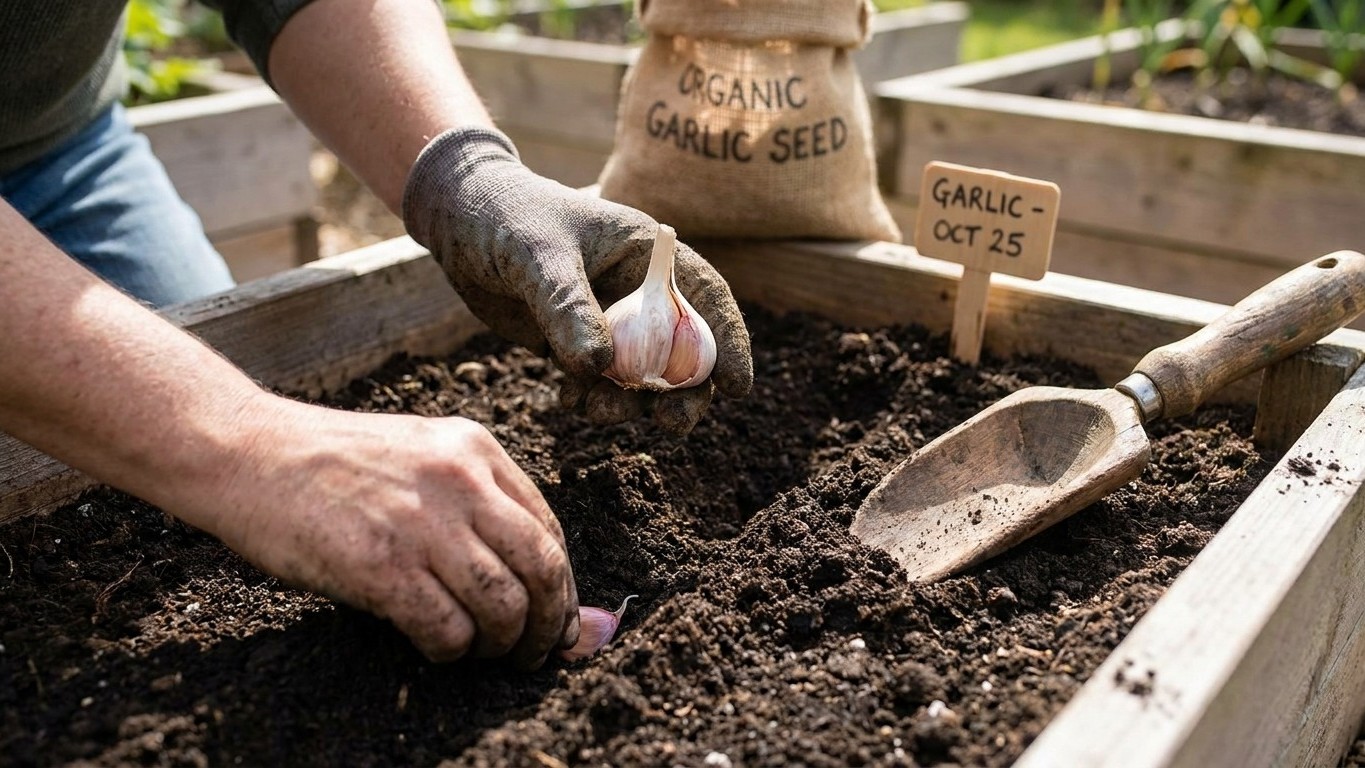

Plant garlic cloves pointed end up, roughly 2 inches deep, spaced 4 to 6 inches apart within the row and about 12 inches between rows. Getting the orientation wrong doesn’t kill the clove, but it forces the shoot to curl around and find its way up, which costs the plant weeks it can’t spare. Before you plant anything, separate a full bulb into individual cloves the day you plant, not weeks ahead, and leave the papery skin on each one.
Why this matters for garlic

Garlic is one of the few crops where a planting mistake in October doesn’t show up until the following summer. You put a clove in the ground, walk away for nine months, and only find out at harvest whether the depth, spacing, and orientation were right. There’s no fixing a bad start in February. By then the root system is already set and the bulb is already forming whatever size it’s going to form.
Plant too shallow and the clove is vulnerable to being pushed out of the soil by repeated freeze-thaw cycles over winter, a problem called frost heave. You won’t see it happen. You’ll see the result in late winter or early spring, when a clove that should be rooting quietly is instead sitting half-exposed on top of the bed. Plant too deep, or crowd cloves too close together, and the plant survives just fine. It simply produces a smaller bulb, because garlic bulb size is largely a function of how much root space and sunlight each plant gets. The bulb you harvest in summer is a direct record of the spacing decision you made in fall.
Orientation matters for a similar reason. A clove planted point-down or on its side will still sprout, but the shoot has to curve back on itself before it can head upward, and that detour delays emergence. In cold climates, a few lost days in spring can matter more than they would in a mild one, because the growing season is already short. Get the point up and the mistake never happens at all.
When to do it
Garlic is planted in fall, and the anchor point is the first hard frost, not a date on the calendar. The clove needs several weeks of relatively warm soil to grow roots before winter shuts things down, but it also needs a real period of cold once it’s in the ground, because that chilling is what triggers the clove to divide into separate cloves inside a new bulb rather than growing as a single round. Plant too early and you risk excessive top growth going into winter, which can be damaged by hard freezes. Plant too late and the roots don’t get established before the ground locks up.
Sources disagree on how to phrase the window, and that disagreement is itself useful information. Some extension programs frame it as a number of weeks before the ground typically freezes solid. Others frame it around the first fall frost, with planting following a few weeks after. Both approaches are trying to describe the same underlying goal: root growth before dormancy, not top growth. Because the actual date this happens varies enormously between a short, sharp winter and a long, mild one, check your local university extension office or state agricultural service for the planting window that applies to your area rather than relying on a date that worked for someone in a different state.
If you’ve already decided which type of garlic you’re growing, the planting window is roughly the same for both. What differs more by climate is which type does well at all, a question covered in detail on Hardneck or Softneck Garlic: Which One Survives Your Winter.
How to do it
Break the bulb the right way
Start with a full head of seed garlic, not grocery-store garlic, and break it apart into individual cloves on the day you plant, not before. Cloves that sit separated from the bulb for days or weeks start to dry out at the base, which slows rooting. Discard any clove that’s soft, discolored, or noticeably smaller than the rest of the bulb. Keep the papery skin on each clove intact. This step is part of the broader groundwork covered on Growing Garlic, including how to choose seed stock in the first place.
Depth and spacing
Push each clove into loosened, well-drained soil pointed end up, flat root end down, so the tip sits roughly 2 inches below the surface. In heavier clay soil, err toward the shallow end of that range since the ground drains more slowly and stays wetter. In light, sandy soil, plant slightly deeper, since sandy ground drains fast and offers less insulation.
Spacing controls bulb size more than almost anything else you’ll do. Wider spacing means more room for root expansion and generally larger bulbs at harvest, at the cost of fewer plants per bed.
| Clove size | Spacing within row | Typical result |
|---|---|---|
| Large | 6 inches | Larger bulbs, fewer plants per bed |
| Medium | 4 to 5 inches | Balanced yield, standard spacing |
| Small | 4 inches | More plants, smaller average bulb |
Rows are typically set about 12 inches apart, though raised beds and wide rows are often planted in a grid at the same spacing rather than in single lines, which uses bed space more efficiently.
Mulch, then feed
After planting, cover the bed with several inches of loose mulch, straw is the most common choice, to buffer soil temperature swings and reduce the frost heave risk described above. Pull the mulch back partway in spring once green shoots appear, so the soil can warm and the plant isn’t smothered. Garlic also has a fall and spring feeding schedule that’s easy to skip and hard to notice you’ve skipped, covered in Feeding Garlic: What It Needs in Autumn, and Again in Spring.
What goes wrong
Most garlic planting mistakes are invisible at the time and only surface much later, which is exactly why they’re worth naming before you plant rather than after.
- Planted too shallow: shows up in late winter or very early spring as cloves partially heaved out of the soil surface after repeated freeze-thaw cycles.
- Planted upside down: shows up at spring emergence as a shoot that’s slow, weak, or comes up curled instead of straight.
- Spaced too tight: invisible all season, then shows up at harvest as a bed full of undersized bulbs despite healthy-looking green growth all summer.
- No mulch applied: shows up as an uneven, gappy stand in spring, since unmulched soil swings in temperature more and stresses new roots.
- Grocery-store garlic used as seed: often looks fine all season, then shows disease or rot only at harvest or in storage, since grocery garlic isn’t screened for the soil-borne pathogens that seed garlic programs check for.
The common thread is timing. Every one of these mistakes is made in fall and confirmed months later, which means the only real defense is getting the depth, spacing, orientation, and seed source right before you close up the bed for winter.
How this changes across the country
Winter severity changes almost everything about garlic timing and aftercare, even though the depth and spacing figures above hold up fairly well nationwide. In cold-winter states such as Minnesota, Vermont, and North Dakota, growers lean toward hardneck garlic, which tends to handle hard freezes better, and they typically apply a thicker mulch layer to protect against the deeper freeze-thaw cycling that drives frost heave. In mild-winter states such as Georgia, Louisiana, and coastal California, softneck garlic is more common, mulch needs are lighter, and the planting window sits later relative to the first frost simply because there’s less risk of hard freeze damage to worry about.
The choice between hardneck and softneck isn’t just about survival, it also affects flavor, storage life, and whether the plant sends up a scape you’ll need to cut. That decision is worth making before you ever get to depth and spacing, and it’s covered in full on Hardneck or Softneck Garlic: Which One Survives Your Winter.
Because frost timing and typical winter lows vary so much between, say, northern Maine and central Texas, treat any single planting date you read online as a starting point, not a rule. Your state’s land-grant university extension office is the most reliable source for the local fall planting window and expected winter severity in your specific county, and it’s worth checking before you commit a bed to a fall crop that’s going to sit there for nine months regardless of what you decide.
Common questions
Can I plant garlic from the grocery store?
You can, but it’s a gamble. Grocery garlic is often treated to slow sprouting, isn’t selected for regional climate performance, and hasn’t been screened for the soil-borne diseases that certified seed garlic programs check for. If it’s what you have, it will often still grow, just with more risk of a disappointing or diseased crop.
What happens if I plant a clove upside down by accident?
It usually still grows. The shoot has to curl around to find the surface, which delays emergence by some amount and can produce a slightly weaker plant, but it’s rarely a total loss. If you catch a clove planted sideways or upside down within a day or two, it’s worth digging it up and turning it the right way.
Do I need to plant garlic every single year in the same spot?
No, and you generally shouldn’t. Garlic is prone to soil-borne fungal issues that build up when the same allium crop is grown in the same ground repeatedly. Rotating the bed to a different spot each year, and avoiding onions or leeks in that same spot too, reduces disease pressure.
Is it too late to plant garlic if the ground is already partly frozen?
If the soil is workable enough to dig a hole, it’s usually still worth planting, since even a short period of fall rooting is better than none. If the ground is frozen solid, it’s better to hold the cloves in a cool, dry place and wait for the first real thaw window, or accept a weaker first-season stand.
Some gardeners also time this by the Moon: when to plant garlic by the moon, as almanac tradition rather than fact.