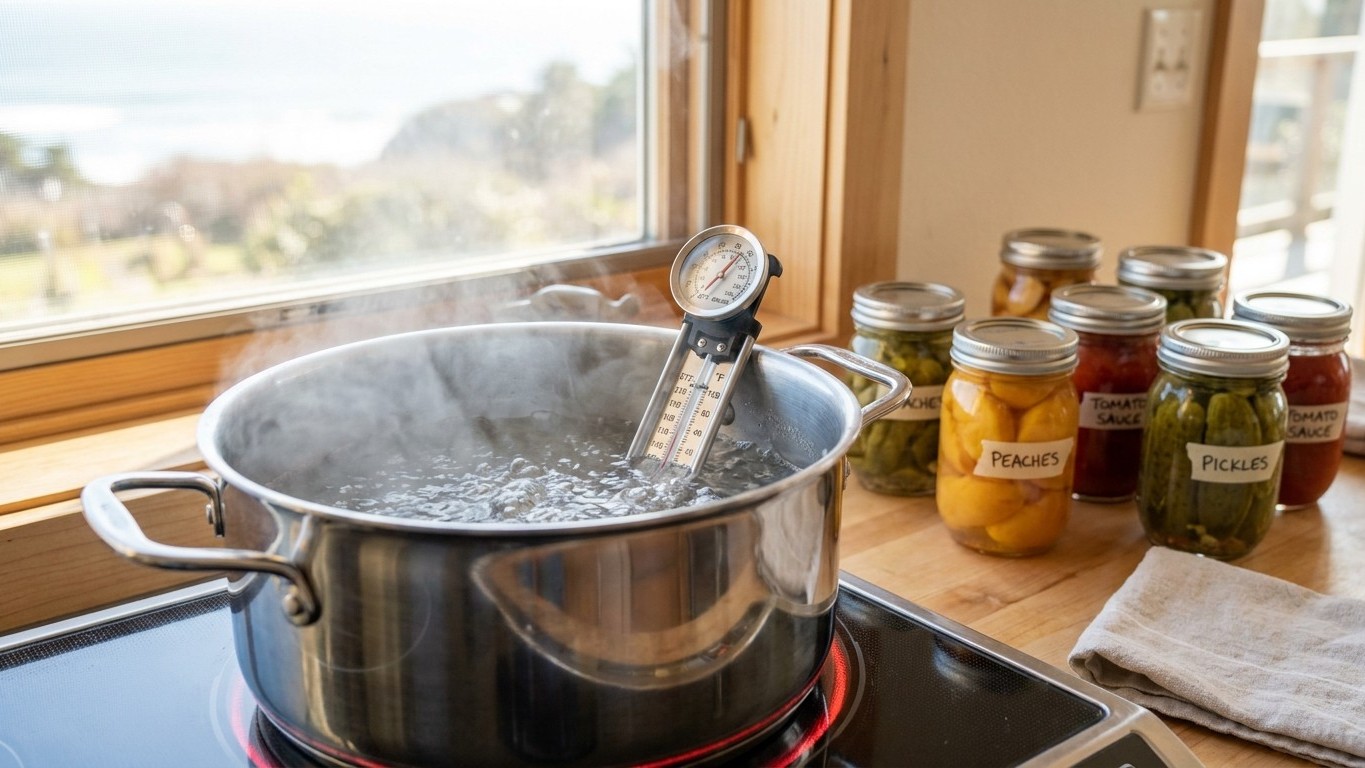

In Wilmington, Delaware, sitting at just 92 feet above sea level, water in a canning pot still boils close to 212°F, the sea-level mark. That places the city firmly in the 0-2,000 foot elevation band, where published boiling temperatures run between 208°F and 212°F. For most canners working near Wilmington, altitude changes nothing about the process. But Delaware isn’t one flat elevation, and your own kitchen might sit somewhere the math looks different.
The short answer

Wilmington, the reference city for this state, sits at 92 feet of elevation. That number places it in the lowest altitude band recognized by home canning guidelines, the 0 to 2,000 foot range, where the boiling point of water falls somewhere between 208°F and 212°F depending on barometric conditions that day. At sea level, water boils at a full 212°F. Climb toward the upper edge of that band and you lose a few degrees, but not enough to matter for a standard boiling-water canner or a dial-gauge pressure canner running at the usual settings.
That’s the practical answer for the vast majority of home canners in this state: no adjustment. If you live in or near Wilmington, or anywhere else that keeps you under roughly 1,000 feet, the tested processing times printed on a trusted recipe apply as written. You don’t need to add minutes to a water bath. You don’t need to bump a dial gauge from 11 pounds to 12. The recipe was almost certainly tested with exactly your situation in mind, because most published canning research assumes a near-sea-level kitchen unless it says otherwise.
Here’s the catch, and it’s an important one: Wilmington’s elevation is not Delaware’s elevation. A state is not a single number. It’s a spread of terrain, and while Delaware is famously flat compared to its neighbors, it still has low-lying coastal towns near the Atlantic and slightly higher inland areas up toward the Pennsylvania border. The reference figure above describes one city, chosen because it’s a population center and a useful benchmark, not because it represents every backyard tomato patch in the state.
When the answer actually changes
If you’re canning at 3 feet above sea level in a marsh-adjacent community, nothing changes. If you were somehow canning at 6,000 feet, which isn’t a realistic scenario anywhere in Delaware, every single jar you process would need a longer boiling-water bath or higher pressure canner setting. The state’s terrain simply doesn’t produce that kind of altitude, which is good news for canners here. But “good news for most people” isn’t the same as “true for everyone,” and the next sections explain why the gap matters even when it’s small.
Why a lower boil is a weaker process
Water molecules escape into vapor when their pressure matches the pressure pressing down on them from the atmosphere. At sea level, that atmospheric pressure is high enough that water has to reach 212°F before it boils. Climb higher, and the air thins out. Less atmosphere pressing down means water can turn to steam at a lower temperature. At 10,000 feet, for example, water boils at just 194°F. It’s still boiling, rolling and bubbling exactly like it does in a lowland kitchen, but it’s doing that job at a temperature nearly 18 degrees cooler.
That temperature difference is the entire reason altitude matters for food safety. Heat is what destroys the microorganisms and enzymes that spoil food or make it dangerous, and a cooler boil delivers less of that destructive heat over the same amount of time. A jar of green beans processed for 20 minutes at 212°F receives a meaningfully different heat treatment than the same jar processed for 20 minutes at 194°F, even though both pots are “boiling” the entire time.
This is where a lot of home canners get tripped up. Turning up the stove doesn’t fix the problem, because boiling water cannot get hotter than its boiling point no matter how hard it’s bubbling. A gentle simmer-boil and a violent rolling boil sitting at the same elevation reach the exact same maximum temperature. Cranking the burner just wastes energy and boils off your canner’s water faster. The temperature ceiling is set by elevation and elevation alone, not by how aggressively the pot is bubbling.
Because you can’t force water hotter, the only way to compensate for a weaker boil is to change something else in the equation. For boiling-water canning, that means extending the time the jars sit in the canner, giving the cooler water more minutes to do the same job. For pressure canning, the fix works differently: raising the pressure inside the canner raises the temperature the contents can reach, since pressure and temperature rise together in a sealed vessel. Either way, the compensation is real and specific to elevation, food type, and jar size, and it’s calculated in tested recipes rather than guessed at the stovetop.
Finding your own elevation
Before any altitude adjustment makes sense, you need a number that describes your kitchen, not a reference city miles away. Here’s how to get there.
- Start with your street address or the nearest well-known landmark, since elevation lookups work from location, not from county or zip code alone.
- Visit the National Center for Home Food Preservation’s “Find Your Elevation” page, built specifically to let home canners locate their own altitude without guesswork.
- Enter your location details as prompted and note the elevation figure the tool returns, in feet above sea level.
- Compare that figure against the altitude bands used in tested canning recipes, typically grouped in ranges like 0-1,000 feet, 1,001-3,000 feet, and higher tiers beyond that.
- Keep that number on hand every time you sit down with a canning recipe, since it’s the figure that determines whether you adjust time, pressure, or nothing at all.
A backyard a few miles from Wilmington might sit at 60 feet or 250 feet, and either way it likely falls in the same lowest band as the reference city. But if you’ve moved recently, or you’re canning at a relative’s place further inland, don’t assume. A five-minute lookup beats a guess every time, especially since the consequence of guessing wrong isn’t spoiled flavor, it’s a genuine safety risk.
What goes wrong
- An under-processed jar that looks perfect. A jar sealed under a weaker boil can look completely normal: lid popped down, seal tight, contents unspoiled to the eye. The danger with botulinum bacteria is that under-processing doesn’t always announce itself with obvious spoilage. The remedy is following the elevation-adjusted time or pressure from the start, not judging safety by appearance after the fact.
- A recipe pulled from a sea-level source without adjustment. Plenty of recipes circulating online or passed down through family don’t mention altitude at all, often because they were written by or for someone at low elevation. Using that recipe unchanged at a meaningfully higher elevation means processing every jar for less time or pressure than the food actually needs. The fix is checking whether the recipe specifies an elevation assumption, and adjusting according to a tested chart if your own elevation sits above it.
- A pressure gauge read as if elevation didn’t exist. Dial gauges and weighted gauges on a pressure canner are calibrated against sea-level assumptions unless the operator adjusts for altitude. Running a canner at a pressure that would be correct at sea level, while actually canning at a higher elevation, delivers less effective heat than the process intended. The remedy is checking your canner’s gauge accuracy periodically and setting pressure according to your actual elevation band, not a default number memorized once and never revisited.
Where the exact adjustment comes from
This page won’t hand you a processing time or a pressure setting, and that’s intentional. Those numbers depend on the specific food, the jar size, and the exact recipe being used, and they only mean something when paired with a tested process. Handing out a generic minute count here would risk being wrong for your situation in a way that has real consequences.
The authority for those exact figures is the National Center for Home Food Preservation, working from the USDA Complete Guide to Home Canning. Their published charts pair each tested recipe with the elevation adjustments needed at every altitude band. The reason this precision matters so much comes down to one uncomfortable fact: botulinum toxin, the danger an under-processed low-acid jar can harbor, has no taste and no smell. There’s no sensory warning system to catch a mistake after the jar is sealed, which is exactly why the tested numbers, not a guess or a family shortcut, are the only safe basis for any canning adjustment.
Common questions
Does Delaware have any high-altitude areas that need canning adjustments?
Delaware’s terrain stays low across the state, and the reference city of Wilmington sits at 92 feet, well within the lowest altitude band used in canning guidelines. Most home canners statewide won’t need altitude adjustments, though checking your own specific location is still worthwhile.
Why does my water boil at a different temperature than 212°F?
Boiling point depends on atmospheric pressure, which drops as elevation rises. At sea level water boils at 212°F, while at 10,000 feet it boils at only 194°F. Even small elevation changes shift that number slightly, which is why altitude bands exist in canning charts.
Can I just boil my jars longer to be safe, regardless of elevation?
Extending time beyond what a tested recipe specifies for your elevation band isn’t a reliable safety shortcut, since the correct adjustment depends on the specific food and jar size. Use the National Center for Home Food Preservation’s elevation charts paired with your specific recipe instead of estimating.
Where do I find my exact elevation for canning purposes?
The National Center for Home Food Preservation publishes a “Find Your Elevation” page designed for exactly this purpose, letting you enter your location and get a precise figure rather than relying on a nearby city’s altitude.