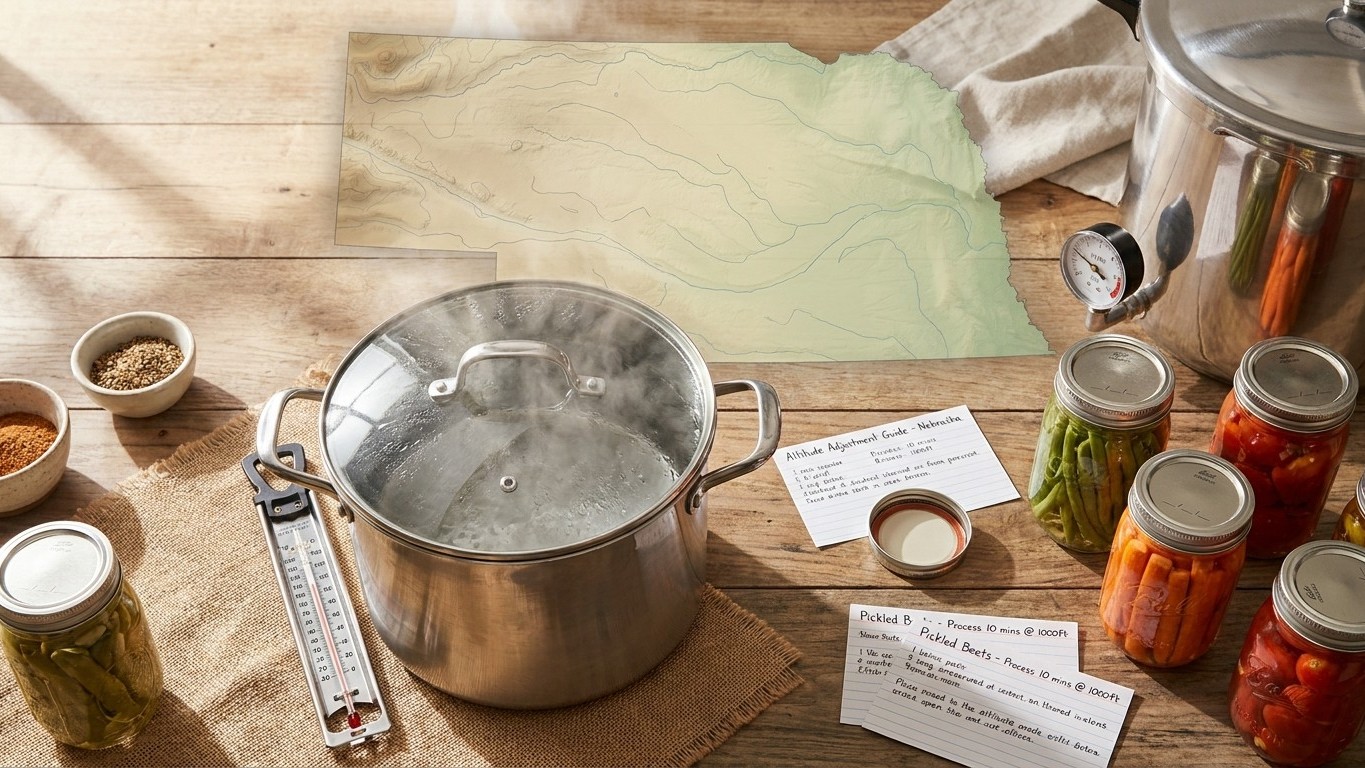

If you can in Nebraska, your safe processing time depends on how high above sea level your own kitchen sits, not on the state as a whole. Omaha, the state’s largest city, sits at 1,060 feet, well inside the 0-2,000 foot band where standard canning times apply unchanged. Water there boils somewhere between 208°F and 212°F. But Nebraska climbs fast toward the Panhandle, and if your kitchen sits higher than Omaha, that boiling point drops further, and every jar you process needs to account for it.
The short answer

Omaha’s elevation is 1,060 feet, and water there boils between 208°F and 212°F, the range published by the USDA for locations in the 0-2,000 foot band. At that band, home canners follow the standard processing times printed in tested recipes, no altitude adjustment required. That’s the figure most people picture when they hear “Nebraska,” because it’s the state’s most populous city. It is not, however, Nebraska’s elevation, because Nebraska doesn’t have one. A state is not a point on a map.
The land rises across the state in a long, steady climb. Eastern Nebraska, along the Missouri River, sits low and flat, close to Omaha’s own elevation. Move west across the Sandhills and toward the Panhandle, and the ground keeps climbing, county by county, until towns near the Wyoming and Colorado borders sit thousands of feet higher than Omaha. Somewhere in that climb, a kitchen crosses out of the 0-2,000 foot band and into territory where the standard processing time in a tested recipe is no longer enough.
Why this matters for your jars specifically
At 3 feet of elevation, this conversation is academic. At 6,000 feet, it changes every single jar you put up, from green beans to salsa to venison. The mechanism is the same everywhere: water boils cooler as elevation rises, and a cooler boil transfers less heat into the food inside the jar over the same amount of time. The USDA’s own bulletin on home canning frames it plainly, boiling water at sea level is a different heat source than boiling water two miles up, even though both are, technically, boiling.
So the real question isn’t “what’s Nebraska’s elevation.” It’s “what’s my elevation,” and whether that number puts you inside or outside the band your recipe was written for. Omaha’s figure is a starting point for orientation, not a substitute for your own address.
Why a lower boil is a weaker process
Boiling water sounds like a fixed, reliable thing. It isn’t, not in terms of temperature. Water boils at 212°F at sea level and at 194°F at 10,000 feet, a difference of 18 degrees that has nothing to do with how hard the water is bubbling and everything to do with air pressure. Less atmosphere pressing down on the pot means water molecules escape into steam at a lower temperature. The bubbling looks identical at both elevations. The heat inside those bubbles is not.
This is the part that trips people up: boiling water harder does not make it hotter. Once water reaches its boiling point for that elevation, it stays at that temperature no matter how high you crank the burner. A rolling, aggressive boil at 6,000 feet is still only about 202°F, still cooler than a gentle simmer-boil at sea level. Cranking the heat wastes propane or electricity and boils off water faster. It does nothing for the temperature inside the jar.
A cooler boil means less heat penetrates the food and the jar’s contents over any given stretch of time. Bacteria, spores, and enzymes that a sea-level process destroys in a set number of minutes survive longer at a lower boiling temperature, because the process simply isn’t as intense. The most concerning of these is Clostridium botulinum, whose spores need sustained heat to be destroyed, and a process built for 212°F water doesn’t deliver the same destruction at 202°F or 194°F.
The fix isn’t a hotter boil, because a hotter boil at altitude isn’t available. Instead, tested recipes compensate in one of two ways depending on the canner. In a boiling-water canner, used for high-acid foods like most fruits, jams, and pickles, the compensation is more time, additional minutes added to the base processing time as elevation increases. In a pressure canner, used for low-acid foods like vegetables, meats, and stocks, the compensation is more pressure, additional pounds added to the canner’s dial or weighted gauge so that the interior temperature climbs high enough despite the thinner air outside. Both approaches solve the same problem from different directions: they restore the heat that the altitude took away.
Finding your own elevation
Omaha’s 1,060 feet tells you nothing about a kitchen in Scottsbluff or Chadron. Before you touch a canning recipe’s altitude chart, you need your own number, and getting it takes just a few steps.
- Identify the town or street address of the kitchen where you’ll actually be canning, since elevation can shift meaningfully even between neighboring towns.
- Go to the National Center for Home Food Preservation’s “Find Your Elevation” page, built specifically so home canners can look up this figure without guesswork.
- Enter your location into the tool and record the elevation in feet that it returns.
- Set that number next to the altitude adjustment table printed in the specific tested recipe you’re using, whether that’s an NCHFP publication or the USDA Complete Guide to Home Canning, since the bands and adjustments live in the recipe, not on this page.
- Recheck your elevation any time you can in a different location, including a relative’s kitchen, a cabin, or a new home, since Nebraska’s elevation range means a move of even a few counties can shift the number that matters.
Skip the Omaha figure once you’ve done this. It served its purpose as an example. Your kitchen’s number is the one that governs your jars from here forward.
What goes wrong
- An under-processed jar that looks perfectly normal. A jar canned at the sea-level time in a high-elevation kitchen seals fine, tastes fine, and can still carry a safety risk, because the seal and the flavor tell you nothing about whether the heat inside reached what the food needed. The remedy is following the altitude-adjusted time from the tested recipe itself, not judging the jar by how it looks on the shelf.
- Using a recipe pulled from a sea-level source without checking its altitude assumptions. Many older family recipes, print cookbooks, or recipes shared online were written for a specific elevation, often sea level, without saying so. The remedy is confirming the recipe comes from a tested source like NCHFP or the USDA guide, which publish altitude adjustments alongside the base time, rather than assuming any processing time is universal.
- Reading a pressure gauge as though elevation doesn’t affect it. A dial or weighted gauge set to a sea-level pressure doesn’t automatically compensate for thinner air at altitude, and it needs to be increased at higher elevations to keep the canner’s internal temperature where the process requires. The remedy is checking the gauge pressure required for your specific elevation band in the tested recipe before you seal the lid.
- Assuming your city’s general reputation (“Nebraska is flat”) applies to your address. The eastern river valleys and the western Panhandle are not remotely the same elevation, and treating the whole state as low and flat leads people to skip the elevation check entirely. The remedy is looking up your specific address rather than relying on a general impression of the state.
Where the exact adjustment comes from
This page will not give you a processing time or a canner pressure, because those numbers belong to the specific food and the specific tested recipe, not to a general article about elevation. The right adjustment for green beans is not the right adjustment for salsa, and guessing between them isn’t a shortcut worth taking.
The reason for that caution is simple: botulinum toxin has no taste and no smell. A jar that’s under-processed because the altitude adjustment was skipped or guessed at won’t announce itself before you eat it. For the actual minutes or pounds that match your elevation and your food, go to the National Center for Home Food Preservation’s published recipe pages, which pair each tested process with the altitude adjustments it requires.
Common questions
Does Nebraska count as a high-altitude state for canning?
Parts of it do. Eastern Nebraska, near Omaha’s 1,060 feet, sits within the standard 0-2,000 foot band that needs no adjustment. Western Nebraska climbs much higher, and kitchens there need to check their specific elevation before following any recipe’s base processing time.
Is Omaha’s elevation the number I should use for my own canning?
Only if you actually live and can near Omaha. Omaha’s 1,060 feet is a reference point for the state’s largest city, not a stand-in for wherever your kitchen actually sits.
Why doesn’t boiling the water harder fix a low-elevation boiling point?
Because water can’t get hotter than its boiling point once it starts boiling, regardless of burner setting. At altitude, that boiling point is already lower, and no amount of extra bubbling raises it further.
What should I do if I’m not sure whether my adjustment matters?
Look up your exact elevation through the National Center for Home Food Preservation’s elevation tool, then match that number to the altitude chart in your specific tested recipe. Skipping this step is the one shortcut canning doesn’t forgive.