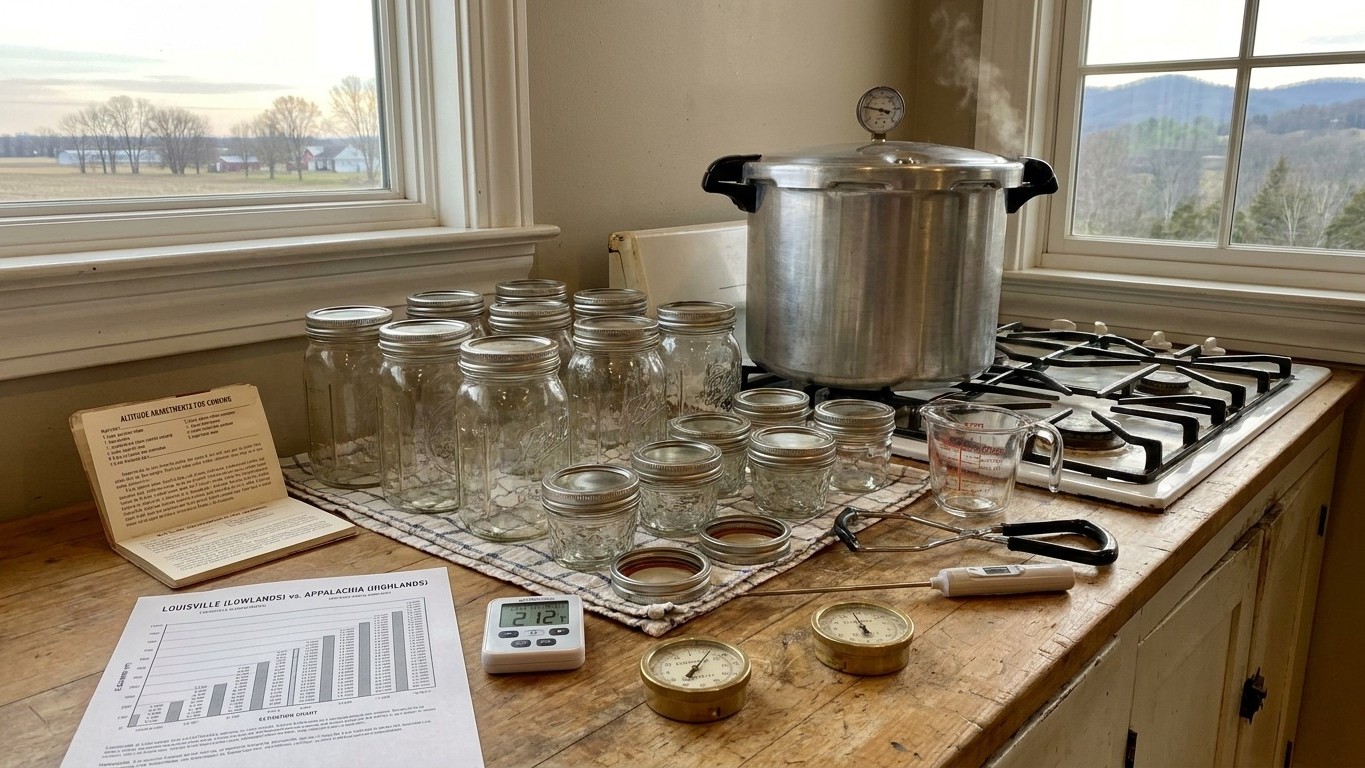

Louisville sits at 466 feet, low enough that most tested canning recipes apply exactly as written. But Kentucky runs from Mississippi River bottomland near sea level to Appalachian ridges well above 3,000 feet, and the adjustment that matters is the one tied to your own kitchen, not to a statewide average. If you live in the hills of eastern Kentucky, your elevation likely tells a different story than Louisville’s does.
The short answer

Louisville, the reference city for this figure, sits at 466 feet in elevation. At that height, water boils somewhere between 208°F and 212°F, depending on barometric pressure and the day’s weather. That range falls inside the 0-2,000 foot band that the USDA treats as needing no altitude adjustment at all. If your kitchen sits in or near Louisville, or anywhere else in Kentucky below 1,000 feet, tested processing times and pressure canner settings apply exactly as printed on the recipe. Nothing to add, nothing to subtract.
That figure describes one city, not the state. Kentucky is not flat, and it is not uniform. The Bluegrass region and much of the Ohio River corridor sit low, often under 1,000 feet, which is why so many Kentucky kitchens never think twice about altitude. But move toward the Cumberland Plateau or the far eastern counties bordering West Virginia and Virginia, and the ground climbs fast, well past the point where the 0-2,000 foot band still applies.
Why the band matters more than the number
Canning guidance is written in bands, not single numbers, because boiling point doesn’t shift in some smooth straight line that would require a separate rule for every fifty feet of elevation. It shifts gradually enough that the USDA groups elevations into ranges, and each range gets its own adjustment (or, at the lowest range, none). Louisville’s 466 feet lands comfortably inside the first band. A home canner working from a garden at 2,500 feet in a Kentucky mountain county is already in different territory, and that’s true even though both kitchens are in the same state, under the same state guidelines, buying jars from the same hardware store.
This is the detail that trips people up. They hear “Kentucky” and assume one rule covers the whole state. It doesn’t, and the reference city figure above is proof of exactly that: it names Louisville specifically because naming “Kentucky” would be meaningless for a process that depends on how thin the air actually is where the jars are sitting on the stove.
Why a lower boil is a weaker process
Water boils at 212°F at sea level. Climb to 10,000 feet, and that same pot of water boils at 194°F. The mechanism is simple: air pressure drops as elevation rises, and water needs less added energy to turn to vapor when there’s less air pressing down on it. Boiling looks the same at both elevations, roiling, bubbling, steam rising, but the two pots are not doing the same job. The one at higher elevation is cooler, and cooler water kills fewer of the bacteria, molds, and spores that spoil food or make it dangerous.
This is where a lot of home canners misjudge the problem. Turning up the burner doesn’t fix it. Boiling water cannot get hotter than its boiling point, no matter how hard it’s boiling or how long the flame’s been on. A rolling boil at 194°F stays at 194°F until you change the pressure it’s boiling under, not the heat under the pot. That’s the whole mechanism, and it’s the reason “just boil it a little harder” is not a real fix for altitude.
What actually compensates is different depending on the method. In a boiling-water canner, the fix is more time, letting the food sit in that cooler boil longer so the cumulative heat exposure still reaches a safe level. In a pressure canner, the fix is more pressure, because raising the pressure inside the sealed canner raises the temperature the food actually reaches, independent of the local boiling point of plain water. Both approaches solve the same problem from opposite directions: one adds duration, the other adds intensity. Neither one is optional once your elevation crosses out of the lowest band, and neither one is something to guess at, because the correct addition depends on the specific food, the jar size, and the processing method, not on elevation alone.
Finding your own elevation
The reference city figure above describes Louisville. It does not describe your kitchen, your garden, or the county extension office three towns over. Before touching a canning recipe, find your own number.
- Start with the National Center for Home Food Preservation’s “Find Your Elevation” page, which exists specifically for this purpose and is built for people who have never needed to know their elevation before.
- Enter your city, town, or zip code rather than guessing based on how hilly the area looks; visual impressions of elevation are unreliable, especially in a state with as much rolling terrain as Kentucky.
- Write the number down in feet, not meters, since every U.S. canning chart is built in feet.
- Match that number to the elevation band your recipe’s adjustment chart uses, rather than rounding it to the nearest round number out of convenience.
- Recheck if you can and garden at more than one property, since a lake house forty minutes away or a relative’s land in a different county can sit in an entirely different band from your primary kitchen.
None of this takes more than a few minutes, and it only needs doing once per location. The number doesn’t change year to year, so once it’s found, it’s done.
What goes wrong
- An under-processed jar that looks perfectly normal. A jar canned at a cooler boil without the added time or pressure can seal, seem shelf-stable, and show no sign of spoilage, while still failing to reach a safe internal temperature. The remedy is following the elevation-adjusted time or pressure from the start, not judging the jar by appearance after the fact.
- A recipe pulled from a sea-level source without checking its assumptions. Older family recipes, or ones found online without a stated elevation baseline, often assume 0-1,000 feet and say nothing about it. The remedy is treating any recipe silent on elevation as a sea-level recipe and adjusting from there based on your own number.
- A pressure gauge read as though elevation doesn’t affect it. The pressure a recipe calls for at sea level is not the pressure that recipe needs at higher elevation; reading the dial correctly but ignoring where you live still produces an under-processed jar. The remedy is applying the elevation adjustment to the pressure setting itself, every time, not just to the processing minutes.
- Assuming a whole Kentucky county shares one elevation. Counties in the eastern part of the state can span low river valleys and high ridgelines within a few miles. The remedy is checking the specific address, not the county name, since “eastern Kentucky” is not a number a canning chart can use.
Where the exact adjustment comes from
This page gives no processing time and no pressure setting, and it isn’t the place to look for one. The correct adjustment for your elevation belongs to the tested recipe for the specific food you’re canning, low-acid vegetables, meats, tomatoes, jams, each carries its own chart because each responds differently to heat and time. For that chart, go to the National Center for Home Food Preservation, the authority behind the USDA’s Complete Guide to Home Canning.
The reason for the caution isn’t bureaucratic. Botulinum toxin, the danger in under-processed low-acid foods, has no taste and no smell. A jar can look, smell, and taste completely normal and still be unsafe. Guessing at an altitude adjustment removes the one part of home canning that has zero margin for improvisation.
Common questions
Does Louisville’s elevation apply to my whole county?
No. Louisville’s 466 feet describes that city specifically. Kentucky counties, especially in the eastern part of the state, can vary by thousands of feet within their own borders, so checking your own address matters more than checking your county’s name.
If my area is under 1,000 feet, do I still need to check anything?
You still need to confirm the number rather than assume it. Most of Kentucky’s lower and central regions fall inside the 0-2,000 foot band where no adjustment applies, but confirming your specific elevation takes a few minutes and removes any guesswork.
Does boiling water harder compensate for altitude?
No. Boiling water cannot exceed its boiling point regardless of flame intensity. At a given elevation, that boiling point is fixed, and only added time or, in a pressure canner, added pressure changes the actual heat the food receives.
Where do I find the exact time or pressure adjustment for my elevation?
The National Center for Home Food Preservation publishes tested adjustment charts by food type and elevation band. This page intentionally doesn’t include specific times or pressures, since the correct figure depends on the exact food being canned.