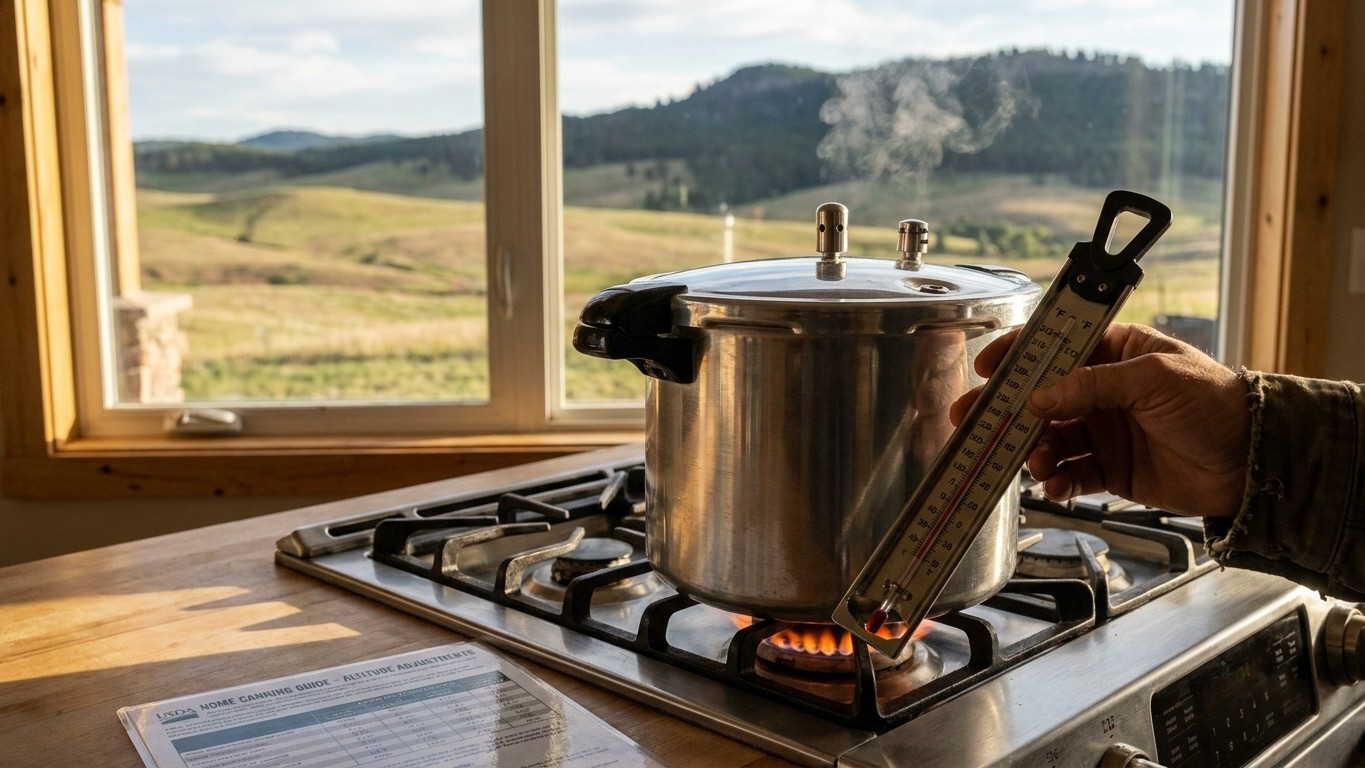

Water boils below 212°F almost everywhere in South Dakota, because almost nowhere in the state sits at true sea level. In Sioux Falls, at 1,470 feet, published boiling points bracket the local boil between 208°F and 212°F. That is not a rounding error you can ignore. If you can in Sioux Falls, or anywhere near that elevation, your process needs the altitude adjustment built into every tested USDA recipe. If you live down near the Big Sioux River bottomlands at a few hundred feet, the math shifts a little; if you’re up in the Black Hills, it shifts a lot.
The short answer

Sioux Falls sits at 1,470 feet above sea level, and at that height, water boils somewhere between 208°F and 212°F rather than the flat 212°F most recipes assume. That range comes from the USDA’s own published tables, not a guess, and it applies specifically to Sioux Falls as a reference point, not to South Dakota as a whole. The state runs from river valleys near 1,000 feet in the east to Black Elk Peak at over 7,000 feet in the Black Hills, so the honest answer to “does altitude matter here” is: it depends entirely on where in the state you’re standing with a canner.
For a home canner working near sea level, three feet of elevation changes nothing. Water still boils at a full 212°F, and every tested recipe written for standard conditions applies exactly as written. That is not the situation for most South Dakotans. Sioux Falls, at 1,470 feet, has already crossed into territory where the boiling point drops measurably below 212°F. That’s a meaningful difference from sea level, though it’s still a world away from what happens in a genuine high-altitude canning situation.
Contrast that with somewhere at 6,000 feet, closer to the elevations found in the western part of the state and in parts of the Black Hills. There, water might boil closer to 201°F, a gap from sea level large enough that every single jar processed without adjustment risks being under-processed. The pattern is linear and predictable: elevation goes up, boiling temperature goes down, and the gap between your kitchen and a sea-level test kitchen widens with every thousand feet.
Why Sioux Falls as the reference point matters
Using Sioux Falls as a reference number is useful precisely because it’s not extreme. It shows what a moderately elevated South Dakota kitchen looks like, not what the highest or lowest point in the state looks like. A canner in Sioux Falls and a canner in Rapid City are both technically “in South Dakota,” but they are working with meaningfully different boiling points, different adjustment needs, and potentially different processing outcomes if either one assumes the other’s number applies to them.
That’s the core problem with any state-level altitude claim for canning. The state doesn’t have one elevation. It has a range spanning thousands of feet, and the only number that matters for your jars is the one under your own feet, not the one attached to whichever city gets used as a benchmark.
Why a lower boil is a weaker process
The mechanism here is simple, even if the consequences aren’t. Water boils when its vapor pressure matches the surrounding atmospheric pressure. At sea level, that balance point sits at 212°F. Climb higher, and the air thins, atmospheric pressure drops, and water reaches that same balance point at a lower temperature. In Sioux Falls, at 1,470 feet, that balance point falls somewhere between 208°F and 212°F. Higher up, in the Black Hills, it falls further still.
A cooler boil kills less. That’s the entire problem, stated plainly. The tested processing times published for canned foods assume a specific boiling temperature, and every minute of that process is calculated against heat penetrating the jar at that temperature. Drop the temperature, and the same number of minutes delivers less lethal heat to the center of the jar. Spores and bacteria that would have been destroyed at 212°F over a given time may survive at 208°F over that same time, because the math of heat destruction is temperature-dependent, not just time-dependent.
Here’s the part that trips people up: boiling water harder doesn’t fix this. A rolling, violent boil and a gentle boil sit at exactly the same temperature, because boiling water cannot exceed its boiling point no matter how much heat you throw at it under normal atmospheric pressure. Turning up the burner makes the water boil more vigorously, not more hotly. All that extra vigor does is boil off water faster and maybe splash the stovetop. It does nothing to compensate for the altitude gap.
What actually compensates is different depending on the canning method. In a boiling-water canner, used for high-acid foods like most fruits, pickles, and jams, the compensation is time. You leave the jars in the boiling water longer, because a longer exposure at a lower temperature can deliver an equivalent lethal effect to a shorter exposure at the full 212°F. In a pressure canner, used for low-acid foods like vegetables, meats, and most mixed dishes, the compensation works differently: pressure canners aren’t limited to water’s boiling point at all, so instead of adding minutes, tested recipes call for more pressure, or a shift from a lower weighted-gauge setting to a higher one, to push the internal temperature back up to where it needs to be regardless of what altitude is doing to the water outside the jar.
Finding your own elevation
Sioux Falls’ 1,470 feet is a reference point, nothing more. Your kitchen might be lower, along the river valleys of eastern South Dakota, or dramatically higher, in the ridges and canyons of the Black Hills. Before any canning adjustment means anything, you need your own number, not the city’s.
- Start with the National Center for Home Food Preservation’s “Find Your Elevation” page, built specifically so home canners can look up a number without guessing.
- Enter your city, town, or the nearest recognizable location to your kitchen if your exact address isn’t listed.
- Record the elevation in feet, since that’s the unit every USDA and NCHFP altitude chart uses for canning adjustments.
- Note which elevation band that number falls into, since tested recipes group adjustments by range rather than by exact foot count.
- Keep that number written down near your canning setup, since it applies to every batch you process at that location, not just the current one.
Skip the temptation to eyeball it from a highway sign or a rough memory of “we’re pretty high up here.” A difference of even a few hundred feet can shift which adjustment band a recipe places you in, and the NCHFP tool exists precisely so nobody has to estimate.
What goes wrong
- An under-processed jar that looks perfectly normal. A jar canned at Sioux Falls elevation using a sea-level process can seal, seal firmly, and sit on a shelf looking exactly like every properly processed jar next to it. There’s no visual sign of insufficient heat treatment. The fix is applying the altitude adjustment before processing, not inspecting after the fact, because inspection can’t catch this failure.
- A recipe copied from a sea-level source. Plenty of recipes circulating online, in old family notebooks, or in general cookbooks were written and tested at or near sea level, with no altitude guidance built in at all. Using one of those as-is in Sioux Falls, let alone in the Black Hills, silently drops the effective process below what’s needed. The fix is checking whether a recipe names its source as tested at your elevation range, and if it doesn’t, going to the NCHFP guidance for that specific food instead.
- A pressure gauge read as though elevation doesn’t exist. Dial gauges and weighted gauges both need altitude-specific settings, and a canner set to a sea-level pressure at a South Dakota elevation of any real height delivers a cooler process than the gauge number suggests. The fix is checking the tested pressure or weight setting for your specific elevation band before the canner ever goes on the burner, not adjusting by feel once it’s running.
- Treating the whole state as one elevation. Assuming Sioux Falls’ number applies statewide, or assuming any single South Dakota figure applies to your specific kitchen, produces the same silent under-processing as skipping the adjustment altogether. The fix is always the reader’s own elevation, found individually, not a state or city average.
Where the exact adjustment comes from
This page won’t give you a processing time or a canner pressure, and that’s deliberate. The right adjustment depends on the specific food, the specific canning method, and your specific elevation together, and that combination belongs to a tested recipe, not to a general explainer. The National Center for Home Food Preservation publishes those tested adjustments food by food, and that’s the authority to check before you can anything at Sioux Falls elevation or higher.
The reason this matters more than most kitchen mistakes is that botulinum toxin, the risk an under-processed low-acid jar carries, has no taste and no smell. A jar can look, smell, and taste completely normal and still be dangerous. There’s no sensory check that substitutes for getting the elevation adjustment right at the source.
Common questions
Does Sioux Falls need an altitude adjustment for canning?
At 1,470 feet, Sioux Falls sits high enough that its boiling point falls below the sea-level standard of 212°F, landing somewhere between 208°F and 212°F according to published USDA figures. That’s enough of a gap that canners in Sioux Falls should check the altitude-adjusted process for their specific recipe rather than assume sea-level timing applies.
Is South Dakota’s elevation the same everywhere?
No. The state spans a wide range, from lower river-valley elevations in the east to well over 7,000 feet in the Black Hills. Sioux Falls’ 1,470 feet describes one city, not the state, and canners elsewhere in South Dakota need their own local number, not this reference figure.
Why doesn’t boiling harder fix a low-elevation boil?
Boiling water sits at its boiling point regardless of how vigorously it boils. A rolling boil and a gentle boil are the same temperature at a given elevation; more heat just makes the water boil off faster, not hotter. Compensation has to come from adjusting time or pressure, not from turning up the burner.
Where should I find the exact time or pressure for my elevation?
The National Center for Home Food Preservation publishes tested adjustments organized by food and elevation band. That’s the source to check for the specific figure, since a general explainer like this one can describe the mechanism but shouldn’t substitute for a tested recipe’s exact numbers.