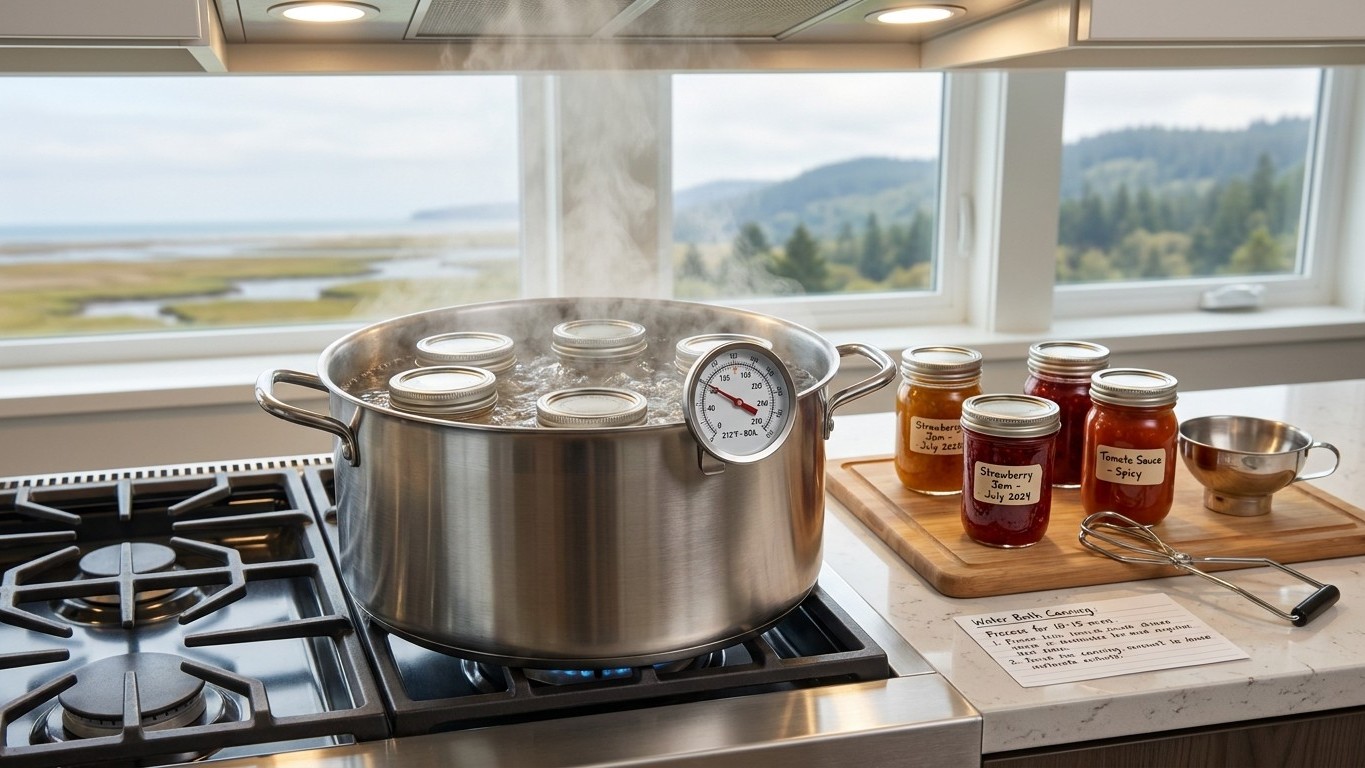

For most of New Jersey, altitude changes nothing in the canner. Newark, the reference point for the state’s lowest band, sits at just 30 feet, where water still boils close enough to the standard 212°F mark that no adjustment applies. But New Jersey isn’t one elevation. If you can in the Kittatinny Ridge or the Highlands region, your kitchen may sit at a different point on that scale, and your own number, not Newark’s, is what a tested recipe asks for.
The short answer

Newark, used here as New Jersey’s reference city, sits at an elevation of 30 feet. That places it inside the 0 to 2,000 foot band that the USDA’s canning guidance treats as a single group. Within that band, published boiling temperatures for water run between 208°F and 212°F, depending on exactly where in the band a kitchen falls. At 30 feet, the boiling point is effectively the full 212°F most cooks assume, the number every stovetop canning instruction is written around.
That’s the reason canning at Newark’s elevation, or anything close to it, doesn’t force a change to a recipe’s process time or a pressure canner’s dial setting. The tested times published by USDA and the National Center for Home Food Preservation (NCHFP) assume a boiling point at or very near 212°F, and Newark delivers that.
Why the state figure isn’t the whole story
New Jersey is a small state on a map, but it isn’t flat in the way that matters here. Coastal counties and much of the central part of the state sit within a few hundred feet of sea level, similar to Newark. Move toward the northwest corner, into Sussex or Warren County, and the ground climbs. High Point, the state’s tallest spot, tops 1,800 feet, still inside that same 0 to 2,000 foot band by the numbers given here, but a meaningfully different kitchen elevation than Newark’s 30 feet.
This is why a state-level figure is a starting point, not an answer. A canning guide can tell you what Newark’s water does at a boil. It can’t tell you what your own kitchen’s water does unless you know your own elevation, which is a separate step covered further down.
Why a lower boil is a weaker process
Water’s boiling point drops as elevation rises. At sea level it’s 212°F. Climb to 10,000 feet and it falls to 194°F. That 18-degree gap isn’t trivial when the entire safety logic of boiling-water canning depends on sustained heat killing off spoilage organisms and, in low-acid foods processed under pressure, killing Clostridium botulinum spores.
A cooler boil does less work. Heat, not the visible violence of bubbles, is what accomplishes food safety inside a jar. A pot boiling hard and a pot boiling gently are both at the same fixed temperature for whatever elevation you’re standing at, water simply can’t get hotter than its boiling point no matter how high the burner is turned. So cranking the heat higher once a boil starts changes nothing about the temperature reaching the jars. It only wastes fuel and boils water off faster.
What actually compensates for a lower boiling point is time or pressure, not intensity. In a boiling-water canner, the fix is leaving jars in that cooler boil longer, giving the reduced temperature more minutes to do the job a hotter boil would have done faster. In a pressure canner, the fix works differently: raising the pressure inside the sealed canner raises the temperature the contents reach, independent of the outside boiling point of plain water. That’s why pressure canning charts list adjustments in pounds of pressure keyed to elevation bands, while boiling-water canning charts list adjustments in added minutes.
Neither adjustment is guesswork, and neither is optional once your elevation moves the number away from sea level. Both come from tested recipes matched to elevation bands, which is the subject of the next two sections.
Finding your own elevation
Newark’s 30 feet is a reference point, not a stand-in for your address. Before touching a canning chart, find the number for the spot where your kitchen actually sits.
- Start with your town or ZIP code rather than the state as a whole, since New Jersey elevations range from sea level along the coast to over 1,800 feet in the northwest.
- Use the National Center for Home Food Preservation’s “Find Your Elevation” page, built specifically to let home canners look up a local elevation in feet without needing a survey tool or a geology background.
- Write down the figure in feet, rounded to a whole number, since canning adjustment tables group elevations into bands rather than requiring an exact figure to the foot.
- Match that number to the elevation band listed in the specific tested recipe you plan to use, whether that recipe calls for a boiling-water canner or a pressure canner.
- Apply the adjustment listed for your band in that recipe, not a figure borrowed from a different food or a different guide, since adjustments are written per recipe, not as a universal formula.
What goes wrong
- An under-processed jar that looks perfectly normal. A jar canned at a lower boiling point but processed for a sea-level time can seal, look clear, and sit on a shelf for months without any visible sign that the heat inside never reached a safe level. The remedy is using the elevation-adjusted time from a tested recipe every single time, not judging safety by appearance after the fact.
- A recipe pulled from a sea-level source and used without changes. Many family recipes, older cookbooks, and recipe cards circulating online were written for, or tested at, low elevations and say nothing about adjustment. The remedy is checking the elevation band assumptions of any recipe against your own elevation before following its times as written, and adjusting per NCHFP guidance if the recipe doesn’t already build in your band.
- A pressure gauge read as if elevation didn’t exist. A dial or weighted gauge set to a pressure that’s correct at sea level can under-process food at higher elevation, since the pressure needed to reach a safe internal temperature rises as outside air pressure and the boiling point of water both fall. The remedy is using the pressure listed for your specific elevation band in the recipe you’re following, not the pressure that “worked before” at a different address.
Where the exact adjustment comes from
This page won’t give you a processing time or a canner pressure, and no general elevation guide safely can. The correct adjustment depends on the specific food, the jar size, the recipe’s acidity, and the canning method together, which is why tested figures live inside individual recipes published by the National Center for Home Food Preservation and the USDA Complete Guide to Home Canning, not in a standalone elevation chart.
The stakes are why this matters more than most kitchen shortcuts. Clostridium botulinum, the organism an under-processed low-acid jar can harbor, produces a toxin with no taste and no smell. A jar can look, smell, and taste completely fine and still be unsafe. Look up your food in NCHFP’s published recipes, find the elevation band matching the number you found for your own address, and use the time or pressure listed there.
Common questions
Does Newark’s elevation apply to my whole county?
No. Newark’s 30 feet is a single reference point for New Jersey’s lowest elevation band, not a county-wide or state-wide figure. Towns even a short distance away can sit at a different elevation, so check your own address using the method described above.
Do I need to adjust canning times if I live near the Jersey Shore?
Coastal New Jersey generally sits close to sea level, similar to Newark’s 30 feet, which falls at the low end of the 0 to 2,000 foot band referenced here. Confirm your specific elevation and check the adjustment table inside the tested recipe you’re using rather than assuming no change is needed.
What if I can’t find my exact elevation in feet?
Use the National Center for Home Food Preservation’s “Find Your Elevation” page, built for exactly this purpose. It’s designed to give home canners a usable figure without requiring surveying equipment or specialized software.
Does boiling water harder make up for a lower boiling point?
No. Once water reaches its boiling point for a given elevation, it stays at that temperature no matter how vigorously it boils. A harder boil doesn’t raise the temperature; only more time or, in a pressure canner, more pressure compensates for a boiling point lowered by elevation.