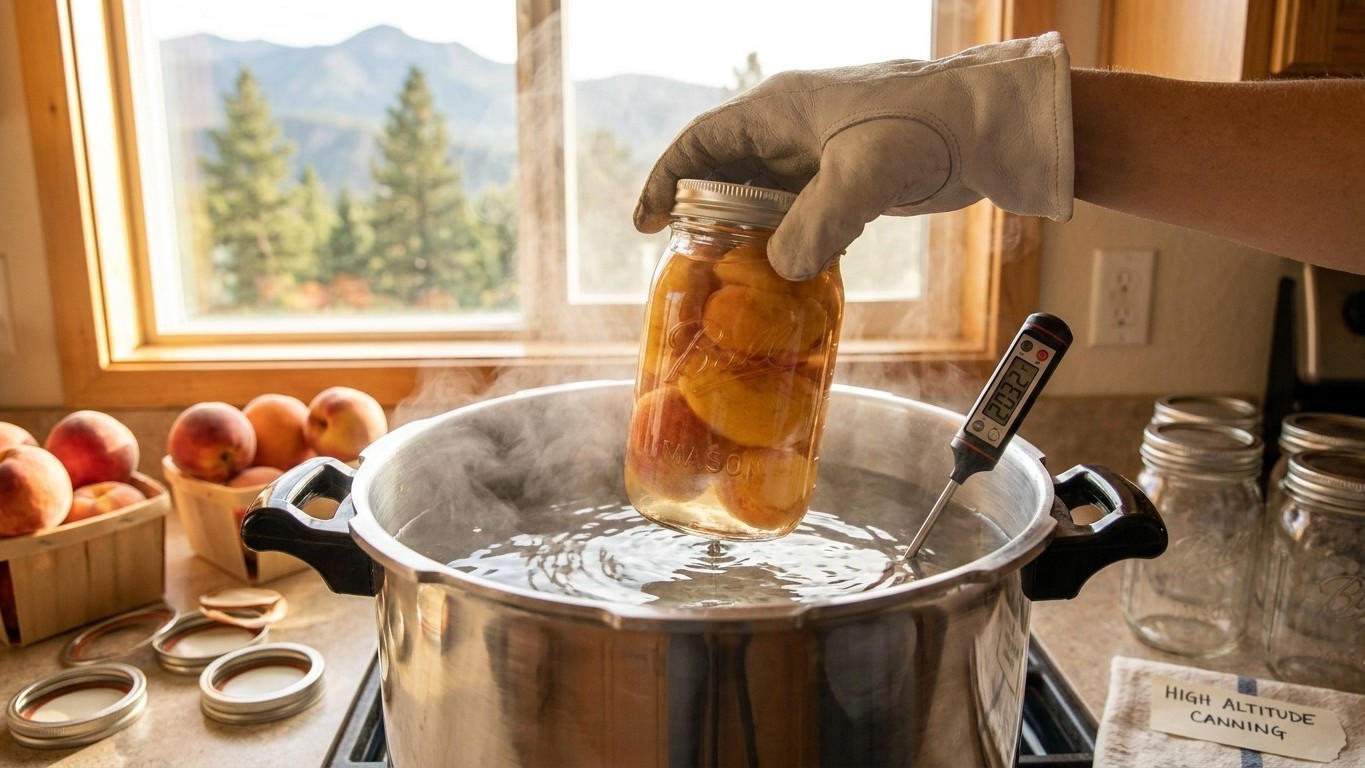

Salt Lake City sits at 4,262 feet, and at that height water boils somewhere between 201°F and 204°F instead of the 212°F you’d get at sea level. That gap is not trivial. If you’re canning anywhere near Utah’s major population centers, the answer is yes: your elevation changes the process. The only question left is which adjustment applies to your specific recipe and your specific jar.
The short answer

Start with the number that matters: 4,262 feet. That’s the elevation of Salt Lake City, used here as a reference point because it’s where most of Utah’s canning kitchens happen to sit. It is not the elevation of the state. Utah runs from desert basins near 2,000 feet to alpine terrain well above 10,000 feet, and the canning adjustment you need follows your own kitchen counter, not a statewide average. Salt Lake City just gives us a concrete, sourced example to work from.
At that elevation, the USDA’s published boiling data puts the boiling point of water between 201°F and 204°F. Compare that to the familiar 212°F at sea level, and you can see the problem in plain terms: your canner’s water is topping out roughly 8 to 11 degrees cooler than the temperature most recipes were originally calibrated against. That’s not a rounding error. It’s the difference between a process that reliably destroys harmful microorganisms and one that falls short.
Three feet of elevation change, the kind you’d get standing on a step stool, changes nothing about how you can. Six thousand feet changes every single jar you process, every time, for the rest of your canning life. Utah’s population centers sit closer to the second case than the first. Salt Lake City, Provo, Ogden, and most of the Wasatch Front fall inside a band running from about 4,000 to 6,000 feet, which is high enough that skipping the adjustment isn’t a minor shortcut. It’s a real gap between what the recipe assumes and what your stove actually produces.
Why this isn’t optional at these heights
Tested canning recipes, the ones published by the USDA and the National Center for Home Food Preservation, assume a sea-level boil unless stated otherwise. Every processing time and every pressure setting in those recipes was calculated against a 212°F benchmark. Once your local boiling point drops below that, the published time or pressure no longer delivers the same heat exposure to the center of the jar. The recipe hasn’t changed. Your kitchen has.
This is why the elevation adjustment exists as a standard, non-negotiable step in every tested canning guide, not a regional curiosity for mountain dwellers. If you live along the Wasatch Front, in the valleys around Provo, or in any of the towns that sit in that 4,000 to 6,000-foot band, this is baseline information for using your canner correctly, not an edge case.
Why a lower boil is a weaker process
Here’s the mechanism, stripped down to its simplest form: water boils cooler as elevation rises, and a cooler boil kills less. That’s the entire physics lesson. Atmospheric pressure drops as you climb, and boiling is just the point where water’s vapor pressure matches the pressure pushing down on it. Less air pressure overhead means water can turn to vapor at a lower temperature. At sea level that threshold sits at 212°F. Around 4,262 feet, it sits between 201°F and 204°F. Climb to 10,000 feet and it drops all the way to 194°F.
The part that trips people up is the instinct to crank the heat higher to compensate. It doesn’t work, and it can’t work. Once water is boiling, it stays at its boiling point no matter how high you turn the burner. A rolling, vigorous boil and a gentle, barely-moving boil are the exact same temperature. Cranking the heat just makes the water boil away faster and rattles your jars around. It does not raise the temperature by even a fraction of a degree. This is the single most common misunderstanding in home canning, and it’s worth saying plainly: a harder boil is not a hotter boil.
So if you can’t heat your way out of the problem, what actually compensates? Two different answers, depending on which type of canner you’re using. In a boiling-water canner, the fix is time. Because the water never gets as hot as it would at sea level, the jars need to sit in that slightly cooler bath for longer, giving the reduced temperature more minutes to do the same job a shorter time would do at sea level. In a pressure canner, the fix is pressure. Adding pounds of pressure inside a sealed canner raises the internal temperature above what a plain pot of boiling water can ever reach, regardless of elevation, and at higher elevations that pressure gets nudged upward to reach the same internal temperature the recipe was designed around.
Neither fix is something you eyeball. Both come from tested figures matched to your food, your jar size, and your exact elevation band, which is exactly why this page won’t hand you a number and why the next two sections exist.
Finding your own elevation
Salt Lake City’s 4,262 feet is a reference point, not your answer. Utah’s terrain shifts by thousands of feet within a single county, so the number you actually need has to come from where your kitchen sits, not from the nearest big city on a map. Here’s how to pin that down before you touch a canner.
- Locate your address or nearest town. Start with the specific place your canning happens, not a general region or county name, since elevation can swing hundreds of feet between a valley floor and a nearby bench or foothill.
- Use the National Center for Home Food Preservation’s “Find Your Elevation” page. This tool exists for exactly this purpose, letting you search by location and return a specific elevation figure rather than a rough guess.
- Match your elevation to the correct band. Canning adjustments aren’t calculated foot by foot; they’re grouped into ranges, and your job is to find which range your number falls into.
- Check your figure against local knowledge. County extension offices and long-time neighbors often know whether your specific area runs higher or lower than the nearest official reading, which is worth a quick sanity check.
- Write the number down somewhere permanent. Tape it inside a cabinet door or on the inside of your canning lid box. You’ll need it every single canning season, and it doesn’t change year to year unless you move.
Once you have that figure, hold onto it. It’s the input you’ll plug into every tested recipe from here forward, the same way you’d note your oven’s true temperature after calibrating it against a thermometer.
What goes wrong
- An under-processed jar that looks perfectly normal. A jar can seal, sit on the shelf looking sealed and stable, and still not have reached a safe internal temperature during processing. There’s no visual cue for this. The remedy is following the elevation-adjusted time or pressure from a tested source every time, not judging safety by appearance after the fact.
- A recipe pulled from a sea-level source without adjustment. Plenty of recipes online, in older family cookbooks, or from out-of-state relatives were written and tested at or near sea level, with no elevation guidance built in at all. Using one of these as-is at 4,262 feet or higher means running a process calibrated for a boiling point your stove can’t produce. The remedy is checking whether a recipe names an elevation assumption before trusting it, and adjusting it against an elevation-aware source if it doesn’t.
- A pressure gauge read as though elevation doesn’t exist. Pressure canner gauges and processing charts both assume a baseline that shifts with altitude, so a pressure setting that’s correct at sea level is not automatically correct in the Wasatch Front’s elevation band. The remedy is matching your gauge type (weighted or dial) and your actual elevation to the correct pressure listed for your specific food and jar size in a tested chart.
- Assuming one adjustment covers every food. Vegetables, meats, and high-acid fruits don’t share identical base processing times, so the elevation adjustment doesn’t produce one universal number you can apply across your whole canning shelf. The remedy is looking up the adjustment separately for each recipe, every time, rather than reusing a figure from a different food.
Where the exact adjustment comes from
This page has deliberately given you no processing time and no pressure setting, and that’s not an oversight. The right adjustment depends on the specific food, the jar size, and the exact recipe you’re using, and that figure belongs to the tested recipe itself, not to a general explainer about altitude. Getting it wrong here carries real weight: botulinum toxin has no taste and no smell, so an under-processed jar gives you no warning before it’s opened and eaten.
For the actual numbers, go to the National Center for Home Food Preservation. Their elevation adjustment charts, built on the USDA’s Complete Guide to Home Canning, list the correct time or pressure for your food once you know your elevation band. That’s the only source this page points to, and it’s the one worth bookmarking before your next canning season starts.
Common questions
Does Salt Lake City’s elevation apply to my whole county?
No. Elevation in Utah can shift by hundreds or thousands of feet within a short drive, so Salt Lake City’s 4,262 feet is a reference point, not a countywide figure. Find your own number using the NCHFP’s elevation lookup tool rather than assuming a nearby city’s figure applies to you.
If I boil the water harder, does that fix the lower boiling point?
No. Boiling water stays at its boiling point regardless of how hard it’s boiling; a rolling boil and a gentle boil are the same temperature at a given elevation. The fix is added time in a boiling-water canner or added pressure in a pressure canner, not a higher flame.
Can I use the same adjustment for every recipe once I know my elevation?
No. The adjustment applies to your elevation band, but the base processing time or pressure still depends on the specific food, jar size, and recipe. Look up each recipe’s tested figures for your elevation band rather than reusing one number across different foods.
What happens if I skip the elevation adjustment entirely?
The jar may still seal and look fine on the shelf, giving no visual sign that anything is wrong. The real risk is an under-processed jar that hasn’t reached a safe internal temperature, which is why tested, elevation-specific figures from the NCHFP or USDA guide matter more than appearance.