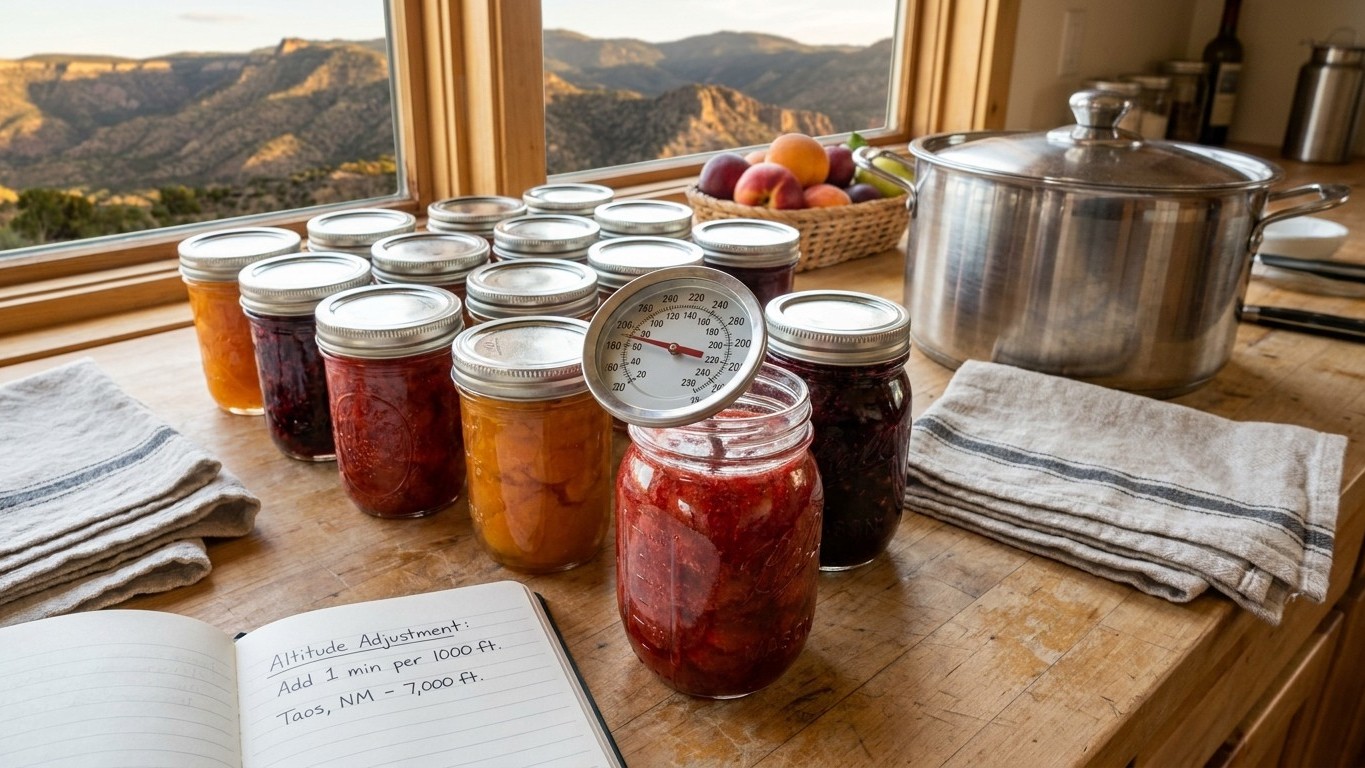

Albuquerque sits at 4,957 feet, and water there boils somewhere between 201°F and 204°F, not the 212°F most recipes assume. That’s New Mexico’s reference point, not the whole state’s elevation. If you’re canning in the Rio Grande valley, in the mountains above Santa Fe, or down near the Pecos lowlands, your own number could be higher, lower, or close to Albuquerque’s. Whatever it is, once you’re above roughly 1,000 feet, that gap between the boiling point at your house and the 212°F a recipe was tested at starts to matter for every jar you seal.
The short answer

Albuquerque, the city most people picture when they think of New Mexico, sits at 4,957 feet above sea level. At that height, published data puts the boiling point of water somewhere between 201°F and 204°F, depending on the day’s barometric pressure. Compare that to the 212°F boiling point most home canning recipes are written and tested for, and the difference is real: 8 to 11 degrees cooler, every single time you can.
That gap isn’t trivia. It’s the entire reason altitude adjustments exist in canning. A recipe that calls for a certain number of minutes in a boiling-water bath, or a certain number of pounds of pressure in a pressure canner, was tested at sea level or close to it. Follow that recipe unchanged at 4,957 feet, and your jars spend the same amount of time being heated to a lower temperature than the one that made the recipe safe in the first place.
New Mexico is not a flat state, and treating Albuquerque’s number as if it applied statewide would be a mistake. The land ranges from around 2,800 feet near the Pecos River in the southeast to well over 13,000 feet at Wheeler Peak in the north. A home canner in Carlsbad is working with a different boiling point than one in Taos or Cloudcroft. Albuquerque’s figure is a useful anchor because it’s the state’s largest city and a common reference point, but it answers the question for Albuquerque, not for every kitchen between the Four Corners and the Texas line.
Does this change anything for you?
If your kitchen sits at 3 feet above sea level, altitude adjustments don’t apply to you at all; the standard processing times already account for that. But if you’re anywhere near Albuquerque’s elevation, or higher, the answer flips completely. Every jar you process needs either more time in a boiling-water canner or more pressure in a pressure canner, adjusted for your specific elevation and the specific food you’re canning. There’s no gray area here, and no shortcut that lets you skip the adjustment because your kitchen “feels” close enough to sea level.
Why a lower boil is a weaker process
Boiling water is boiling water. That sounds obvious, but it’s the part people misunderstand most. Water at a rolling, vigorous boil in Albuquerque is not hotter than water at a gentle boil in the same kitchen. Once water reaches its boiling point for that elevation, it stays at that temperature no matter how hard it bubbles. Cranking up the stove doesn’t push the temperature past 201–204°F at 4,957 feet; it just makes the water boil away faster and evaporate sooner. The heat you’re adding goes into turning water into steam, not into raising the temperature further.
That matters because the entire safety logic of home canning rests on temperature, not on visual intensity. A boiling-water canner is designed to reach a temperature high enough, held for a long enough time, to destroy the specific microorganisms and enzymes that spoil high-acid foods like most fruits, pickles, and tomatoes with added acid. A pressure canner does the same job for low-acid foods, but it reaches the much higher temperatures needed to destroy Clostridium botulinum spores, the organism behind botulism, by building pressure inside a sealed vessel rather than just boiling harder.
When your water boils at 201°F instead of 212°F, every minute of processing at that lower temperature does less work than the same minute would at sea level. It’s not a small stylistic difference; it’s a measurable reduction in the lethal heat reaching the food inside the jar. A process designed around 212°F, run unchanged at 201–204°F, simply doesn’t deliver the same margin of safety. The food might look perfectly canned. The jar might seal with a satisfying pop. None of that tells you whether the temperature actually reached the level needed to make it safe.
The fix isn’t to boil harder or longer out of instinct. It’s to follow the specific adjustment built for your elevation and your method. For boiling-water canning, that adjustment means extending the processing time, sometimes by several minutes, to compensate for the lower boiling point. For pressure canning, it means increasing the pounds of pressure used, since pressure raises the internal temperature of the canner above what boiling alone can reach at any elevation. Both approaches solve the same problem from different directions, but neither one is optional once you’re canning above sea level.
Finding your own elevation
Albuquerque’s number won’t help you if you live in Roswell, Farmington, or Ruidoso. Before you touch a canning recipe, you need your own elevation, found through a real, checkable source rather than a guess based on how far a drive feels from the coast.
- Start with the National Center for Home Food Preservation’s “Find Your Elevation” page, built specifically to help home canners locate this number without guesswork.
- Enter your city, town, or zip code rather than relying on memory or a rough sense of “up in the mountains” versus “down in the valley.”
- Note the elevation in feet exactly as given, since canning adjustment charts are organized in specific feet ranges rather than rounded figures.
- Compare that number to the elevation bands listed in your tested recipe source, whether that’s the USDA Complete Guide to Home Canning or a current NCHFP recipe page.
- Recheck if you can and preserve at a second location, such as a family member’s house in the mountains or a vacation property at a different elevation, since the adjustment follows the kitchen, not the person.
Skipping this step and borrowing a neighbor’s adjustment, or assuming your town matches a nearby city you’ve heard an elevation for, introduces exactly the kind of error that altitude adjustments exist to prevent. New Mexico’s elevation swings by thousands of feet across fairly short driving distances, so “close enough” isn’t a safe standard here.
What goes wrong
- An under-processed jar that looks perfect. A jar can seal, look clear, and show no signs of spoilage while still failing to reach a safe internal temperature during processing. The remedy is following the elevation-adjusted time or pressure for your food exactly as published, rather than judging safety by appearance.
- A recipe pulled from a sea-level source. Many older family recipes, and plenty found online, were written by or for people at or near sea level and never mention altitude at all. The remedy is checking any recipe against a current NCHFP-tested version before using it, and adjusting for your elevation band if the original doesn’t address it.
- A pressure gauge read as if elevation didn’t exist. Someone sets a dial or weighted-gauge pressure canner to the same pressure they’d use at sea level, assuming pressure is pressure everywhere. The remedy is checking the pressure adjustment for your specific elevation range, since higher elevations require higher pressure to reach the same internal temperature a sea-level canner reaches at lower pressure.
- Guessing between two nearby elevation bands. Adjustment charts are organized in ranges, and a home canner near a boundary, say between the 4,000–6,000 foot band Albuquerque falls into and the next range up, sometimes rounds down to the easier or shorter option. The remedy is always processing at the higher of two bands when your elevation sits near the line.
Where the exact adjustment comes from
This page won’t give you a processing time or a pressure setting, and no general altitude article safely can. The right adjustment depends on the specific food, the size of the jar, the method (boiling-water or pressure), and your exact elevation together, and that combination only exists in a tested recipe.
For the actual figures, go to the National Center for Home Food Preservation, which publishes elevation-adjusted processing times and pressures for each tested recipe, along with the “Find Your Elevation” tool mentioned above. The USDA Complete Guide to Home Canning is the other authority behind those recipes.
The reason none of this is worth guessing at: Clostridium botulinum, the organism a proper canning process is built to destroy, produces a toxin with no taste and no smell. A jar can look, smell, and taste completely normal and still be dangerous. That’s what makes the published, tested adjustment worth following exactly, rather than approximating.
Common questions
Is Albuquerque’s elevation the same as my elevation?
No. Albuquerque, at 4,957 feet, is the reference city used because it’s New Mexico’s largest population center, but the state ranges from roughly 2,800 feet to over 13,000 feet. Use the NCHFP’s elevation tool to find your own number rather than assuming your town matches.
Do I need to adjust canning times if I live below 1,000 feet?
Standard tested recipes are typically written for sea level up to around 1,000 feet, so most locations below that threshold don’t require an altitude adjustment. Above that, check the elevation band your kitchen falls into.
Why does boiling water harder not fix the lower boiling point?
Water can’t get hotter than its boiling point at a given elevation and pressure, no matter how vigorously it bubbles. Extra heat just speeds up evaporation. The only ways to compensate for a lower boiling point are more time in a boiling-water canner or more pressure in a pressure canner.
What if my elevation falls right between two adjustment bands?
When you’re near a boundary between elevation ranges, such as the line at the edge of the 4,000 to 6,000 foot band that includes Albuquerque, process according to the higher band. It’s the safer choice and costs you only a small amount of extra time or pressure.