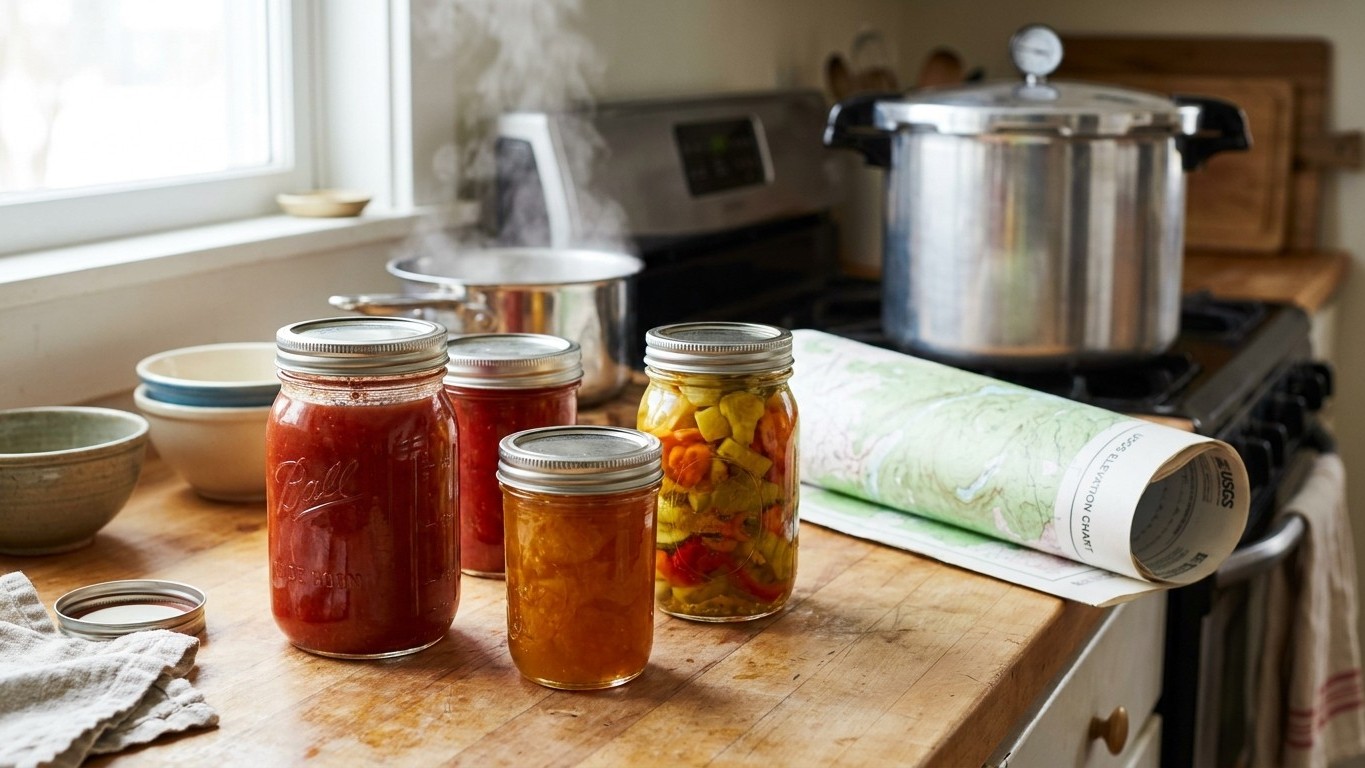

At 528 feet above sea level, Toronto (the reference city Open-Meteo/GeoNames uses for this region) sits well inside the 0-2,000 foot band where water still boils between 208 F and 212 F. For most canners in Ontario, that means no altitude adjustment is needed at all. But Ontario spans a lot of ground, and your own elevation, not Toronto’s, is what actually decides whether your jars need extra time or extra pressure.
The short answer

Toronto’s elevation, 528 feet, falls into the lowest altitude band recognized by home canning guidelines: 0 to 2,000 feet. Inside that band, published boiling temperatures range from 208 F to 212 F, and every tested canning recipe from the USDA Complete Guide to Home Canning already assumes a boil somewhere in that window. If your kitchen sits at roughly the same elevation as Toronto, or anywhere else under 2,000 feet, the standard processing times and pressures printed in a tested recipe apply as written. No math, no adjustment table, no guessing.
That’s the part that trips people up: a single figure gets quoted as “the altitude of Ontario,” as if a province, or a state, had one elevation the way it has one capital. It doesn’t. Ontario stretches from lakeshore towns barely above the waterline to inland areas several hundred feet higher, and canning guidance was never built around a political boundary. It’s built around feet above sea level, full stop. Toronto’s 528 feet is a reference point, useful because it’s a large, well-documented population center, not a stand-in for every kitchen in the region.
Why 2,000 feet is the line that matters
Home canning references split elevation into bands, typically starting at sea level and stepping up every 1,000 or 2,000 feet, because each step changes the boiling point of water by a predictable amount. Below 2,000 feet, that change is small enough that tested recipes don’t require any adjustment. Cross above it, even by a few hundred feet, and the math starts working against you. A cabin in the hills an hour outside a low-lying city can sit in a completely different band than the city itself, even though both would get lumped into “the same region” on a map.
So the honest short answer is this: if you know you’re near Toronto’s elevation, or anywhere under 2,000 feet, you’re in the safe zone where standard processing applies. If you’re not sure, the next section explains exactly why that uncertainty matters, and the one after it shows you how to resolve it in a few minutes.
Why a lower boil is a weaker process
Water doesn’t boil at a fixed temperature. It boils at whatever temperature matches the surrounding air pressure, and air pressure drops as elevation climbs. At sea level, water boils at 212 F. Climb to 10,000 feet, and it boils at 194 F. That’s not a rounding error. It’s an 18-degree gap between two pots of water, both of them “boiling” as hard as they’ll ever boil, doing very different jobs.
Canning works because heat, sustained over time, destroys the microorganisms and enzymes that would otherwise spoil food or make it dangerous. The most serious risk in low-acid canning is Clostridium botulinum, a bacterium that survives easily in a weak heat treatment and produces a toxin with no taste, no smell, and no visible sign in the jar. Boiling-water canning and pressure canning both rely on reaching a specific internal temperature for a specific duration to make sure that risk is eliminated. When the boiling point itself drops because you’re higher up, the entire process runs cooler than the recipe assumed, even though the water is still visibly boiling.
This is where people get fooled. A rolling boil at 194 F looks exactly like a rolling boil at 212 F. Bubbles, steam, the whole visual. So the instinct to “just boil it harder” does nothing, because boiling water cannot get hotter than its boiling point no matter how high you crank the burner. The pot will boil away faster, sure. It won’t run hotter. There’s no shortcut through intensity; the only lever left is time or pressure.
That’s exactly what altitude adjustments compensate for. In a boiling-water canner, used for high-acid foods like most fruits, pickles, and tomatoes with added acid, the fix is more time in the canner, letting the cooler water make up in duration what it lacks in temperature. In a pressure canner, used for low-acid vegetables, meats, and poultry, the fix is more pressure, since pressure is what pushes the internal temperature of the canner above what plain boiling water could ever reach on its own, regardless of elevation. Both adjustments exist for the same reason: to restore the exact thermal kill step the tested recipe was designed to deliver, no matter how thin the air is where you’re standing.
Finding your own elevation
Toronto’s 528 feet tells you nothing about the elevation under your own kitchen counter. Before you touch a canning recipe, you need your number, not the reference city’s. Here’s the order to do it in.
- Start with the National Center for Home Food Preservation’s dedicated page. NCHFP publishes a “Find Your Elevation” resource built specifically so home canners can look up their own altitude instead of guessing from a regional average.
- Enter your specific address or nearest town, not your state or province name. Elevation can shift by hundreds of feet between neighboring towns, so the more local the search, the more reliable the number.
- Note the figure in feet above sea level, and round up if you’re near a band boundary. If you’re sitting close to a threshold like 2,000 feet, treat yourself as being in the higher band; it costs you nothing to over-adjust slightly, but under-adjusting is a real risk.
- Match that number to the altitude band listed in your specific tested recipe. Every properly sourced canning recipe from USDA or NCHFP includes an altitude adjustment table; find the row that corresponds to your elevation, not Toronto’s or anyone else’s.
- Re-check if you move, can somewhere else, or use a relative’s kitchen at a different elevation. Altitude adjustments are location-specific, not recipe-specific; the same jar of salsa needs a different process time in a valley kitchen versus a hillside one.
What goes wrong
- An under-processed jar that looks completely normal. Jars sealed after an under-processed run can seal properly, sit on the shelf for months, and show no bulging, no off odor, no visible spoilage, while still harboring a toxin that never announces itself. The remedy isn’t inspecting the jar harder; it’s getting the elevation-adjusted process right before the jar is ever filled.
- A recipe pulled from a sea-level source without checking its altitude assumptions. Plenty of recipes circulating online were written by or for someone canning near sea level and never mention altitude at all. The fix is to cross-reference any recipe you didn’t get directly from USDA or NCHFP against your own elevation band before trusting its times as written.
- A pressure gauge read as if elevation doesn’t exist. Dial gauges and weighted gauges on pressure canners need to be set to the pressure appropriate for your elevation band, not a flat number memorized from someone else’s canner. Reading 10 pounds of pressure as universally safe, when your elevation calls for more, quietly weakens the entire process the same way a low boil does.
- Treating “close enough” as good enough near a band boundary. Someone at 1,900 feet who assumes they’re still comfortably in the lowest band, without checking, may in fact be one town’s elevation away from needing the next tier of adjustment. The remedy is simple: when in doubt, look it up rather than estimate.
Where the exact adjustment comes from
This page won’t give you a processing time or a pressure setting, and no page should, unless it’s built around the specific food you’re canning. The exact adjustment for your elevation lives inside the tested recipe itself, in the altitude table published by the National Center for Home Food Preservation for that particular food and jar size. A processing time that’s correct for green beans at your elevation isn’t automatically correct for salsa or peaches at the same elevation; each tested recipe carries its own table because acidity, density, and jar size all factor into the math.
The reason this can’t be generalized comes back to what’s at stake. Clostridium botulinum toxin has no taste and no smell, which means a jar processed a few minutes short, or a few pounds of pressure light, gives you no warning before it’s opened. Go to the food’s specific NCHFP tested recipe, find your elevation band in its table, and use the figure printed there.
Common questions
Does Toronto’s elevation apply to my whole area of Ontario?
No. Toronto’s 528 feet is a reference point for a large city in the region, not a figure that describes the whole province. Elevation varies place to place, and your own number is what determines your altitude band.
What if I’m right on the edge between two altitude bands?
Treat yourself as being in the higher band. Adjusting for a slightly higher elevation than you actually have causes no harm, while assuming you’re in a lower band than you really are can leave your process under-strength.
Can I just boil my jars longer without checking the tables?
Guessing at extra time isn’t the same as following a tested adjustment. The correct time depends on the specific food, jar size, and your exact elevation band as published in the recipe’s own altitude table, not on an arbitrary extra ten minutes.
Does altitude change anything for boiling-water canning versus pressure canning?
Yes, differently. Boiling-water canning compensates for elevation with additional processing time, while pressure canning compensates by increasing the pounds of pressure used, since pressure is what raises the canner’s internal temperature above what boiling water alone could reach.