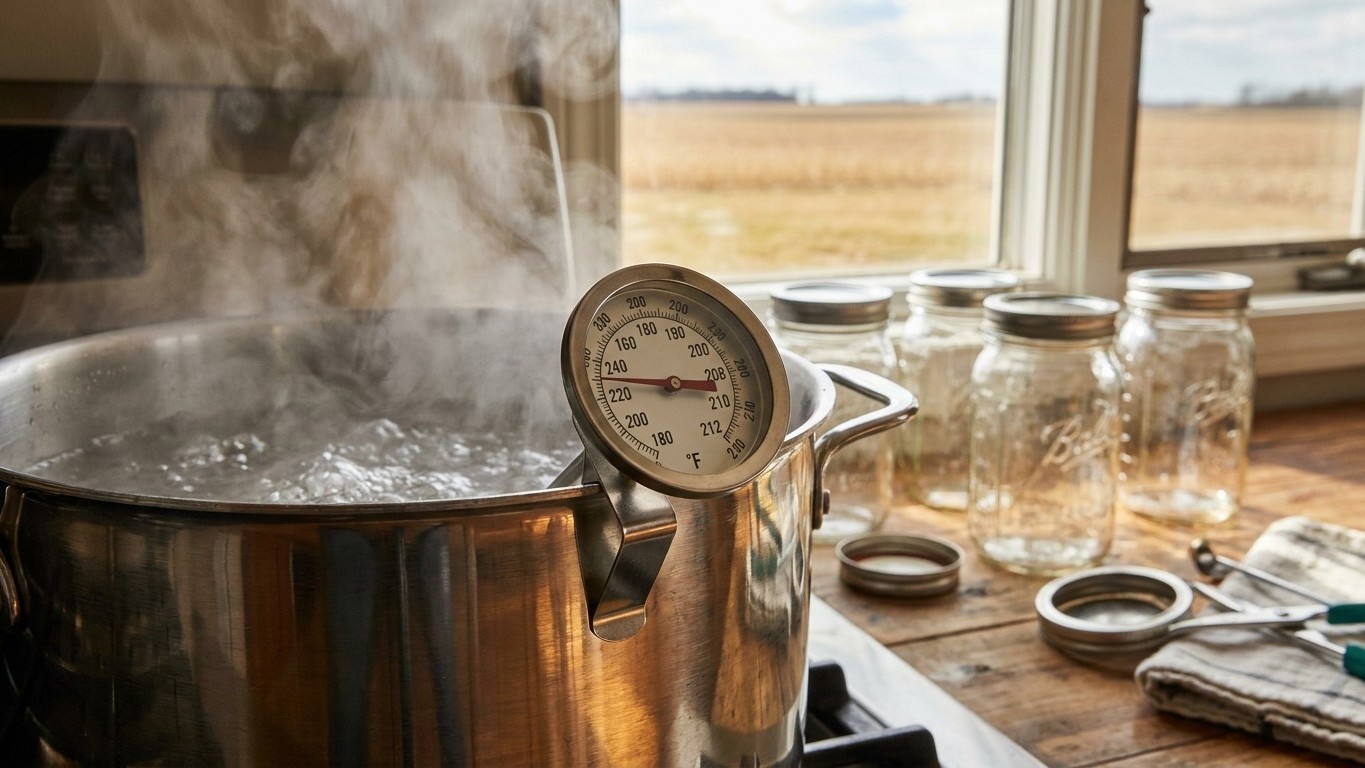

Chicago sits at 587 feet above sea level. At that height, published boiling temperatures for water run between 208°F and 212°F, depending on the day’s barometric pressure. That’s the number worth anchoring to, and it’s an important distinction: Illinois itself has no single elevation. The northern lakeshore, the flat central prairie, and the hillier southern tip near the Ohio River all sit at different heights, so the adjustment that matters is the one at your own address, not the one for the state capital or its biggest city.
The short answer

For a home canner working somewhere close to Chicago’s 587 feet, the honest answer is: probably not much changes. Water there boils between 208°F and 212°F, a range that sits inside the lowest altitude band used in tested canning guidance, the band that runs from sea level up to 2,000 feet. That band is effectively the baseline most published recipes are built around. So if your kitchen sits at 500 feet, or 900 feet, or even close to 1,800 feet, you’re still working inside the same reference zone Chicago falls into.
Compare that to a kitchen at 6,000 feet, somewhere you won’t find in Illinois but that exists across parts of the Mountain West. There, water might struggle to reach 200°F before it’s already boiling as hard as it’s going to boil. Every single jar processed in a boiling-water canner at that height needs more time, and every jar processed in a pressure canner needs more pressure, because the physics of boiling water changed underneath the recipe. Illinois, by contrast, never gets there. Charleston in the far south sits low. Rockford in the north sits low. Even the higher ground near the Mississippi bluffs in the northwest corner of the state stays modest by national standards.
Why this matters even at low elevation
None of this means altitude is irrelevant to every Illinois household. It means the risk is concentrated at the edges: a reader living on genuinely elevated ground, even a few hundred feet higher than a nearby river town, should still check where they actually land rather than assuming the state’s flat reputation applies to their specific yard. Elevation is measured at a point, not a region, and the boiling point of water follows that point exactly. A property built into a bluff, a home at the top of a long grade, or simply a location you’ve never had surveyed can sit meaningfully higher than the surrounding area without looking like it.
The takeaway for most Illinois canners is reassuring but not a free pass: you’re likely inside the band where the difference between 208°F and 212°F barely registers against a tested recipe’s built-in safety margin. But “likely” isn’t “certain,” and the only way to know for sure is to find your own number, not borrow Chicago’s.
Why a lower boil is a weaker process
Water has a ceiling. At sea level, that ceiling is 212°F. Add heat past that point and the water doesn’t get hotter, it just boils harder, throwing off steam faster while the liquid itself stays pinned at 212°F. Climb higher and that ceiling drops. At 10,000 feet, water boils at roughly 194°F. It’s still a rolling boil, it still looks and sounds exactly like the boil at sea level, but it’s a cooler boil, and cooler water kills fewer of the organisms and spores that home canning is designed to destroy.
This is the entire mechanism, and it trips people up because the visual cue lies to them. A pot of water at a hard boil in Denver looks identical to a pot of water at a hard boil in Springfield, Illinois. Nothing about the appearance signals that one is roughly 18 degrees cooler than the other. Cranking up the burner doesn’t fix it either, because once water is at its boiling point for that elevation, more flame just makes it boil more vigorously at the same temperature, not hotter. You cannot boil your way past the ceiling.
That’s why tested recipes build in a compensation that has nothing to do with flame intensity. In a boiling-water canner, the fix is time: jars stay in the boiling water longer at higher elevations, giving the cooler boil more minutes to do the work a hotter boil would have done faster. In a pressure canner, the fix is pressure: the gauge target goes up as elevation climbs, because raising the pressure inside the sealed canner raises the temperature the food actually reaches, independent of what the water itself is doing at atmospheric pressure. Time compensates in one method, pressure compensates in the other, and neither compensates by making the boil look more dramatic.
For Illinois canners near Chicago’s 587 feet, this mechanism is worth understanding even though the practical adjustment may be minimal, because it explains exactly why altitude shows up in canning charts at all, and why “it looked like it was boiling hard” is not a food-safety measurement.
Finding your own elevation
Chicago’s 587 feet describes Chicago. It doesn’t describe a farmhouse outside Galena, a ranch house in the flatlands near Danville, or a bungalow on a rise above the Rock River. Before touching a canning chart, find the number that actually applies to your kitchen.
- Start with your street address, not your city name, since elevation can shift meaningfully within the same town.
- Use the National Center for Home Food Preservation’s “Find Your Elevation” page, built specifically so home canners can look up a location and get a usable figure without needing surveying equipment.
- Enter your address or nearest cross streets as precisely as you can, since a general zip code lookup can smooth over real differences of a few hundred feet.
- Note the elevation in feet, not meters, since American canning charts are built around feet.
- Match that number to the altitude band listed in your specific tested recipe, not to a generic rule of thumb you remember from somewhere else.
- Recheck if you move, even locally, because a few miles in Illinois can shift you from one side of a river valley to the other.
What goes wrong
- The jar that looks perfectly sealed but wasn’t processed long enough. A lower boil at elevation under-processes food that shows no visible sign of the shortfall, since seal formation and safe processing are two different things. The remedy is following the elevation-adjusted time from a tested recipe, never the base time alone.
- A recipe pulled from a sea-level source without checking its origin. Older family recipes, printed clippings, or recipes from a canning book written for a coastal audience often assume conditions that don’t match higher ground. The remedy is confirming the recipe comes from, or has been checked against, current USDA or NCHFP guidance that includes altitude adjustments.
- Reading a pressure gauge as if elevation didn’t exist. A dial or weighted gauge canner needs a pressure setting matched to elevation, not a single number used everywhere. The remedy is checking the gauge target for your specific elevation band before the canner ever goes on the stove.
- Assuming a whole county shares one elevation. Rolling terrain near river bluffs or a home built on a rise can sit higher than the surrounding flatland everyone assumes describes the area. The remedy is looking up the address itself rather than trusting a general sense of the region.
Where the exact adjustment comes from
This page won’t hand you a processing time or a pressure setting, and it shouldn’t. That number belongs to the specific tested recipe for the specific food you’re canning, matched against your specific elevation, and it comes from the National Center for Home Food Preservation, working from the USDA Complete Guide to Home Canning. Guessing here isn’t a small risk. Clostridium botulinum, the organism these adjustments guard against, produces a toxin with no taste and no smell, which means an under-processed jar can look, smell, and taste completely normal right up until it isn’t. Find your elevation, then find the matching tested recipe on the NCHFP site, and use the numbers published there.
Common questions
Does Illinois have one official canning altitude?
No. Illinois spans a range of elevations from its lowest river bottoms to higher ground in the northwest and south. Chicago’s 587 feet is a reference point for one city, not a statewide figure, and every home canner needs their own elevation, not the state’s.
If I live near Chicago, do I need to adjust my canning times?
Chicago’s elevation falls within the lowest published altitude band, the one running from sea level to 2,000 feet, where boiling water reaches between 208°F and 212°F. Many tested recipes treat this band as the baseline. Still, check your own address rather than assuming Chicago’s number applies to your kitchen.
Why does a hard boil not fix a low boiling point?
Boiling water sits at a fixed temperature for its elevation. Turning up the heat once water is already boiling makes it boil more vigorously, not hotter, because the water can’t exceed its boiling point at that atmospheric pressure. The compensation has to come from more time or more pressure, not a bigger flame.
Where should I look up my exact elevation?
Use the National Center for Home Food Preservation’s “Find Your Elevation” page, entering your specific address rather than your city or zip code, since elevation can vary within a few miles or even within a single town.