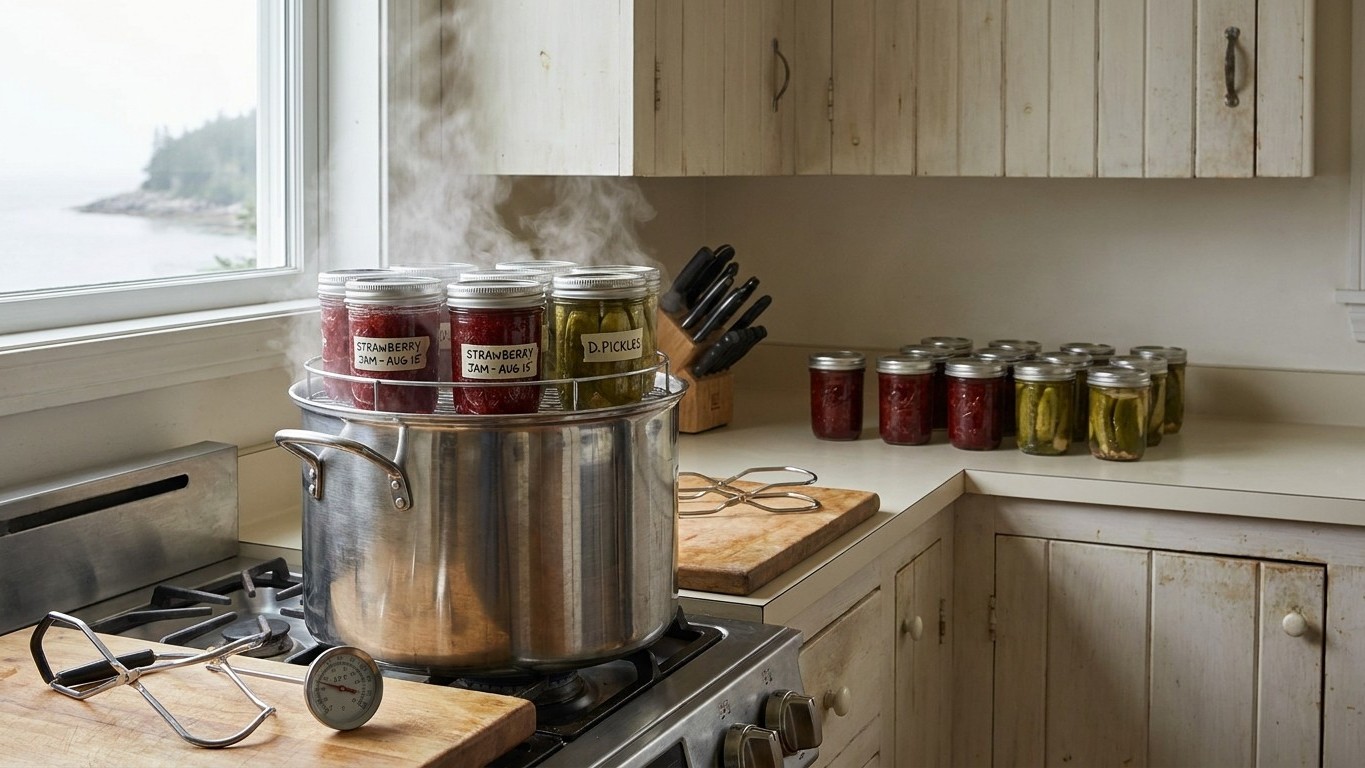

Charlottetown, Prince Edward Island’s capital, sits at 46 feet above sea level, and water there boils somewhere between 208°F and 212°F depending on the day’s barometric pressure. For nearly every canner working across the province, that’s low enough that altitude changes nothing about how a jar is processed. The tested recipe applies as written. But “nearly every” isn’t “every,” and knowing your own elevation, not the capital’s, is what actually protects the jar on your counter.
The short answer

Charlottetown sits at 46 feet above sea level, a figure drawn from geographic elevation data rather than from any canning authority. At that height, water boils somewhere in the range of 208°F to 212°F, the two published figures the USDA’s Complete Guide to Home Canning uses to bracket boiling behavior at low elevation. Forty-six feet is barely a rise at all, closer to sea level than to any band that would call for a longer processing time or a higher canner pressure.
That figure belongs to Charlottetown specifically, not to Prince Edward Island as a whole. The province is small compared to most U.S. states, but small and flat aren’t the same thing. A province-wide average would mean nothing to a canner standing over a stockpot in a specific kitchen, which is exactly why this page names a reference city instead of guessing at a territory-wide number.
For a home canner in or near Charlottetown, 46 feet lands well inside the lowest elevation band the USDA guide recognizes, the band running from sea level up to 2,000 feet. Recipes tested at sea level, with sea-level processing times and sea-level pressure-canner settings, apply here without modification. That’s the practical meaning of “changes nothing”: the boiling point stays close enough to the textbook 212°F that the tested process still delivers its full effect.
Compare that to a canner working at 10,000 feet, where water boils around 194°F, a full 18 degrees cooler than sea level. At that height, every processing time in a boiling-water canner needs lengthening, and every pressure canner needs a higher setting, because a cooler boil is a weaker one. Prince Edward Island’s terrain never approaches that range.
The one caveat worth stating flat out: this page describes Charlottetown’s elevation, not yours. If you can outside the capital, in a slightly higher inland spot or along a coastal bluff, your actual number could differ. Tens of feet rarely matter this close to sea level, but the only way to know for certain is to check, which is covered further down.
Why a lower boil is a weaker process
Water’s boiling point drops as elevation climbs, a straightforward consequence of falling atmospheric pressure. At sea level, water boils at 212°F. Climb high enough and it boils at 194°F, a difference between two pots that both look identical, both roiling and steaming on the stove. The higher pot simply can’t get any hotter than its boiling point, no matter how long it sits on the burner or how high the flame is turned.
That matters for canning because heat, sustained at a specific temperature for a specific duration, is what destroys the microorganisms and enzymes a tested process is designed to eliminate. A jar processed at a cooler boil for the same number of minutes as a sea-level jar receives less total lethal heat. The cooler boil isn’t a cosmetic difference. It’s a measurably weaker process, and a weaker process is exactly what allows survivors, bacterial spores among them, to make it through intact.
The instinct to crank the burner higher when a recipe seems to be underperforming is understandable, and it’s also useless. Boiling water cannot exceed its boiling point at a given elevation, full stop. A harder rolling boil at a higher elevation still tops out at the same temperature; more flame just boils the water away faster, risking a canner running dry, without adding a single degree of extra heat to the jars inside. Vigor isn’t temperature, and that distinction trips up plenty of careful cooks who assume canning problems can be solved the way stovetop cooking problems usually are.
What actually compensates for a cooler boil is time or pressure, depending on which kind of canner is doing the work. In a boiling-water canner, tested recipes at higher elevations call for longer processing times, giving the cooler water more minutes to do the same lethal job a hotter pot does faster. In a pressure canner, the fix runs the other direction: the canner’s pressure setting increases, because raising pressure inside a sealed canner raises the temperature water reaches before it boils, independent of outside elevation. Either way, the adjustment restores the same total heat exposure a sea-level jar receives automatically. Skip it, and the jar looks exactly like a correctly processed one, sealed lid, clear liquid, no sign of trouble, while carrying a process that never quite finished the job.
Finding your own elevation
Charlottetown’s 46 feet describes one point on the map. Your kitchen might sit closer to sea level or somewhat higher, and the only way to know which elevation band applies to your own canning is to look it up rather than estimate from the provincial reference point.
- Start with your street address or the nearest town center, since elevation lookups work from a specific location rather than a general region.
- Visit the National Center for Home Food Preservation’s “Find Your Elevation” page, built specifically to answer this question for home canners without requiring a survey or specialized equipment.
- Enter your location and note the elevation returned in feet, since USDA processing charts are built around feet rather than meters.
- Compare that number to the elevation band listed in the tested recipe you’re using, since USDA canning charts break adjustments into bands rather than a sliding per-foot scale.
- If your elevation falls in a different band than the one assumed by a recipe written elsewhere, follow the adjustment listed for your band rather than the recipe’s default figures.
- Recheck if you move somewhere new. Elevation is fixed to a spot on the ground, not to a general province, and even a modest move can shift which band you fall into.
What goes wrong
- A jar that looks perfectly sealed but was never fully processed. An under-processed jar shows no visible sign of failure: the lid pops down, the liquid looks clear, the seal holds for months on a shelf. The remedy is procedural, not visual, since the only fix is following the elevation-adjusted time or pressure from the start, because inspection after the fact can’t detect a weak process.
- A recipe borrowed from a sea-level source and used without adjustment. Plenty of recipes circulating online or handed down through family were tested at or near sea level and never mention elevation at all. The remedy is checking your own elevation band against the source’s assumptions before starting, and adjusting according to a tested chart rather than the original recipe’s unmodified figures.
- A pressure gauge read as though elevation doesn’t factor in. Dial gauges and weighted gauges both need a pressure setting matched to elevation, and a canner running at a sea-level pressure setting in a location with even a modest elevation increase delivers a cooler process than intended. The remedy is confirming the correct pressure for your specific elevation band before sealing the canner, not adjusting mid-process.
- Treating “close to sea level” as “exactly sea level.” Charlottetown’s 46 feet sits low enough that it rarely requires adjustment, but assuming every location in the province matches that figure skips the one step that actually confirms it. The remedy is looking up the specific elevation for wherever the canning is happening, rather than borrowing the provincial reference point as a stand-in.
Where the exact adjustment comes from
This page names an elevation and the boiling temperatures that bracket it, but it doesn’t publish a processing time or a canner pressure, and it isn’t going to. Those figures belong to the tested recipe for the specific food being canned, not to a general page about elevation. A processing time for green beans differs from one for tomatoes, and both differ again depending on jar size and whether the pack is raw or hot.
The National Center for Home Food Preservation publishes the tested processes, broken out by food and by elevation band, that answer the question this page deliberately leaves open. Its figures come from research confirming that a given time and pressure combination reliably destroys the organisms of concern at each elevation, rather than from tradition or approximation.
The stakes of getting this step from an untested source are worth stating directly. Clostridium botulinum, the organism a correctly elevation-adjusted process is built to destroy, produces a toxin with no detectable taste and no smell. A jar carrying it looks, smells, and tastes exactly like a safe one, which is precisely why the adjustment has to come from a tested source rather than a guess, however reasonable the guess seems.
Common questions
Does Prince Edward Island have one elevation for canning purposes?
No. Charlottetown’s 46 feet is the reference point named on this page, but elevation varies point to point across the province. Check your own location using the NCHFP’s elevation lookup rather than assuming the capital’s figure applies to your kitchen.
Do I need to adjust canning times if I live in Charlottetown?
At 46 feet, Charlottetown falls within the lowest elevation band recognized by USDA canning guidance. Recipes tested at sea level generally apply without modification at this height, though confirming your specific address rather than relying on the city center figure is still the safer step.
Why does boiling water seem the same everywhere if the temperature differs?
Boiling looks identical at every elevation, roiling bubbles and rising steam, because boiling simply means water has reached its maximum temperature at that pressure. What differs is the temperature itself, cooler at higher elevations, even though the water’s visual behavior gives no hint of the difference.
What happens if I use a sea-level processing time at a higher elevation?
The jar receives less total heat than the tested process assumes, which can leave heat-resistant organisms, including bacterial spores, alive inside a jar that otherwise looks and seals normally. There’s no visible way to detect this after the fact, which is why the elevation adjustment has to be applied before processing, not checked afterward.