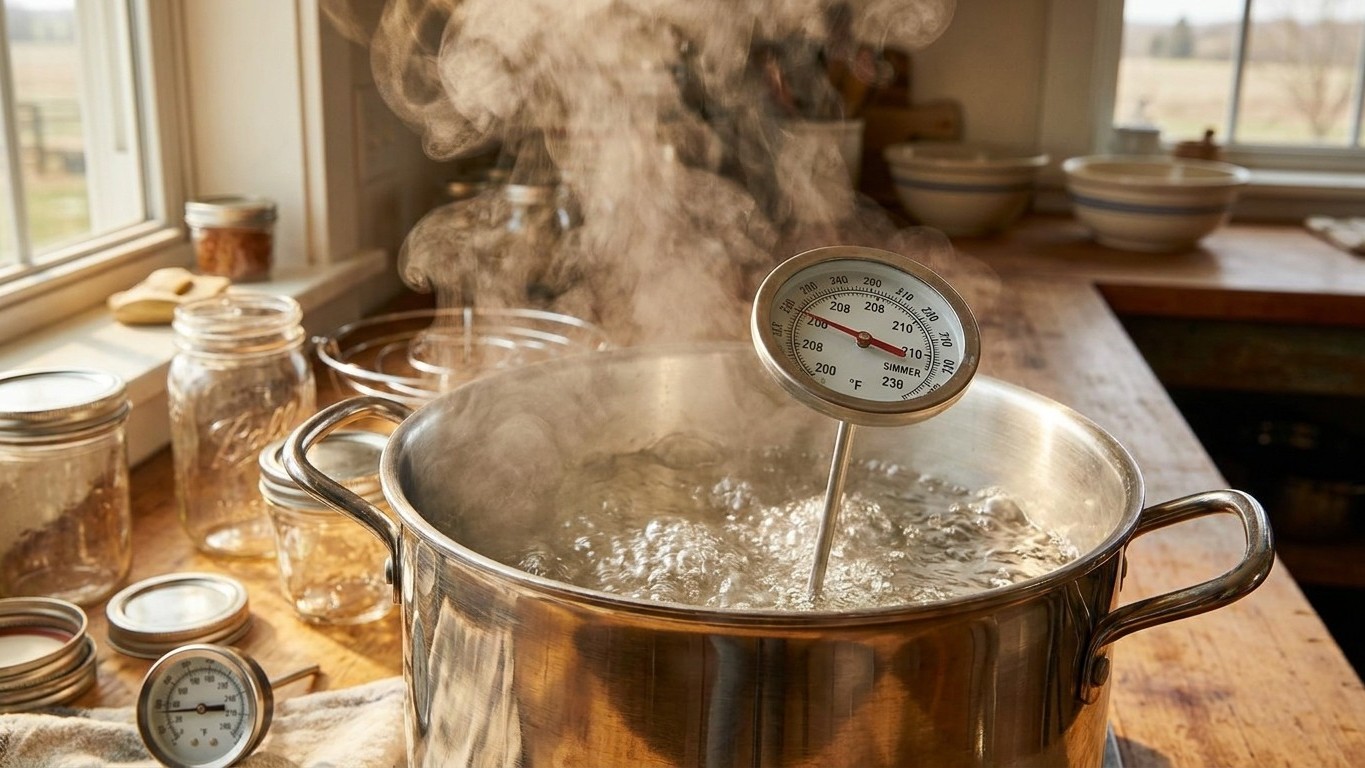

Saskatoon, the reference point used throughout this guide, sits at 1,588 feet above sea level, where published data puts the boiling point of water somewhere between 208°F and 212°F. That’s enough elevation to matter for anyone using a boiling-water canner or reading a pressure gauge. Saskatoon is one point in a province that spans many elevations, so the number that actually governs a canning recipe is the reader’s own elevation, not the city’s.
The short answer

Saskatoon sits at 1,588 feet above sea level. At that elevation, water reaches a boil somewhere between 208°F and 212°F depending on the day’s barometric pressure, according to the USDA’s canning guidance published through the National Center for Home Food Preservation. That’s up to 4 degrees below the textbook 212°F most home canning instructions assume as a baseline, and 4 degrees is not a rounding error when the entire safety margin of a canned recipe rests on heat reaching every part of a jar for a specific number of minutes.
Compare that to two extremes. A cook three feet above sea level watches water boil at essentially 212°F, no adjustment needed, no second thought given to the fine print in a recipe. A cook near 6,000 feet, by contrast, sees water boiling closer to 202°F, and every jar processed in a boiling-water canner needs extra minutes to make up for it, while pressure canner settings shift as well. Saskatoon’s 1,588 feet falls between those two pictures, closer to the “pay attention” side than the “don’t worry about it” side.
That distinction matters because Saskatchewan does not sit at one elevation. Saskatoon is a single reference city, not a stand-in for the whole province. A home canner working in a river valley could be sitting at a noticeably different elevation than a neighbor on higher ground a short drive away, and the boiling point of their water follows the ground under their own kitchen, not a provincial average. That’s why every canning authority asks for a specific elevation figure rather than a state or province-wide one: the adjustment is personal, tied to the exact spot where the stove sits.
The takeaway here is simple. At 1,588 feet, most tested recipes call for some kind of adjustment, whether that means extra minutes in a boiling-water bath or a different pressure setting on a gauge. What that adjustment actually is isn’t something this page hands over, because it depends on the specific food, the jar size, and the tested recipe being followed. What this page can offer is the reasoning behind the number, so the gap between “the water is boiling” and “the jar is safely processed” stops feeling arbitrary.
Why a lower boil is a weaker process
Water boils when its vapor pressure matches the surrounding atmospheric pressure. At sea level, that balance happens at 212°F. Climb higher and there’s less air pressing down, so water reaches that same balance at a lower temperature. This isn’t a quirk of canning, it’s basic physics, and it applies whether the water is in a canner, a coffee pot, or a pot of pasta.
Home canning relies on heat destroying microorganisms, most seriously the spores of Clostridium botulinum, over a specific amount of time. That destruction is a race between temperature and duration. A hotter environment kills faster; a cooler one kills slower and needs more time to finish the job. A boil at 208°F is doing real work, but it’s doing it more slowly than a boil at 212°F, and a recipe timed for sea-level boiling simply doesn’t give a cooler boil enough time to catch up.
Here’s the part that trips people up: boiling water harder does not make it hotter. Turning the burner to maximum, watching the water churn violently, none of that pushes the temperature past its boiling point at that elevation. Water at a rolling boil and water at a gentle boil are the same temperature, they just lose steam at different rates. So cranking the heat on a canner at elevation gives a false sense of security while doing nothing to fix the underlying gap in temperature.
What actually compensates for a lower boiling point comes in two forms, depending on the method. In a boiling-water canner, the fix is time: extending how long jars sit in the boiling water so that the slower, cooler heat still reaches the necessary lethal exposure. In a pressure canner, the fix is pressure: raising the pounds of pressure inside the sealed canner, which in turn raises the temperature the water and steam can reach well above 212°F regardless of outside elevation. Both approaches solve the same problem from different directions, and both come from tested recipes rather than guesswork at the stove.
Finding your own elevation
- Start with the assumption that Saskatoon’s 1,588 feet does not describe your kitchen. Elevation in Saskatchewan varies enough across the province that a few miles can change the number meaningfully.
- Look up your specific elevation using the National Center for Home Food Preservation’s published “Find Your Elevation” page, built for exactly this purpose. It lets you search by location rather than guess.
- If you’d rather use a device you already own, a smartphone’s built-in elevation feature or a dedicated GPS unit will give a serviceable reading, particularly if cross-checked against a second source.
- Write the number down somewhere permanent, next to your canning equipment or in the front of a recipe binder. Elevation doesn’t change, but memory does, and re-guessing it every canning season invites mistakes.
- Match your elevation to the altitude chart published alongside the specific tested recipe you’re using, since charts are organized by elevation bands rather than a single cutoff number.
- Repeat the check if you move to a new home, even within the same city, since a hillside address and a valley address a few blocks apart can land in different elevation bands.
What goes wrong
- A jar that looks perfectly sealed but was never processed long enough. A popped lid and a tight seal only confirm that a vacuum formed, not that the contents reached a safe temperature for a safe duration. The remedy is following the elevation-adjusted time from a tested chart rather than judging safety by appearance.
- A recipe pulled from a source that never mentions elevation at all. Many family recipes and older printed instructions assume sea level without saying so. The remedy is treating any recipe silent on elevation as a sea-level baseline, then applying the adjustment for your own elevation before trusting the timing.
- A pressure gauge read as if elevation doesn’t exist. Dial gauges and weighted gauges respond differently to elevation, and a dial gauge in particular needs periodic testing for accuracy regardless of where it’s used. The remedy is checking the gauge against elevation-specific guidance and having a dial gauge tested rather than assumed correct.
- Turning up the heat to “be safe” instead of adjusting time or pressure. As covered above, a harder boil at a given elevation is still the same temperature. The remedy is trusting the clock or the pressure dial, not the intensity of the boil, to make up the difference.
Where the exact adjustment comes from
This page deliberately stops short of naming a processing time or a canner pressure. Those figures belong to a tested recipe for a specific food, adjusted for a specific elevation, and pulling a number from a general article rather than a food-specific chart risks getting it wrong in a way that isn’t visible until it’s too late. The safe next step is the National Center for Home Food Preservation, which publishes elevation-adjusted processing charts organized by food type and canning method.
The reason this caution matters so much comes down to one fact worth repeating: the toxin produced by Clostridium botulinum has no taste and no smell. A jar that’s under-processed because of an unadjusted elevation can look, smell, and taste completely normal right up until it isn’t. That’s not a risk worth estimating from a general guide, it’s one worth checking against the specific chart built for the food actually going into the jar.
Common questions
Does Saskatchewan have one official altitude for canning purposes?
No. Saskatoon’s 1,588 feet is a reference point for this guide, not a provincial figure. Elevation varies across Saskatchewan, and the number that matters is the reader’s own, found through a personal elevation lookup rather than a province-wide average.
Is 1,588 feet high enough to actually change anything?
It’s high enough that most tested recipes call for some form of adjustment, since it sits well above sea level and pushes the boiling point of water below 212°F. It’s not the kind of dramatic mountain elevation that changes every jar’s chemistry, but it’s not low enough to ignore either.
Can I just boil the water longer instead of following an elevation chart?
Boiling longer at a lower boiling point is exactly what elevation-adjusted processing times account for, but the specific extra minutes come from a tested recipe chart, not a personal guess. Guessing at extra time without a chart risks under-processing in ways that aren’t visible from outside the jar.
Where do I find the exact adjustment for my food and elevation?
The National Center for Home Food Preservation publishes elevation-adjusted charts organized by food and canning method, alongside a page to help locate a personal elevation. Those two tools together give the specific figures this general guide intentionally leaves out.