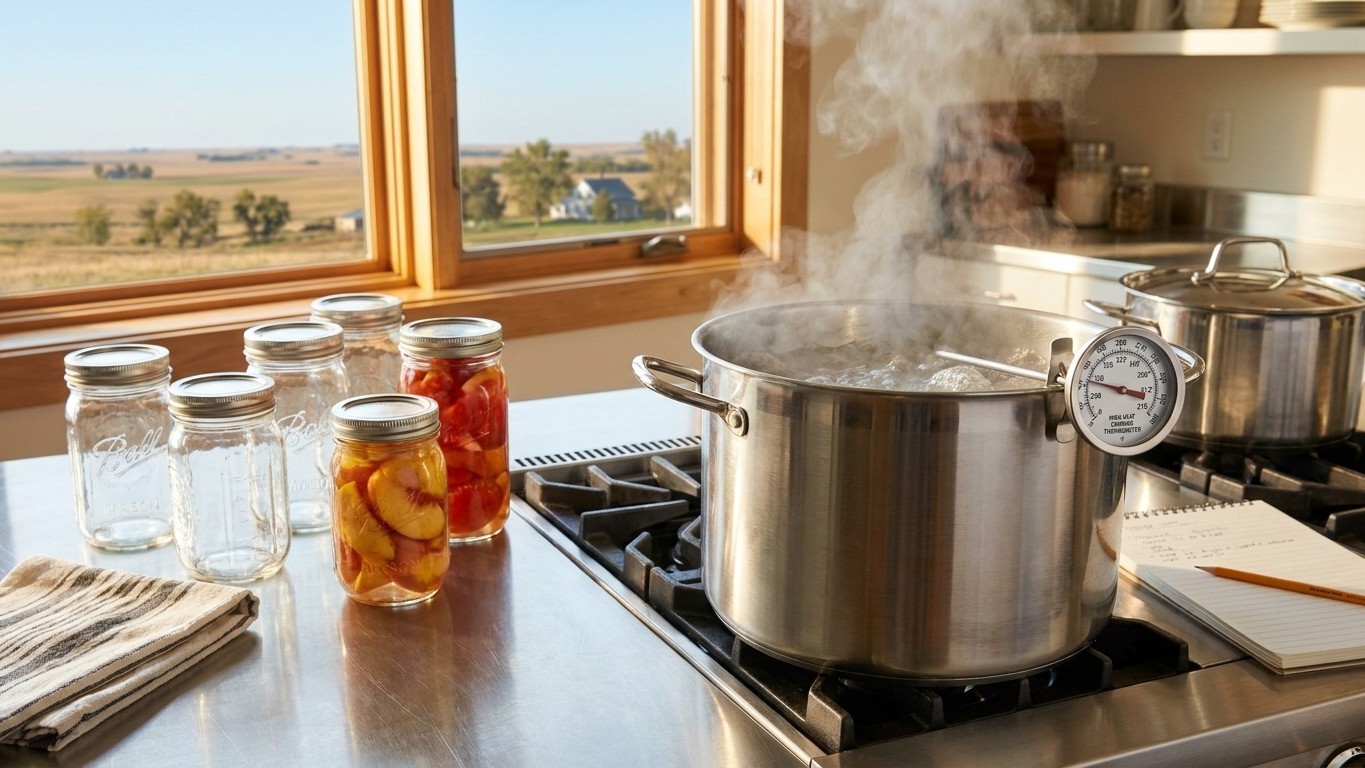

Wichita sits at 1,299 feet, and water there boils somewhere between 208°F and 212°F, not the flat 212°F that most recipes assume. That gap is small compared to the mountain West, but it is not zero. If you live near Wichita’s elevation, you are past the point where a canning recipe written for sea level can be trusted without a second look.
The short answer

Kansas is not one elevation. It runs from river bottoms near 700 feet in the southeast corner to well over 4,000 feet along the Colorado border in the far west. Wichita, the reference city used here, sits at 1,299 feet above sea level, a figure that comes from geographic elevation data, not from any canning authority. At that height, published boiling-point references place water’s boiling temperature between 208°F and 212°F, according to the USDA Complete Guide to Home Canning as republished by the National Center for Home Food Preservation.
That range matters because 212°F is the number baked into almost every processing time you will find printed on a jar lid box or in an old family recipe card. Those times were tested at sea level, where water actually reaches the full 212°F. Once you are canning somewhere that only reaches 208°F or 210°F, the water in your canner is doing less work per minute than the recipe assumed, even though it looks identical, sounds identical, and rolls at a full boil just the same.
Is this a problem for someone canning in Wichita, or in Topeka, or Salina, all sitting in roughly the same elevation band? It is not nothing. Kansas’s population centers cluster mostly under 2,000 feet, a band where many tested recipes still call for standard timing, but a meaningful number of tested recipes shift their instructions once you cross into higher terrain within the state, particularly toward the western third. The honest answer is that the number that matters is not Wichita’s, and it is not an average for Kansas. It is the elevation of the kitchen where the jars are actually going into the canner.
Why the reference city isn’t your answer
Someone canning tomatoes in Garden City, out toward the Colorado line, is working at a meaningfully higher elevation than someone in Pittsburg near the Missouri border. Both are Kansans. Neither one should use “Kansas” as their altitude. The state figure only exists here to anchor the discussion; your own address is the number a tested recipe actually needs.
Why a lower boil is a weaker process
Here is the entire mechanism, and it is simpler than most people expect. Water boils when its vapor pressure matches the surrounding air pressure. Air pressure drops as elevation rises, so water reaches its boiling point at a lower temperature the higher up you go. At sea level that’s 212°F. Climb toward 10,000 feet and boiling water tops out around 194°F. Nothing about the water itself changes; the ceiling on how hot it can get just moves lower.
A canner full of boiling water at 208°F is not doing the same job as one at 212°F, even though both look like a rolling boil. Heat, not motion, is what destroys microorganisms and inactivates enzymes during processing. A cooler boil delivers less thermal energy into the jar over the same stretch of time, which means the center of that jar of green beans or peach halves takes longer to reach a temperature high enough to make the food safe for storage on a shelf.
This is where a common instinct backfires. Cranking the burner higher, or letting the canner “really rip” at a vigorous boil, does not raise the temperature of that water past its boiling point. Boiling water cannot get hotter than its boiling point, no matter how hard it boils. All that extra heat does is boil off water faster and waste fuel. The temperature ceiling is fixed by elevation, full stop, and no amount of visible bubbling pushes past it.
What actually compensates for a cooler boil is time, or in the case of pressure canning, added pressure. In a boiling-water canner, tested recipes extend the number of minutes food spends processing once you’re above a given elevation, giving the lower temperature more time to do the same job. In a pressure canner, the fix runs the other direction: pressure raises the temperature inside the sealed canner above what a simple boil could reach, so the tested adjustment usually means dialing in a higher pressure rather than a longer clock. Either path solves the same problem: a lower boiling point needs something added back, in minutes or in pounds, to reach the safety margin the original tested process was built around.
Finding your own elevation
- Start with a street address, not a city name. Even within one Kansas town, elevation can shift by a hundred feet or more from one side to the other, and canning adjustments are sometimes based on bands that a small shift can cross.
- Check a USGS topographic reference or a reliable mapping tool that reports elevation in feet for a specific point, rather than relying on memory or a rough guess from driving distance to a known landmark.
- Use the National Center for Home Food Preservation’s “Find Your Elevation” page, built for exactly this purpose, to confirm the number against a source built specifically for home canners rather than a general travel site.
- Round conservatively. If your address sits close to a boundary between two altitude bands in a tested recipe’s chart, treat yourself as belonging to the higher band rather than the lower one.
- Write the number down somewhere it will actually get used, like taped inside a canning cupboard, since this is not a figure most people remember accurately season to season.
What goes wrong
- An under-processed jar that looks perfect. A jar sealed with a good pop, clear liquid, and no bulge can still have received too little heat if the elevation adjustment was skipped. Nothing about the visible seal tells you whether the center of the food reached a safe temperature for the full tested time. The remedy is to apply the correct adjustment before processing, never to judge safety by appearance afterward.
- A recipe copied from a sea-level source. Older family recipe cards, out-of-state cookbooks, and many recipes found online were tested at or near sea level and carry sea-level times. Used as-is anywhere above that baseline, they under-process the food. The fix is to match the recipe against a current tested source that publishes elevation adjustments for that specific food, not to assume the original author accounted for it.
- A pressure gauge read as if elevation didn’t exist. Both dial and weighted gauges need their target pressure raised for elevation, and a dial gauge specifically should be checked periodically for accuracy, since a gauge reading low will process food at less pressure than the display suggests. Skipping this check and canning at a “standard” pressure figure ignores exactly the adjustment altitude requires.
- Treating one part of Kansas like another. A tested time confirmed once for a kitchen near Wichita does not automatically carry over to a relative’s kitchen in western Kansas at a noticeably higher elevation. Each kitchen’s own elevation needs its own check against the tested chart, not an inherited number from somewhere else in the state.
Where the exact adjustment comes from
This page will not give a processing time or a canner pressure, and it should not. The correct adjustment for altitude belongs to the specific tested recipe for the specific food, published by the National Center for Home Food Preservation, and it varies by the food itself, the size of the jar, and the method of canning. Guessing, estimating, or borrowing a number from an unrelated recipe removes the safety margin that testing built in.
The reason this matters more than it might seem: Clostridium botulinum, the organism a proper canning process is built to control, produces a toxin with no taste and no smell. A jar that under-processed can look, smell, and taste completely normal right up until it makes someone seriously ill. There is no shortcut around a tested source when that is the risk on the other side of a skipped step.
Common questions
Does Wichita’s elevation mean all of Kansas needs the same altitude adjustment?
No. Wichita’s 1,299 feet is a reference point, not a statewide figure. Kansas spans elevations from roughly 700 feet to over 4,000 feet, so a kitchen in the western part of the state may need a different adjustment than one near Wichita.
Why does boiling water harder not fix a lower boiling point?
Because boiling water cannot exceed its boiling point regardless of how vigorously it bubbles. A harder boil at 208°F is still 208°F; it just consumes more fuel and boils off water faster without adding heat capacity.
Do I need to worry about altitude if I’m using a pressure canner instead of a water bath?
Yes, but the fix looks different. Pressure canners compensate for elevation by raising the pressure setting, since higher pressure raises the internal temperature above what boiling alone could reach at that elevation.
Where do I find the actual adjusted time or pressure for my recipe?
The National Center for Home Food Preservation publishes tested adjustments by food type and elevation band. That is the source to check for the specific number, not this page or a general estimate.