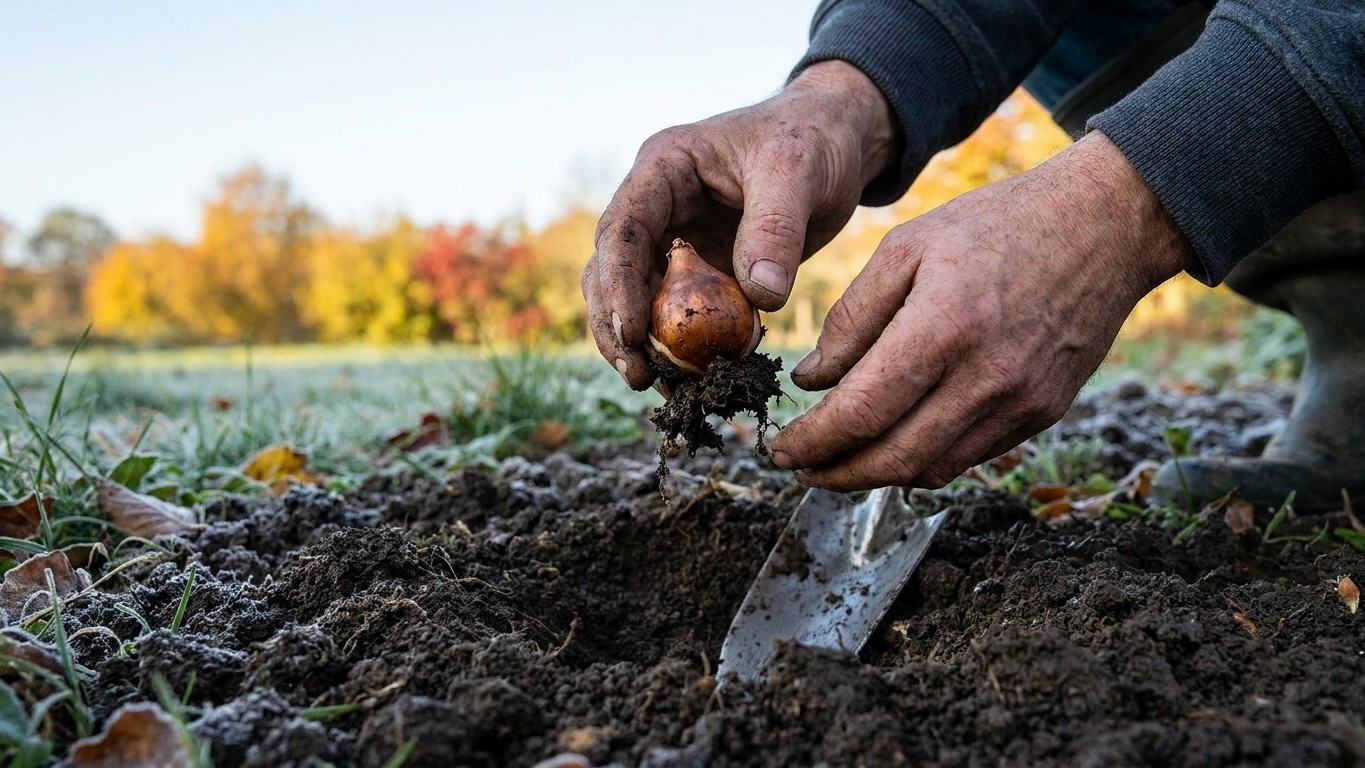

Spring Bulbs in Saskatchewan face two separate tests before they ever bloom: they have to go in the ground on a schedule that beats the freeze, and they have to be varieties that actually want the cold this province delivers. Get either one wrong and you get leaves with no flowers, or nothing at all.
When to plant bulbs in Saskatchewan

The average first fall frost at the Saskatoon SRC station lands on September 18, according to Environment and Climate Change Canada’s 1981-2010 climate normals. That date is the anchor for the planting window, not a deadline in itself. Spring bulbs go into the ground once the soil has cooled below the mid-50s Fahrenheit but before it locks up hard for winter, and the standard rule of thumb, roughly six weeks ahead of a hard ground freeze, puts most of Saskatchewan’s planting window somewhere between mid-September and mid-to-late October, depending on how quickly the cold settles in that particular year.
What happens at each end of the window
Plant too early, while the soil is still warm from summer, and a bulb reads that warmth as a signal to grow. It pushes top growth before winter arrives, and that growth gets killed by the first hard frost, weakening the bulb before it has even rooted properly. Plant too late, after the ground has already gone cold and started to firm up, and the bulb never gets the six to eight weeks of root establishment it needs before freeze-up. The result the following spring is a stunted plant, a flower that never opens fully, or in a bad year, nothing above ground at all.
Here’s the part gardeners tend to forget: September 18 is a mean date, not a guarantee. Half of all years on record fall later than that average, sometimes by two or three weeks. A gardener who plants strictly by the calendar date risks either the early-warmth problem or the late-freeze problem, depending on which side of the average that particular fall lands on. The safer approach is to watch soil temperature directly, or at minimum wait for the first light frost to actually happen before committing bulbs to the ground, rather than planting by a fixed day on paper.
Whether your winter is cold enough
This is the question that decides whether spring bulbs are worth planting at all in a given place, and it gets skipped more often than it should. A spring bulb needs a long stretch of cold, typically twelve to fourteen weeks with soil temperatures below about 45°F, to complete the internal process that turns a bulb into a flower rather than just a leafy stem. Skip that chilling period and the bulb still comes up, but it produces foliage with no bloom, or a flower bud so short it barely clears the soil line. That twelve-to-fourteen-week, 45°F threshold is the number every bulb buyer should carry with them, whether they’re gardening in a place that clears it easily or one that barely does. Gardeners who want more control over that chilling period, or who want blooms well before the outdoor season allows, can also look into Forcing Spring Bulbs Indoors in Saskatchewan, which replicates the same cold requirement in a refrigerator or cold room. Gardeners without reliable in-ground chilling, or those wanting more control over the process, can also look into Growing Spring Bulbs in Containers in Saskatchewan.
What Saskatchewan actually delivers
Saskatchewan clears that threshold by a wide margin. The mean daily minimum temperature in the coldest month at the Saskatoon reference station is -5.3°F, and the province sits in Canadian plant hardiness zone 3a (a rating built on Natural Resources Canada’s own seven-variable system, not the USDA scale used elsewhere on this site, and the two are not interchangeable). Ground here stays well below 45°F for months, not weeks, running from roughly late fall through the tail end of winter under snow cover. That length of cold is several times over what any common spring bulb requires, which means the chilling question is effectively settled here before it’s even asked. No pre-chilling in a refrigerator, no shortcuts, no special treatment needed for standard tulips, daffodils, crocus, or alliums.
That margin matters because it flips the whole conversation for Saskatchewan gardeners. In places where winter barely reaches the chill threshold, buyers have to pre-chill bulbs themselves, typically twelve weeks in a refrigerator kept away from ripening fruit, since the ethylene gas fruit gives off kills the flower bud inside the bulb before it ever gets planted. Saskatchewan skips that step entirely. The open question here isn’t whether a bulb gets enough cold. It’s whether the bulb can survive being left outdoors, unprotected, through a winter that reaches -5.3°F on an average night in January, which is a hardiness question rather than a chilling one.
| Species | Weeks of cold needed (below ~45°F) | What Saskatchewan delivers | Verdict |
|---|---|---|---|
| Tulips | 12-14 weeks | 20+ weeks under snow cover | Clears easily, no pre-chilling needed |
| Daffodils | 12-16 weeks | 20+ weeks | Clears easily |
| Crocus | 8-15 weeks, varies by species | 20+ weeks | Clears easily |
| Hyacinths | 12-14 weeks | 20+ weeks | Chilling clears; hardiness is the real limit |
| Alliums | 8-10 weeks | 20+ weeks | Clears easily |
Which bulbs suit Saskatchewan
Once the chilling question is settled, the limiting factor becomes straightforward cold hardiness: can the bulb survive being left in the ground through a winter that averages -5.3°F on the coldest nights. Nursery tags almost always list hardiness using the USDA scale rather than Canada’s zone map, and the two systems don’t convert cleanly, but as a practical matter a bulb tagged hardy to USDA zone 3 is built to take exactly the kind of winter Saskatchewan delivers.
The following bulbs are rated hardy enough for this territory and meet the cold requirement described above without any special treatment:
- Darwin Hybrid tulips, hardy USDA zones 3-7
- Species tulips such as Tulipa tarda, hardy zones 3-8
- Daffodils and narcissus, hardy zones 3-8
- Crocus, hardy zones 3-8
- Siberian squill (Scilla siberica), hardy zones 2-8
- Snowdrops (Galanthus), hardy zones 3-7
- Smaller alliums such as Allium moly, hardy zones 3-8
Bulbs that disappoint here
Hyacinths sit right at the edge, rated to zone 4 by most nurseries, and while they often survive a Saskatchewan winter with a heavy mulch layer, they tend to weaken over a few years, coming back with shorter stems and fewer flowers until they fade out. Anemone blanda, hardy only to zone 5, simply freezes out over winter and rarely returns a second spring. Ranunculus and freesia, rated to zones 8-10, aren’t a marginal case at all; they will not survive an outdoor Saskatchewan winter under any circumstances and have to be treated as one-season annuals or lifted and stored, which defeats the point of planting them as Spring Bulbs in the first place. A hardiness range near the edge, like zone 4 for hyacinths, isn’t an absolute line either way: a sheltered spot against a south-facing foundation can carry a borderline bulb through, while the same variety planted in an open, wind-scoured bed often doesn’t make it.
What digs them up here
Squirrels and voles are selective, and the pattern isn’t random. It comes down to chemistry inside the bulb itself. Daffodils contain lycorine, a compound that makes them bitter and mildly toxic, and alliums carry the same sulfur compounds that make onions unappealing to rodents. Tulips and crocus have no such defense, and both rank among the most reliably raided bulbs in any garden bed.
Bulbs squirrels and voles take
- Tulips
- Crocus
Bulbs they leave alone
- Daffodils and narcissus
- Alliums
- Snowdrops
- Siberian squill
For the bulbs on the vulnerable list, one measure actually works: laying wire mesh flat over the planting bed and pinning it down until the ground freezes solid, which blocks digging without blocking growth once shoots come up in spring. Repellent sprays and granules get pitched as a solution, but they wash off with the first rain or watering and need reapplying constantly to have any effect at all, which makes them a poor match for a bulb bed planted once in fall and left alone until spring.
Where to check for your own county
Every figure above, the September 18 frost date, the -5.3°F coldest-month minimum, the zone 3a rating, comes from a single reference station: Saskatoon. Saskatchewan stretches across a huge range of latitude, from the grain belt in the south to boreal forest in the north, and a planting calendar built around Saskatoon can run two or three weeks off for a garden near Prince Albert or up toward La Ronge, and just as far off in the other direction down near Estevan.
Saskatchewan doesn’t use counties the way U.S. states do; local government runs through Rural Municipalities, and the province’s agriculture ministry maintains a farmers’ and gardeners’ resource hub with regional contacts. Before locking in a planting date based on provincial averages, check the Saskatchewan agriculture and natural resources office for guidance closer to your own soil and microclimate, since a date that works in the South Saskatchewan River valley isn’t the same date that works two hours north.