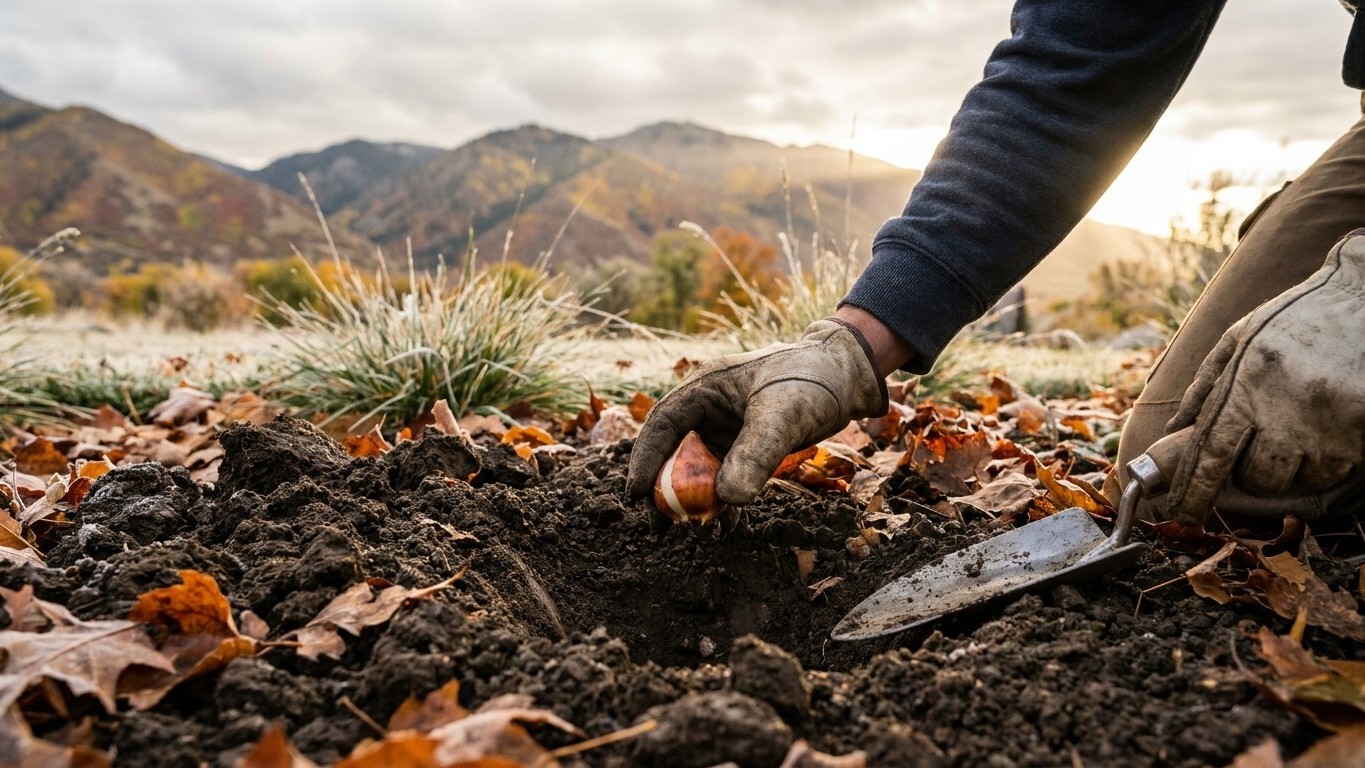

Spring bulbs planted in Utah face two separate tests: does the ground stay open long enough this fall to root, and does the winter stay cold long enough to force a bloom next spring? The answers differ by bulb, by elevation, and by which end of the state you garden in.
When to plant bulbs in Utah

Bulbs need soil that has cooled from summer heat but hasn’t yet locked up hard. That window opens once nighttime temperatures settle into the 40s and closes once the ground freezes solid, and the rule of thumb gardeners use nationwide is to get bulbs in about six weeks before that hard freeze arrives. In the Salt Lake Valley, the closest usable marker is the average first fall frost, which lands between October 18 and October 29 according to NOAA’s 1991-2020 climate normals for station USW00024127 in Salt Lake City. That puts the practical planting window for most valley gardeners from roughly early-to-mid September through the last week of October, with some flexibility running into November since a light frost isn’t the same as a frozen soil profile.
What happens at each end of the window
Plant too early, while soil is still warm from summer, and a bulb often pushes soft top growth before winter arrives. That growth gets nipped by the first hard freeze, and the bulb spends its stored energy recovering instead of building the root system it needs. Plant too late, after the ground has already started to firm up, and the bulb goes into winter without rooting at all. It may still flower the following spring, but often weakly, on a short stem, or not until a full year later once it’s had time to catch up.
One thing worth saying plainly: the frost dates above are averages built from thirty years of data, which means roughly half of all years fall on the early side of that range and half on the late side. A gardener who waits until October 29 on the calendar is gambling that this particular year runs true to average, and in Utah’s mountain and high-desert climate, it often doesn’t.
Whether your winter is cold enough
This is the question that decides whether a spring bulb blooms at all, and it has nothing to do with whether the bulb survives. A tulip, daffodil, or hyacinth needs a sustained cold spell, typically twelve to fourteen weeks with soil temperatures below about 45°F, to complete the internal chemistry that turns a bud into a flower. Skip that requirement and the bulb doesn’t die. It just leafs out in spring with no flower, or with a bloom stalk too stunted to clear the foliage. That figure, twelve to fourteen weeks below 45°F, is the number every gardener needs regardless of where they live, because it’s the yardstick for judging any bulb offered at a nursery or in a mail-order catalog, and it’s the same chilling period gardeners have to recreate artificially when Forcing Spring Bulbs Indoors in Utah.
Utah clears that bar with room to spare, at least at the elevations most people garden in. The coldest month at the Salt Lake City reference station averages a daily minimum of 24.2°F, more than 20 degrees below the 45°F threshold, and that cold isn’t a brief dip. In most valley locations, soil temperatures stay under 45°F from sometime in November through February, a stretch well past the minimum any common spring bulb requires. That margin means Salt Lake Valley gardeners, and most of the rest of the state outside the warmest low-desert corners, don’t need to pre-chill bulbs before planting. Buy them, plant them on schedule, and the winter does the rest.
| Bulb | Weeks of cold below 45°F required | What the Salt Lake Valley delivers | Verdict |
|---|---|---|---|
| Tulips | 12-14 weeks | Roughly 4 months (Nov-Feb) below 45°F, coldest month averaging 24.2°F minimum | Meets requirement with wide margin, no pre-chill needed |
| Daffodils | 12-14 weeks | Same | Meets requirement easily |
| Hyacinths | 12-14 weeks | Same | Meets requirement easily |
| Crocus | 8-15 weeks depending on species | Same | Meets requirement across all common species |
| Grape hyacinth (Muscari) | 10-12 weeks | Same | Meets requirement, one of the least demanding bulbs anyway |
The exception sits at the state’s warm edge, around St. George and the southwest corner, where winter lows run considerably milder than the Salt Lake reference and the margin above the 45°F threshold narrows. Gardeners there should treat the chill requirement as a real constraint rather than an automatic pass, and consider pre-chilling tulips and hyacinths for twelve weeks in a refrigerator crisper drawer, kept away from apples, pears, or any ripening fruit, since the ethylene gas fruit gives off can kill the flower bud inside a chilling bulb. Skip that step in a marginal climate and the bulb still comes up. It just won’t bloom, which makes the whole purchase money spent for nothing but green leaves.
Which bulbs suit Utah
Utah’s statewide hardiness range runs from USDA zone 4a in the high mountain valleys to zone 9a in the low desert around St. George, based on the USDA Plant Hardiness Zone Map’s 1991-2020 normals. That’s a wide spread built on one variable, the average annual extreme minimum temperature, so a bulb rated for the state doesn’t mean it thrives in every corner of it. The following do well across most of Utah’s populated elevations, including the Salt Lake Valley reference point:
- Tulips (Tulipa) — hardy zones 3-7, solid through most of Utah, marginal in the warmest zone 8-9 pockets
- Daffodils (Narcissus) — hardy zones 3-8, reliable statewide except the very warmest desert edges
- Crocus — hardy zones 3-8, dependable and often the first bloom of the year
- Hyacinth — hardy zones 4-8, good match for valley and mountain gardens alike
- Grape hyacinth (Muscari) — hardy zones 3-8, low-maintenance and reliably perennial
- Allium — hardy zones 3-8, tolerant of Utah’s dry summers once established
A few bulbs sold in the same nursery aisle will disappoint, and it’s worth knowing how before spending money on them. Ranunculus, hardy only to zone 8, doesn’t survive an open Utah winter outdoors in most of the state; it either freezes outright or needs to be dug and stored, which most gardeners never planned for. Anemone coronaria, hardy zones 7-10, sits at the edge of viability even in the mildest Utah locations and typically gives one good spring before fading. Freesia, hardy zones 9-10, is simply not built for Utah cold and will rot or freeze in the ground rather than come back. None of these are hard lines; a bulb rated for zone 8 sometimes survives a sheltered, south-facing bed against a heated foundation wall and dies the same winter six feet away in an open lawn. But treating the rating as a rough guide rather than a guarantee saves a second trip to the garden center.
What digs them up here
Squirrels and voles are selective, and the selection comes down to chemistry rather than which bulb happens to be easiest to find. Daffodils and every member of the allium family contain compounds that make them bitter or mildly toxic, and most rodents leave them alone entirely. Tulips and crocus have no such defense and rank among the most frequently dug and eaten bulbs in any Utah yard.
- Bulbs rodents typically leave alone: daffodils, alliums, grape hyacinth
- Bulbs rodents typically dig and eat: tulips, crocus, hyacinth
The one method with a real track record is physical exclusion: laying a sheet of galvanized wire mesh directly over a newly planted bed and pinning it down until the ground freezes hard. Bulbs still send up shoots through the mesh openings in spring, but the digging window closes before rodents get a chance. Repellent sprays and granules sold for this purpose wash off with the first watering or fall rain, and reapplying them through the entire six-to-eight week vulnerable period is more work than most gardeners keep up with.
Where to check for your own county
Every figure above traces back to a single reference point, the Salt Lake City station used in NOAA’s climate normals, and Utah’s geography makes that point a poor stand-in for the whole state. A range running from 4a in the Uinta Mountains and high Wasatch valleys to 9a around St. George means a planting date or frost window calculated for the Salt Lake Valley can be off by two to three weeks in either direction once you climb a few thousand feet or drop into the southwest corner. Gardeners in Logan, Park City, or Bear Lake are typically planting earlier and banking on an even longer, colder winter than the numbers here suggest. Gardeners near St. George are working with a narrower cold margin and should treat the pre-chilling advice above as more than a footnote.
Utah State University’s Cooperative Extension Service, the state’s official land-grant extension program, maintains county-level offices with planting calendars and frost data specific to local conditions. Checking with the USU Extension office for your own county before finalizing a fall planting date accounts for the elevation and latitude swings a single statewide article can’t capture.