
Alabama gardens face a rough combination during peak summer: rainfall drops to its lowest point right when heat pushes evaporation to its highest. Knowing exactly how much water a bed gets from the sky, and how much a gardener has to supply by hand, turns a guessing game into a routine that actually works.
What changes here

August is the driest summer month at the reference station used for these normals, delivering 3.55 inches of rain for the whole month. That same station logs 58.5 days a year at 90F or hotter. Put those two together and the message is simple: the month when a garden needs the most water is also the month the sky provides the least of it.
Spread that 3.55 inches across the roughly 4.3 weeks in August and the sky delivers about 0.8 inches of water a week on average. A vegetable bed or a young shrub generally wants close to an inch of water a week to keep growing without stress. That leaves a gap of roughly a quarter inch that has to come from a hose, a soaker line, or a watering can, week after week, for the whole month.
That quarter inch doesn’t sound like much until the heat load gets factored in. With nearly two months of the year sitting at 90F or above, a lot of what does fall as rain evaporates off the soil surface before roots ever reach it, especially when it arrives as a short afternoon thunderstorm rather than a slow, soaking rain. The same rainfall total behaves very differently depending on the ground underneath it. A sandy bed lets water drain through within hours, so that quarter-inch deficit shows up again in just a couple of days. A heavy clay bed holds moisture far longer, sometimes for the better part of a week, which changes how often a gardener needs to step in but not how much water the plants ultimately need over the course of the month.
None of this is a forecast for any single week. It’s what the reference station’s climate normals show as typical for the period 1991 to 2020. A gardener’s own yard, with its own slope, shade, and soil, will run a little wetter or drier than that average, which is exactly why the numbers below are a starting point rather than a fixed rule.
How to water when it matters
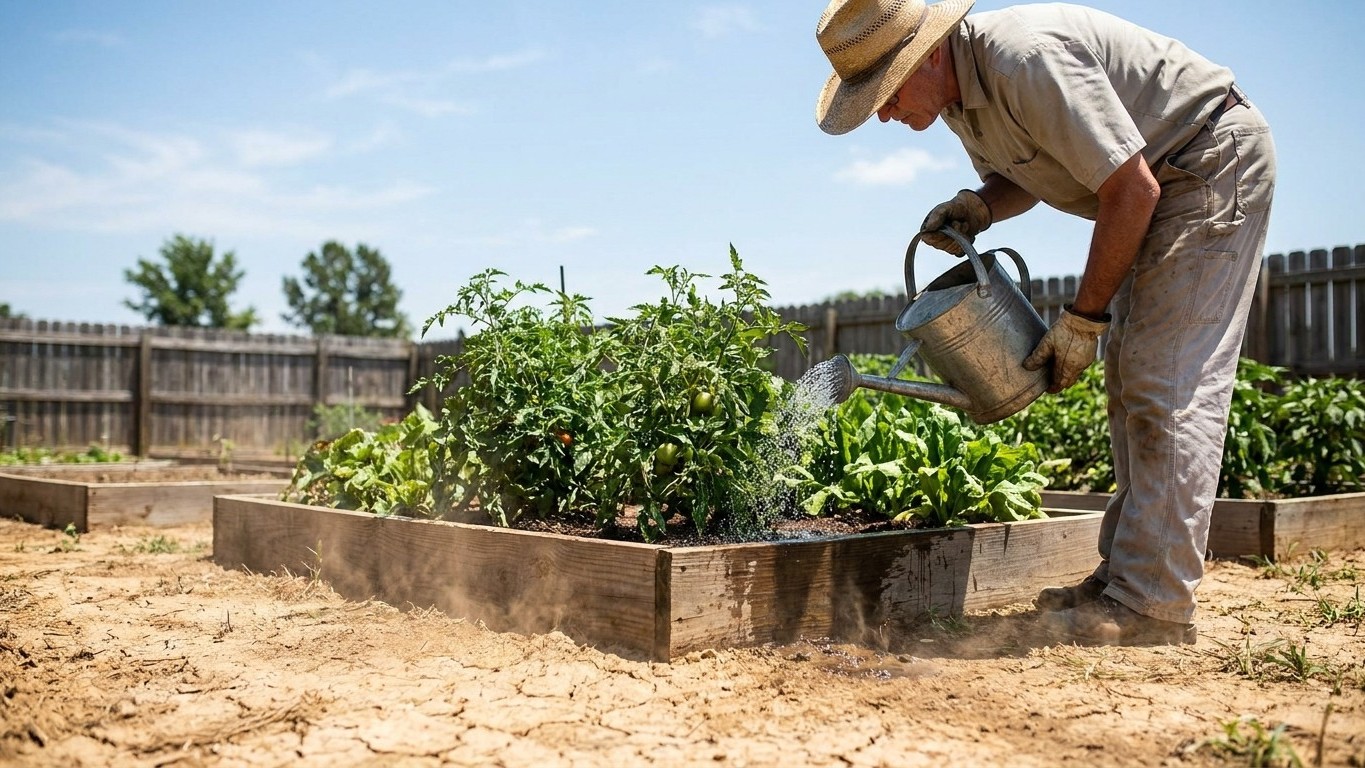
The method that works during an Alabama dry spell isn’t complicated, but it goes against instinct for a lot of new gardeners. Watering deeply and infrequently, at the base of the plant, in the morning, does three specific jobs that a quick daily sprinkle can’t do.
A deep soak pushes water several inches down, which is exactly where roots grow when they’re encouraged to chase moisture rather than sit near the surface waiting for the next light rain. Watering at the base instead of overhead keeps the leaves dry, which matters because wet foliage sitting overnight is what lets fungal disease get a foothold. And morning watering gives the soil surface time to dry out before evening, cutting down that same disease risk while also reducing how much water is lost to evaporation compared with watering under the midday sun.
Checking the soil before turning on the hose beats watering on a fixed schedule. A finger pushed two inches into the ground, or a trowel pulled up for a quick look, tells a gardener whether the root zone is actually dry or whether the surface just looks that way after a hot afternoon. Soil that’s dark and cool below the surface doesn’t need water yet, no matter how crusty the top inch looks.
Soil texture changes the rhythm of this routine more than almost anything else. Sandy ground holds very little water, so it calls for shorter, more frequent soakings, sometimes every two to three days during the driest stretch of August. Heavy clay holds a week’s worth of water at once, but watering it again before it has dried invites root rot, since roots sitting in saturated clay are effectively drowning even though the surface looks fine.
A reasonable starting point for most garden beds during a dry August is about one inch of total water a week, counting both rainfall and hand-watering, delivered in one or two deep sessions rather than daily light ones. That number is a baseline to check against, not a rule, since sandy and clay soils will each pull it in a different direction.
- Check the soil two inches down with a finger or trowel before watering, rather than judging by how the surface looks.
- Water at the base of the plant, using a soaker hose or the tip of a watering can, not an overhead sprinkler.
- Water in the early morning so the soil has all day to absorb it and the foliage dries before evening.
- Aim for about one inch of total water per week on most beds, adjusting the frequency for sandy soil (more often, smaller amounts) or clay soil (less often, letting it dry between sessions).
- Add two to three inches of mulch around the base to slow evaporation between waterings, especially through the driest weeks of August.
What goes wrong
Watering a little every day
A light daily sprinkle feels responsible, but it wets only the top inch or so of soil. Roots follow the water, which means they stay shallow and close to the surface where summer heat bakes them hardest. When a hot, dry stretch hits, those shallow roots have nowhere deeper to draw from and the plant wilts fast, even though it’s technically been watered every single day.
Watering the leaves at night
Running a sprinkler in the evening because it’s cooler and more comfortable to be outside sounds reasonable, but it leaves foliage wet for hours in the dark. That damp, warm overnight window is exactly the condition fungal diseases need to spread across leaves and stems, a risk that barely exists when the same water is applied at the soil line in the morning instead.
Trusting the last rain shower
An afternoon thunderstorm can look like it solved the water problem, but a brief, heavy downpour often wets only the top half-inch of soil before running off. Checking with a finger two inches down, rather than assuming the rain did the job, is the only way to know whether the root zone actually got a drink or just the surface did.
Skipping the mulch
Bare soil left exposed through nearly two months of 90-degree-plus days gives the sun a direct path to pull moisture back out almost as fast as it goes in. A layer of mulch left off a bed is one of the most common reasons a gardener ends up watering more often than the soil and climate actually require.
Local help
For questions specific to a county, soil type, or plant variety, the Alabama Extension service is the resource built for exactly that. Watering restrictions vary by water provider and change with local conditions, so checking directly with a city or county water utility for current rules is worth doing before setting up an automatic irrigation schedule.
Common questions
How often should I water my garden during an Alabama dry spell?
About once or twice a week with a deep soak works for most soils, adjusted more often for sandy ground and less often for heavy clay, aiming for roughly one inch of total water per week.
Is early morning really better than evening for watering?
Yes. Morning watering lets the soil absorb moisture before the day’s heat pulls it back out, and it gives any water that lands on foliage time to dry before nightfall, cutting down disease risk.
Can I rely on August rain to water my garden for me?
Not fully. August averages only 3.55 inches of rain for the whole month at the reference station, well under what most beds need, and much of it can arrive as short, hard rain that runs off rather than soaking in.
Does mulch actually make a measurable difference?
Mulch slows evaporation from the soil surface, which matters most during stretches with heavy heat load, and with nearly two months a year reaching 90F or above, that saved moisture adds up over a season.