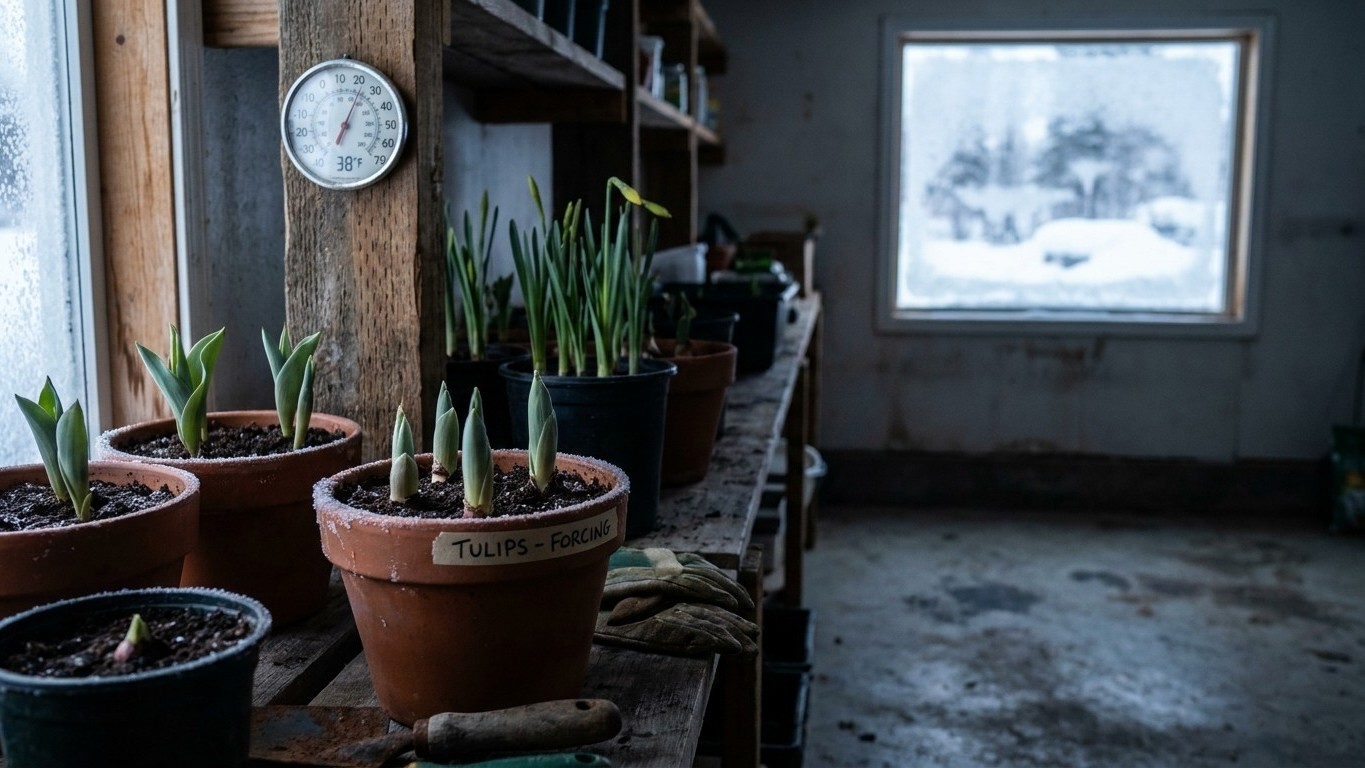

An unheated garage that holds steady in the high 30s does more for a bulb here than any greenhouse. Alaska’s problem with forcing spring bulbs indoors isn’t a shortage of cold, it’s finding a spot that isn’t colder than the bulb can survive.
Why this matters in Alaska

The coldest month at the Anchorage reference station averages an 11.0°F daily minimum, according to NOAA’s 1991-2020 Climate Normals. That single figure reframes the whole question. A spring bulb needs twelve to fourteen weeks somewhere between 35°F and 45°F to break dormancy and set up a flower stalk. Anchorage’s winter blows past that window in the wrong direction: it doesn’t fail to deliver cold, it delivers far more cold than a bulb can tolerate while still forming a bloom.
That distinction matters because the two problems that drive people to force bulbs indoors are opposites. In a mild-winter state, forcing exists because the ground never gets cold enough, so a refrigerator supplies the missing chill. In Alaska, the ground gets plenty cold. The trouble is that a bulb left in a pot outdoors, or in bare soil without protection, drops well below the 35°F floor it needs and simply freezes solid. A garden bed insulates itself with soil mass and, often, snow cover. A container has no such buffer. Roots, bulb, and growing medium all reach outdoor air temperature at close to the same rate, which is why a pot can kill a bulb that would have survived the same winter in the ground a few feet away.
This is where the USDA Plant Hardiness Zone Map earns its caution label. Alaska’s statewide range runs from zone 1a to zone 8a, built entirely on the average annual extreme minimum temperature. That’s not a typo: the state spans nearly the entire zone chart the USDA uses for the whole country. A recommendation based on the “Alaska zone” means almost nothing without naming a location, because a gardener in the interior and a gardener on the southeast coast are gardening in different worlds. Anchorage, the reference station behind the 11.0°F figure above, sits toward the milder end of that range, but even there, a container is exposed to swings a planted bed never sees.
So the practical answer for most of the state: this is container territory, not chill-deficit territory. The forcing method below exists less to manufacture cold than to control it, keeping the bulb in that narrow 35°F to 45°F band instead of letting outdoor air push it into the teens or single digits.
How to do it here
The sequence below assumes a standard spring bulb (tulip, daffodil, hyacinth, crocus, muscari) rather than a paperwhite, which skips the cold step entirely and gets its own note in the next section.
- Buy or select bulbs sized for forcing in early fall, before the first hard freeze. Firm, heavy bulbs with no soft spots or mold do best; anything already shriveled won’t rally once potted.
- Pot the bulbs in a well-draining mix, with the tips just at or slightly below the soil surface, and bulbs close together but not touching. Water once, thoroughly, right after potting.
- Move the pot into cold storage for twelve to fourteen weeks. An unheated garage or an enclosed, unheated porch works if it reliably stays above freezing through the coldest stretch, meaning above roughly 32°F even on the coldest nights. If that space can’t be trusted to stay above freezing, a refrigerator crisper drawer is the more reliable option.
- Keep the fridge drawer away from ripening fruit. Apples, pears, and bananas release ethylene gas, and ethylene damages the flower bud forming inside the bulb before it ever gets the chance to open.
- Check soil moisture every few weeks. The mix should stay barely damp, never soggy, for the entire cold period; a bulb sitting in wet soil at low temperatures is a rot risk long before it’s a bloom.
- If the pot stays outdoors instead of in cold storage, the container needs to be rated at least two hardiness zones hardier than the bulb variety itself, since a pot loses heat on all sides. Where that rating can’t be confirmed, move the pot to an unheated but frost-buffered space, and mulch it heavily with straw or bagged leaves to slow the freeze.
- After the cold period, bring the pot into a cool, bright room, around 50°F to 60°F, for one to two weeks before moving it to full room temperature and stronger light. This gradual step keeps the stem from stretching too fast and flopping over.
- Once buds show color, move the pot to its final display spot and expect bloom within one to three weeks, depending on the bulb type.
Which bulbs are worth it
Not every spring bulb makes forcing worth the shelf space in a fridge or the floor space in a garage. The ones that work best share two traits: a shorter cold requirement and a stem sturdy enough to stand up once it’s growing in a warm room instead of anchored in garden soil against wind. It also helps to remember that most bulbs bought specifically for forcing were never going to be planted out and left to naturalize in Alaska’s harsher zones anyway, so treating them as a single-season purchase costs nothing extra.
Bulbs that force reliably here
- Paperwhite narcissus, which needs no cold period at all and can bloom in three to four weeks from potting
- Crocus, with one of the shortest chill requirements among true spring bulbs
- Hyacinth, thanks to a stiff stem that holds up well in a warm room
- Muscari (grape hyacinth), short and compact enough to stay upright without staking
- Dwarf or species tulips, which stay low and don’t topple the way taller hybrids do
Bulbs that sulk
- Standard tall tulips, which often stretch and flop once indoors, especially with weak winter light
- Large-trumpet daffodils, which need a longer cold period and tend to lean badly indoors
- Alliums, whose chill requirement runs longer than most home setups can manage
- Iris reticulata, which is finicky about timing and frequently fails to open fully after forcing
What goes wrong, and when you can still fix it
Leaves, but no flower
This means the cold period ran short. The bulb had enough energy to push foliage but never finished forming the flower bud inside itself. There’s no rescue for this season’s pot; once the leaves are up without a bud, no amount of light or warmth will manufacture a flower that never formed. Note the date it went into cold storage and add two to three weeks next time.
A flower on a stem too short to notice
This is the opposite problem: the pot was moved into warmth too early, before the cold period finished, so the stem never had the chance to elongate normally. The bloom that does open sits low and often looks stunted rather than showy. Nothing brings the stem back once it’s grown this way, but the bulb itself isn’t necessarily wasted; some gardeners still get a smaller, second-year bloom from hyacinth or crocus bulbs planted out afterward, though tulips and most forced daffodils won’t repeat.
Rot in the pot
Soft, discolored bulb tissue with a sour smell almost always traces back to drainage, either a mix that holds too much water or a pot without a drainage hole. If the rot has reached the bulb’s core, that bulb is done for this cycle. If it’s caught early, with the bulb still mostly firm but the surrounding soil soggy, repotting immediately into a fresh, well-draining mix can sometimes stop the spread before it reaches the growing point.