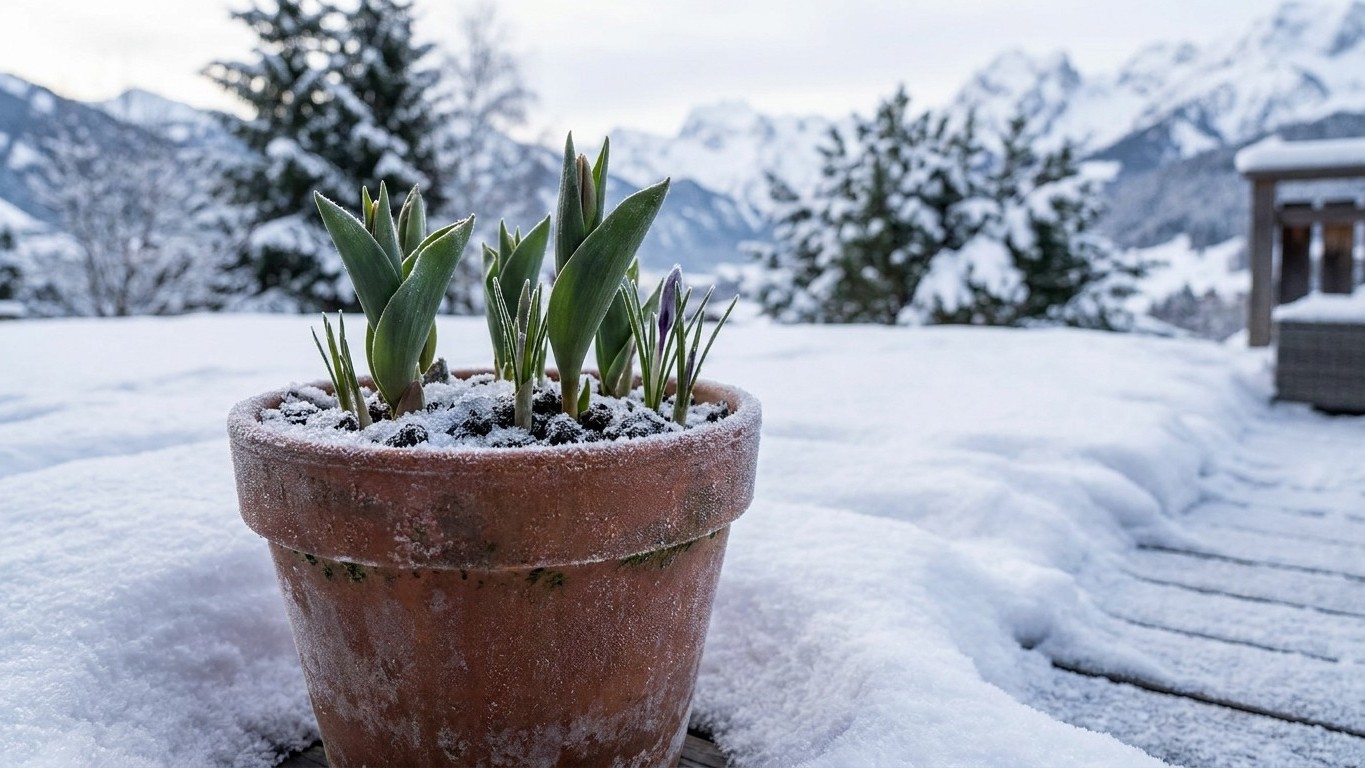

Alaska’s cold season doesn’t lack chill, it has more of it than almost any bulb needs. The mean daily minimum in the coldest month sits at 11°F in Anchorage. That number changes the whole strategy: forcing here isn’t about supplying missing cold, it’s about protecting a pot from cold that would otherwise kill the bulb outright before spring ever arrives.
Why this matters in Alaska

Forcing exists as a technique for gardeners whose winters don’t deliver the twelve to fourteen weeks below 45°F that a spring bulb needs to bloom. That’s not Alaska’s problem. With a coldest-month mean minimum of 11°F (NOAA NCEI Climate Normals, 1991-2020, Anchorage station), the state blows past that threshold for months, not weeks. If anything, Alaska has a surplus of cold, not a deficit.
The real issue is what a container does to that surplus. A bulb planted in the ground sits below the frost line, insulated by soil mass that never drops much past the mid-30s even in a hard winter. A bulb in a pot has no such buffer. The pot freezes clear through, roots and all, at whatever temperature the air outside reaches. That’s a fundamentally different exposure than the same bulb would face in a garden bed just a few feet away.
This is why the USDA Plant Hardiness Zone Map lists Alaska across an unusually wide band, from 1a to 8a (USDA Plant Hardiness Zone Map, 2023, based on 1991-2020 normals). That range spans everything from the rainforest-influenced southeast coast to the interior and Arctic zones, and a bulb rated for a given zone in the ground is not automatically safe for that same zone in a pot. The zone map measures average annual extreme minimum air temperature, a single variable, and it was built for plants rooted in open ground.
Put those two facts together and the situation in Alaska is clear: this is a container-threshold problem, not a chilling-deficit problem. The practical fix borrows the forcing method, not because the bulb needs help getting cold, but because moving the pot into controlled, moderate cold protects it from the far harsher and less predictable cold sitting just outside the door.
How to do it here
The steps below assume a spring bulb (tulip, crocus, daffodil, hyacinth) that needs a defined chilling period before it will flower. Each step is something you can check yourself with a thermometer, not a guess.
- Pot up before the ground freezes. Use a container with drainage holes and fresh potting mix, not garden soil, which compacts and holds too much water around the bulb in cold storage.
- Water once, thoroughly, then ease off. The mix should be barely damp during the cold period, not soggy. Overwatering during dormancy is the single most common cause of loss in containers.
- Give the pot twelve to fourteen weeks below 45°F. An unheated attached garage often works if it stays above freezing rather than swinging into the single digits like the outdoors does; check it with a min-max thermometer over a few nights before trusting it. A refrigerator crisper drawer is the other option, but keep it away from apples, pears, or any ripening fruit. Fruit releases ethylene gas, and ethylene kills the flower bud forming inside the bulb even though the leaves may still grow fine.
- Watch for pale shoots. Once shoots push an inch or two above the soil, the chilling requirement is essentially satisfied.
- Move the pot into bright, cool conditions gradually, ideally 60-65°F, before exposing it to full warmth or direct sun. A pot moved straight from a cold garage to a warm, sunny windowsill often blooms on a stunted stem.
- If you’d rather leave the container outdoors instead of forcing it indoors, size it up. The pot needs to be rated at least two hardiness zones colder-hardy than the bulb itself, or it needs to be moved into an unheated shelter and buried in mulch or leaves up to the rim. A bulb hardy in Anchorage ground is not automatically hardy in an exposed pot sitting on a deck through an Anchorage winter.
Which bulbs are worth it
Not every spring bulb rewards the effort of forcing in a container, and the difference usually comes down to two plant traits: how short the cold requirement is, and how tall the finished stem gets. A short chilling period means faster, more predictable results. A tall, heavy flower stalk grown in a small pot with limited root anchorage tends to flop over before it ever opens fully.
Bulbs that force reliably here
- Crocus — short cold requirement, low stem, rarely topples
- Grape hyacinth (muscari) — compact, sturdy, forgiving of slightly uneven chilling
- Dwarf iris (Iris reticulata) — short stem, blooms early, low weight per stalk
- Hyacinth — thick stem carries its own flower spike without support
- Paperwhite narcissus — needs no cold period at all, making it the fastest option for a windowsill display
Bulbs that tend to sulk
- Tall Darwin and triumph tulips — long cold requirement, tall stem, prone to flopping in a pot
- Trumpet daffodils — tall and top-heavy relative to typical container root volume
- Fritillaria — sensitive to overwatering, unforgiving of the wrong drainage
- Allium — long chilling window and tall stem, a poor match for indoor forcing
Where a bulb was never going to survive Alaska’s outdoor extremes as a permanent planting anyway, paperwhites are the clearest case, forcing costs nothing in the long run. The bulb was a one-season purchase regardless of what happens to it after it blooms.
What goes wrong, and when you can still fix it
Leaves but no flower
This means the cold period was too short. The bulb had enough stored energy to push foliage but the flower bud inside never fully differentiated, since that process depends on a completed chilling cycle. There’s no fix this season. Let the foliage grow and yellow naturally to recharge the bulb, then give it a full, properly timed cold period the following year.
A flower on a stem too short to see
This happens when the pot moved from cold storage into warmth too fast, before the stem had elongated. Heat triggers the flower to open on whatever stem length exists at that moment. It’s not fixable this season since the elongation window has already closed. Next time, give the pot a week or two in a cool, bright spot before full warmth.
A soft, mushy bulb
This is rot, almost always from a pot without enough drainage holes or from soil kept too wet during the cold period. Once a bulb turns soft, it’s dead. There’s no saving it this season or any other. The only fix is prevention: drainage holes, a fast-draining mix, and watering just enough to keep the mix barely damp rather than moist through the entire chilling window.