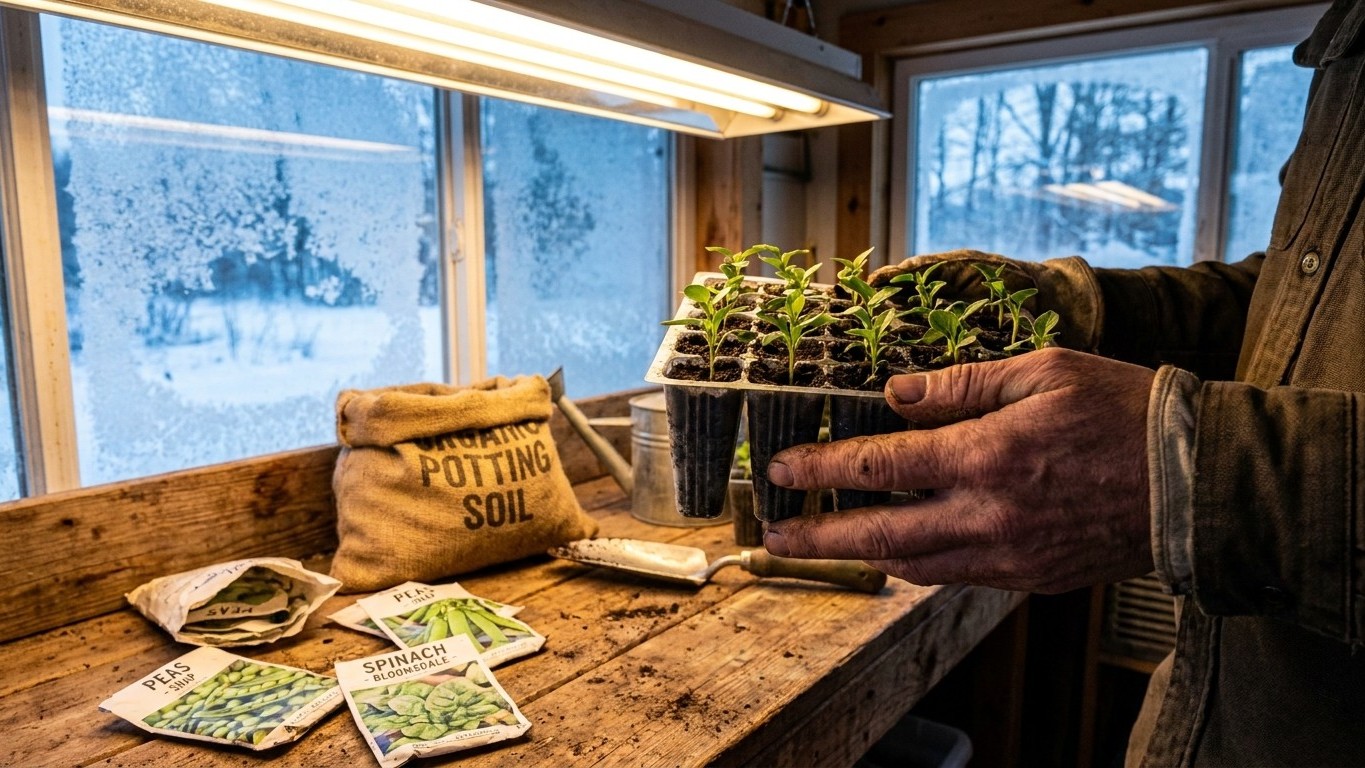

April in Alaska is a preparation month, not a planting month, across nearly all of the state. With the statewide last spring frost falling anywhere from May 3 to May 12 in the Anchorage area, and far later in the Interior and north, open ground stays off-limits for direct sowing. The work that pays off now happens indoors, under cover, and in the tool shed.
What goes in the ground in April

The number that actually matters is soil temperature, not the date on the wall calendar. Alaska’s frost window, May 3 to May 12 at the Anchorage reference station, tells you when the air stops freezing, but the ground under a foot of melting snowpack lags weeks behind that. Most Alaska soil in April is still frozen solid a few inches down, or turned to cold mud on top, and neither state supports seed germination or root growth.
That single fact rules out almost everything for the open garden this month. Corn, beans, squash, tomatoes, and every other warm-season crop have no business anywhere near unprotected soil in April, no matter how many sunny afternoons roll through.
What does have a shot depends heavily on where in the state you garden. The USDA hardiness zone range for Alaska runs from 1a all the way to 8a, one of the widest spreads of any state, and that spread is doing a lot of work. A gardener in a milder Southeast coastal pocket may find soil workable by late April and can risk peas, onion sets, and hardy greens like spinach and kale sown directly once the ground crumbles rather than clumps. A gardener in the Interior is still looking at frozen ground and has no such option this month.
What’s actually safe right now
If your soil has thawed and drains freely rather than pooling, cold-tolerant crops can go into a cold frame or under a low tunnel: peas, spinach, arugula, and radish all germinate at soil temperatures too cool for almost anything else. Garlic and shallots that missed fall planting can still go into workable ground early, though fall planting remains the stronger option for bulb size. Bare-root fruit trees and canes, if they arrive from a nursery this month, can be heeled into a trench or planted once the hole doesn’t fill with meltwater. Everything else waits.
What to start under cover
Seed starting math in Alaska runs backward from that same frost window, not forward from today’s date. Tomatoes and peppers need roughly six to eight weeks indoors before they’re ready to go outside, and because Alaska soil stays cold well past the air frost date, most gardeners hold warm-season transplants until soil has genuinely warmed, often weeks after the May frost window closes. Counting back from that later outdoor date puts an indoor start for tomatoes and peppers squarely in April for much of the state.
Cabbage, broccoli, and other brassicas need less lead time, generally five to six weeks, and they tolerate a cooler transplant date since a light frost doesn’t kill them. Starting those indoors in mid-to-late April lines up with an early-to-mid-May move outside, assuming soil is workable by then.
Both failure modes show up every season. Start too early and you’re nursing rootbound, leggy tomato seedlings under grow lights for an extra month with nowhere to put them, since the ground still isn’t ready. Start too late and the short growing season, roughly 143 frost-free days at the Anchorage reference point and considerably fewer inland, doesn’t leave time for a full harvest before the first fall frost arrives between September 22 and October 1. Alaska’s long April daylight helps seedlings grow stocky rather than stretched, but it doesn’t fix a start date that’s badly timed against the local frost window.
What is ready to pick
Almost nothing comes out of an Alaska garden in April, and there’s no point pretending otherwise. Outdoor beds are frozen, snow-covered, or waterlogged across most of the state, and the growing season hasn’t started.
What keeps a household fed this month comes from what was put away last fall or grown indoors this week. Sprouts and microgreens on a windowsill or under a grow light are ready in days rather than months and give fresh greens with zero garden risk. Any cold frame that was sown in late winter with spinach or lettuce may be starting to produce thin, tender leaves worth cutting.
The bigger job this month is triage on the root cellar and pantry. Stored potatoes, carrots, and onions have been sitting for several months by now, and April is when sprouting, soft spots, and early rot show up in force. Potatoes that have sprouted eyes longer than an inch are past prime for eating but can still be cut for seed potatoes later in spring. Onions that have gone soft at the neck won’t improve with more storage time and should be used first. Squash held whole since fall should be checked at the stem end, since that’s where mold typically starts before it spreads into the flesh.
The jobs that matter this month
April carries real deadlines even though nothing is going into the ground. Dormant pruning of fruit trees, currants, and raspberry canes should happen before buds swell and sap starts running, since cuts made after growth begins cost the plant more energy and heal more slowly. Once leaves emerge, that window closes for the season.
Seed ordering has its own clock. Alaska’s short season narrows the list of varieties bred to mature fast enough, and the popular short-season tomato, cabbage, and pea varieties sell out earlier than gardeners expect. Ordering now, rather than waiting for warmer weather to feel motivating, avoids settling for whatever’s left.
Soil testing and amending belong here too. A soil sample sent through the University of Alaska Fairbanks Cooperative Extension Service gives an actual nutrient and pH reading rather than a guess, and amendments like lime or compost need time to integrate before planting begins. Turning the compost pile, even a half-frozen one, speeds up decomposition once temperatures climb and means finished compost is ready when beds thaw.
Tool maintenance is the kind of job that never feels urgent until a dull hoe or a rusted pruner slows down real fieldwork in May. Sharpening blades, oiling wooden handles, and checking raised bed frames or fencing for winter damage now means none of that competes for time once planting actually starts. Greenhouses and hoop houses need attention too: on a sunny April day, the inside of a covered structure can overheat even while the outside air is still near freezing, so venting on clear days prevents cooked seedlings.
What not to do in April
The most common mistake is trusting a warm afternoon over the soil itself. A string of 50-degree days can make April feel like planting season, but air temperature and soil temperature move at different speeds, and warm-season seeds dropped into cold, wet ground simply rot before they sprout. Wait for the soil to crumble in your hand rather than clump, and test with a thermometer if you’re unsure, rather than going by how the day feels on your skin.
A related error is pulling row cover or mulch off perennial beds too early after a mild stretch. The frost window doesn’t close until May 3 to May 12 at the earliest for the Anchorage area, and considerably later inland, so a hard freeze is still well within range even after several soft days. Exposed crowns and emerging shoots can be knocked back badly by a return freeze that uncovered beds no longer buffer against.
Fertilizing too early causes its own damage. Nitrogen applied to dormant lawns or perennial beds before real growth resumes tends to push soft, tender new growth right when a frost is still likely, and that new growth is the tissue most easily killed. Holding off until growth is clearly underway, rather than by the calendar, protects the investment. Finally, resist tilling waterlogged spring soil just to feel productive: working wet soil destroys its structure and creates compaction that takes a full season to undo.
Checking this against your own county
A statewide frost window is a starting point, not a fixed instruction, and Alaska proves that better than almost anywhere. The hardiness zone range alone, 1a to 8a, spans from Arctic tundra to a mild coastal rainforest climate, and elevation, coastal exposure, and distance from the Interior’s deep continental cold all shift planting dates by weeks in either direction from the Anchorage reference figures used here.
Before committing seed or transplants to the ground, check conditions against your specific location through the University of Alaska Fairbanks Cooperative Extension Service, which tracks regional variation and offers soil testing and local planting guidance tailored to district rather than statewide averages.
Common questions
Can I direct-sow anything outdoors in Alaska in April?
In most of the state, no. Soil is still frozen or waterlogged. In milder coastal areas where ground has thawed and drains well, hardy crops like peas, spinach, and onion sets can sometimes go in under a cold frame or low tunnel.
When should I start tomato seeds indoors for an Alaska garden?
Tomatoes need six to eight weeks indoors before transplanting, and since Alaska soil stays cold well past the May frost window, most gardeners start indoors in April for a transplant date in late May or June once soil has actually warmed.
Why does Alaska have such a wide hardiness zone range?
The USDA Plant Hardiness Zone Map places the state between 1a and 8a because it measures average annual extreme minimum temperature, and Alaska’s geography ranges from Arctic interior cold to a comparatively mild, coastal Southeast climate within the same state.
What should I check on stored vegetables in April?
Potatoes, onions, and squash held since fall are at peak risk of sprouting or rot by this point. Check potatoes for long sprouts, onions for soft necks, and squash at the stem end where mold typically starts, and use or discard affected produce before it spreads to the rest of the stored batch.