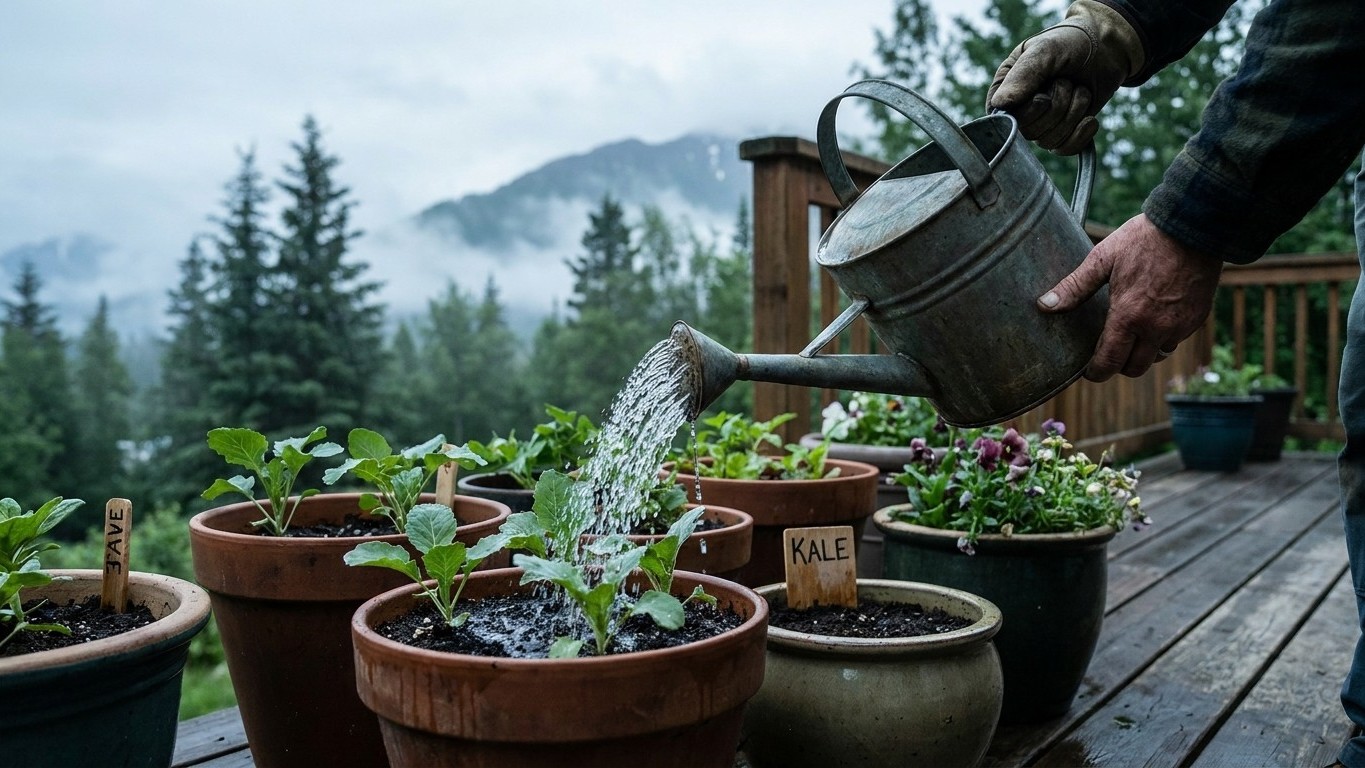

Alaska gardeners aren’t fighting heat, they’re fighting timing. The state’s reference station logs zero days a year at 90F or hotter, so evaporation demand stays low all summer. But the driest month, June, brings just 1.02 inches of rain, meaning that early-season watering falls almost entirely on the gardener rather than the sky.
What changes here

Two numbers set the terms for watering in this state: 1.02 inches of rain in June, the driest summer month, and 0.0 days a year that reach 90F. Read together, they describe a garden that almost never faces heat stress but also can’t count on June rain to carry it through the growing season’s most critical stretch.
The arithmetic matters more than the mood of the numbers. A vegetable bed or a young perennial wants roughly an inch of water a week. June, spread across its roughly 4.3 weeks, delivers about 0.24 inches of rain per week on average, based on that 1.02-inch monthly figure. That leaves close to three-quarters of an inch that has to come from a hose, a can, or a drip line if the bed is going to get what it needs. July and August ease the gap somewhat, with 1.82 and 2.93 inches respectively, but June is where a new planting is most exposed.
The absence of 90-degree days changes what “watering” is protecting against. In hotter states, watering is often a race against evaporation and wilting on a single scorching afternoon. Here, with no days that reach that threshold, the risk shifts. Moisture that does arrive, whether from rain or from a hose, tends to linger in the soil rather than flash off in an afternoon. That’s a benefit for a plant’s roots, but it also means a gardener who waters on a hot-climate schedule, checking daily and dousing lightly, is solving a problem this soil doesn’t really have while ignoring one it does: staying wet too long at the surface and encouraging shallow root growth instead of depth.
Why the gap still matters
Even without heat stress, a three-quarter-inch weekly shortfall in June adds up over a month to nearly three inches of water a bed simply won’t get unless someone supplies it. Seedlings and transplants, with roots still shallow, feel that gap first.
How to water when it matters
The method that fits this climate is deep, infrequent watering at the base of the plant, done in the morning, and each piece of that has a reason tied to how the plant actually works. Deep watering pulls roots downward, chasing moisture lower in the soil profile, which builds a plant that can ride out the low-rainfall stretch of June without daily attention. Watering at the base, rather than overhead, keeps foliage dry, and in a climate where days rarely get hot enough to dry leaves off quickly, that matters more than usual: wet leaves here can stay wet longer. Morning watering gives whatever moisture reaches the leaves time to dry before evening, when cooler temperatures and dampness together invite fungal problems.
Checking the soil, rather than the calendar, is what keeps this on track. A finger pushed two inches down, or a trowel turned to check the same depth, tells the gardener what the surface can’t: whether moisture has actually reached where the roots are working. Surface soil can look dry within hours of a rain and still be damp two inches down, especially with the more clay-heavy, poorly draining ground common in parts of this state, where a single inch of water can sit for the better part of a week rather than draining through in a day the way it would on sandy ground. On that kind of heavy ground, watering again before it’s actually dried out doesn’t help the plant, it drowns the roots.
- Check the soil two inches down with a finger or trowel before watering at all, rather than watering on a fixed schedule.
- If it’s dry at that depth, water deeply at the base of the plant until the top six to eight inches of soil are moist, roughly one inch of water in a single session as a starting point.
- Water in the morning, so any splashed foliage has the day ahead of it to dry.
- On heavier, slow-draining ground, wait longer between sessions and check depth again before repeating; on lighter, fast-draining ground, expect to repeat sooner and in smaller amounts.
- Recheck the two-inch depth every few days through June specifically, since that’s the month least likely to be topped up by rain on its own.
That one-inch, two-inch-depth starting point is exactly that, a starting point. Every yard’s soil drains at its own pace, and the only way to know for certain is to check it directly rather than trust a rule written for a different plot.
What goes wrong
Watering a little, every day
A light daily sprinkle wets the top inch of soil and nothing more. Roots follow the moisture, staying shallow near the surface instead of reaching down, which leaves the plant more exposed the moment a watering gets skipped. It’s the single most common way a well-intentioned gardener actually weakens a plant’s resilience.
Watering leaves in the evening
Wetting foliage late in the day leaves it damp through the cooler overnight hours, and that dampness is exactly the condition fungal disease needs to take hold. In a climate that rarely bakes leaves dry quickly, this risk lingers longer than it would somewhere hotter.
Trusting a shower that barely wet the surface
A passing summer rain can look like it’s done the job while only dampening the top half-inch of soil. The only way to know is the same finger-and-trowel check used before any manual watering; the sky gets no free pass just because it rained.
Letting a bed sit soggy because it “just rained”
Given how little heat this climate carries, the more expensive mistake here isn’t drought, it’s the opposite: watering again on a fixed schedule before heavy, slow-draining soil has actually dried at root depth. With no 90-degree days to pull that moisture back out quickly, a bed can stay waterlogged for days, and roots sitting in saturated soil that long can suffocate and rot.
Local help
The University of Alaska Fairbanks Cooperative Extension Service is the state’s land-grant extension office and a direct source for local growing guidance. Watering restrictions, where they exist, are set district by district and change from year to year, so check with your own municipal or local water provider for current rules rather than relying on statewide assumptions.
Common questions
Does Alaska’s cool summer mean I can water less overall?
Less often, yes, since evaporation demand is low with no days reaching 90F, but June still only delivers about 1.02 inches of rain, so new plantings still need supplemental watering during that specific month.
How do I know if my soil is heavy or fast-draining?
Water a small area and time how long it takes to disappear from the surface; if it lingers for many minutes to hours, the ground is holding water the way heavier soil does, and watering sessions should be spaced further apart.
Is morning really better than evening for watering here?
Yes, because any moisture that lands on foliage gets the day’s light to dry off, which lowers the odds of fungal issues that damp, cool evenings can otherwise encourage.
Should I mulch if the climate is already cool and moist?
Mulch still helps by evening out soil moisture between waterings and reducing surface evaporation, even in a low-heat climate, and it’s especially useful during June when rainfall is at its lowest for the summer.