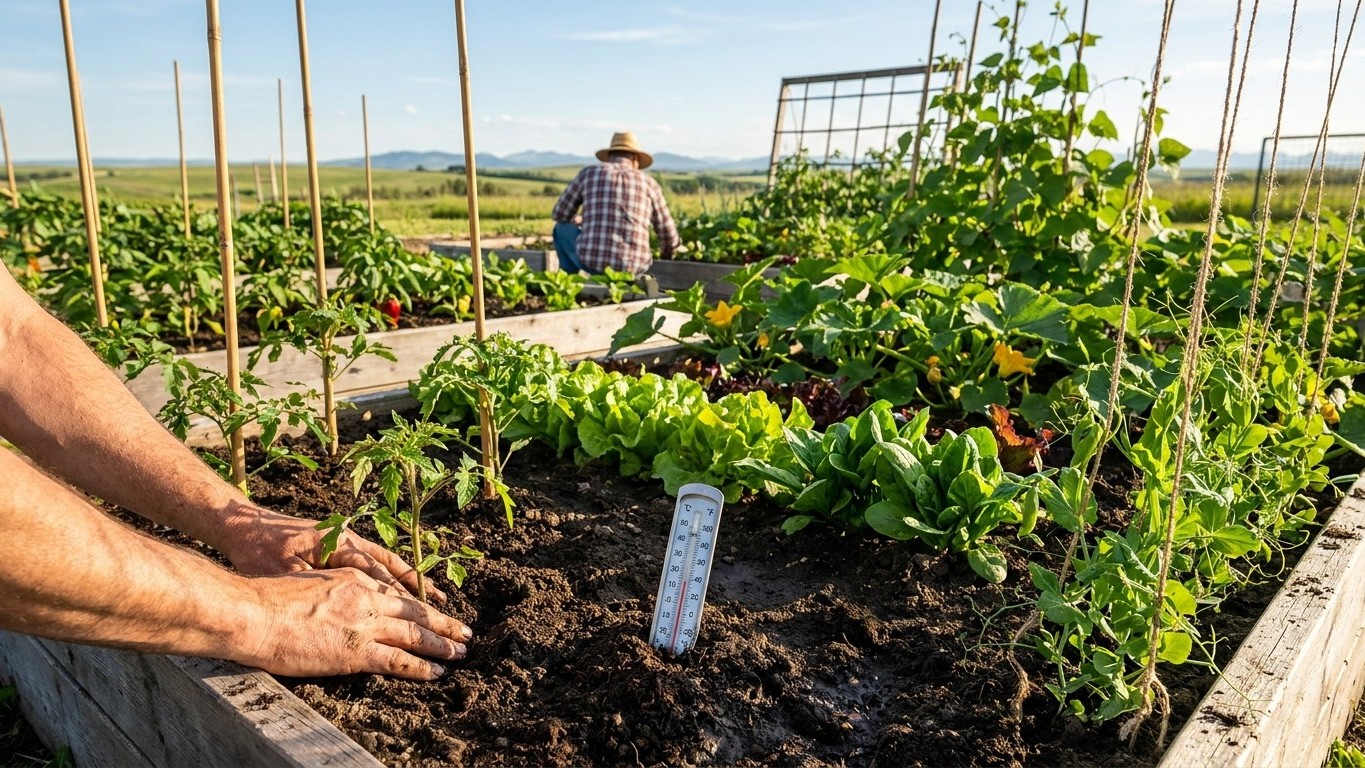

By June, most of Alberta is working with open ground rather than frozen soil. The province’s average last frost sits behind you, which means the warm-season list finally becomes plantable alongside the cool-season crops you may already have going: tomatoes, peppers, beans, squash and corn join continued rounds of lettuce, spinach, peas and root vegetables in a single, busy month.
What goes in the ground in June

The calendar says June is safe. The soil doesn’t always agree. Environment and Climate Change Canada’s normal for the Calgary Int’l A station puts the average last spring frost at May 21, which sounds like a green light for June planting. But that number is a mean, not a guarantee: in one year out of two, frost actually falls later than May 21. Early June in a cool spring, especially at higher elevation or further north, can still carry a frost risk that the calendar hides.
That’s why soil temperature, not the date on the wall, should decide what goes in first. Cool-tolerant crops don’t care much either way. Peas, spinach, lettuce, radishes, and alliums like onion sets and garlic can go in the moment the ground is workable, and by June they should already be up if you started in spring. What changes in June is the warm-season group: beans, squash, cucumbers, and corn can be direct-sown once the soil has held warmth for a stretch rather than just the air temperature climbing on a sunny afternoon. Tomatoes, peppers, and eggplant, started indoors earlier, move outside as transplants only after they’ve been hardened off and the frost risk has genuinely passed for your specific location.
| Crop group | Method | June status in Alberta |
|---|---|---|
| Peas, spinach, lettuce, radishes | Direct sow | Continue succession sowing every 2-3 weeks |
| Onions, garlic (sets/cloves) | Already in ground | Maintain, weed, mulch |
| Potatoes | Direct plant | Plant early June if not already done |
| Beans, corn, squash, cucumbers | Direct sow | Plant once soil has warmed and settled |
| Tomatoes, peppers, eggplant | Transplant | Move out after hardening off, once frost risk is past locally |
Alberta’s Canadian plant hardiness zone for the Calgary reference area is 4a, under the Canadian system. That number does not translate to a USDA zone the way many gardeners assume. The Canadian classification is built from seven climate variables rather than one, and Natural Resources Canada itself notes there’s no clean conversion between the two systems. Canadian zone 4a can overlap anywhere from USDA 3a to 7a depending on the variables involved, so use it as a general reference for cold hardiness, not as a stand-in for a US zone map.
What to start under cover
Starting seeds indoors in June feels backwards to gardeners used to March seed trays, but it still has a purpose here, particularly for a second wave of fast crops or for fall harvest. The math runs from the other end of the season: Alberta’s average first fall frost lands around September 16, again a mean date rather than a hard line, meaning some years it arrives earlier and some later. Count backward from that date rather than from any fixed calendar day.
A crop that needs roughly 60 to 70 days to mature, started under cover in early June and transplanted out a couple weeks later, still has a reasonable shot at finishing before the average frost window closes in mid-September. Crops needing 90 days or more are cutting it close if started this late unless they’re frost-tolerant at harvest, like many brassicas. This is where the two common failures show up. Start too early relative to your transplant date and seedlings sit too long indoors, turning leggy and rootbound before the weather cooperates. Start too late and the plant runs out of daylight and warmth before it ever reaches harvest size, especially once Alberta’s short growing season starts trimming days off both ends.
Cold frames, cloches, and simple row covers do double duty in June: they let a gardener push the season on both sides, protecting a late-started tray of greens from a surprise cool night, or giving warm-season seedlings a few extra degrees of buffer right after transplanting, when they’re most vulnerable to a swing back toward frost.
What is ready to pick
June harvests in Alberta lean toward what survived winter and what went in earliest, not toward anything warm-season yet. Overwintered or very early spring crops carry the month. Asparagus crowns that have been established for a couple of seasons produce their first cuttings now, and established rhubarb is usually ready for its first pull, with stalks firm and a good hand-width long before you cut.
Early spring plantings of radishes are often ready within weeks of sowing and should come out promptly once they size up, since they turn woody and hot-flavored fast if left in warming soil. Leaf lettuce and spinach sown as soon as the ground was workable are typically at cutting size, and green onions planted from sets earlier in spring are ready to pull as needed. Peas planted early may just be starting to flower or set their first pods toward the end of June, depending on the variety and how the season has run.
What’s not ready yet: anything from the tomato, pepper, squash, or corn family. Those plants are just getting established this month, not producing. If stored root vegetables or winter squash from the previous season are still in the cellar, June is a good point to check them over; any softening, sprouting, or off smell means that one comes out and gets used or composted before it affects the rest of the stored crop.
The jobs that matter this month
June rewards steady maintenance more than any single big task. Weeds that get ahead of the garden now compete with young transplants for water and light for the rest of the season, so a thorough weeding pass while roots are still shallow saves hours later. Mulching follows right behind it: a layer around transplanted tomatoes, peppers, and squash holds soil moisture through Alberta’s often-windy early summer and keeps soil temperature more even, which matters for crops that dislike cold shocks.
Staking and support structures belong in the ground before plants need them, not after they’ve flopped. Tomatoes, peas, and vining squash all sprawl fast once the warm days of June arrive, and installing cages or trellises early avoids damaging roots later by driving stakes through them.
Watering rhythm matters more than watering volume. Deep, less frequent watering encourages roots to grow down rather than staying shallow and dependent on daily surface moisture, which becomes important if July brings a dry stretch. Succession sowing keeps the harvest window open. Rather than planting a full row of lettuce or radishes at once, putting in a short row every couple of weeks through June means a steady supply instead of one glut followed by a gap. Pest scouting rounds out the list. Flea beetles and cutworms are active in Alberta gardens through June, and catching a problem on young brassicas or newly transplanted seedlings early is far easier than recovering a stand that’s already been stripped.
What not to do in June
The most common mistake this month is trusting the air rather than the soil. A run of warm, sunny days can push the air temperature well above what the soil underneath has actually reached, and tender transplants set into soil that’s still cold below the surface often stall for weeks rather than dying outright, which is worse because the problem isn’t obvious right away.
Uncovering plants too early after a mild stretch is the second trap. Because Alberta’s average last frost of May 21 is a midpoint and not a safety line, a warm week in early June doesn’t retire the frost risk for the season, particularly in low-lying areas where cold air pools overnight. Row covers and cloches removed too soon can leave tender crops exposed to a late cold snap that a covered bed would have shrugged off.
Nitrogen timing trips people up too. Heavy nitrogen feeding on tomatoes and peppers once they’re flowering pushes leafy growth at the expense of fruit set, the opposite of what a gardener wants heading into the productive part of the season. A balanced feed, or one lighter in nitrogen, suits crops that are moving from establishment into flowering and fruiting.
Checking this against your own county
A province-wide frost date is a starting point, not an instruction for your particular yard. Alberta’s geography moves these windows by weeks in either direction: southern regions around Lethbridge typically warm earlier than the Peace River country in the north, and elevation changes across the foothills and central Alberta shift both the last spring frost and the first fall frost independent of latitude. A backyard in a low frost pocket can lag a neighborhood a few miles away by a week or more.
For local planting guidance and frost data specific to your district, the Alberta agriculture and irrigation service is the right next stop before finalizing a planting schedule built on province-wide averages.
Common questions
Is it too late to plant tomatoes in June in Alberta?
No. June is actually the standard month to move hardened-off tomato transplants outside in most of the province, since it follows the average last frost window rather than crowding against it.
Can I still direct-sow corn and beans in June?
Yes, and for many Alberta gardeners this is the intended timing, since these crops need soil that has genuinely warmed rather than just an early-season warm spell.
What does Alberta’s hardiness zone of 4a actually tell me?
It’s a Canadian-system rating for the Calgary reference area, built from seven climate factors rather than one. It does not convert directly to a USDA zone, so use it for general cold-hardiness planning rather than matching it against US zone charts.
Should I worry about frost after the last frost date has passed?
It’s worth some caution. The May 21 average last frost date is a mean, meaning frost arrives later than that in about half of all years, so keeping row cover handy into early June is a reasonable safeguard, especially in cooler or low-lying districts.