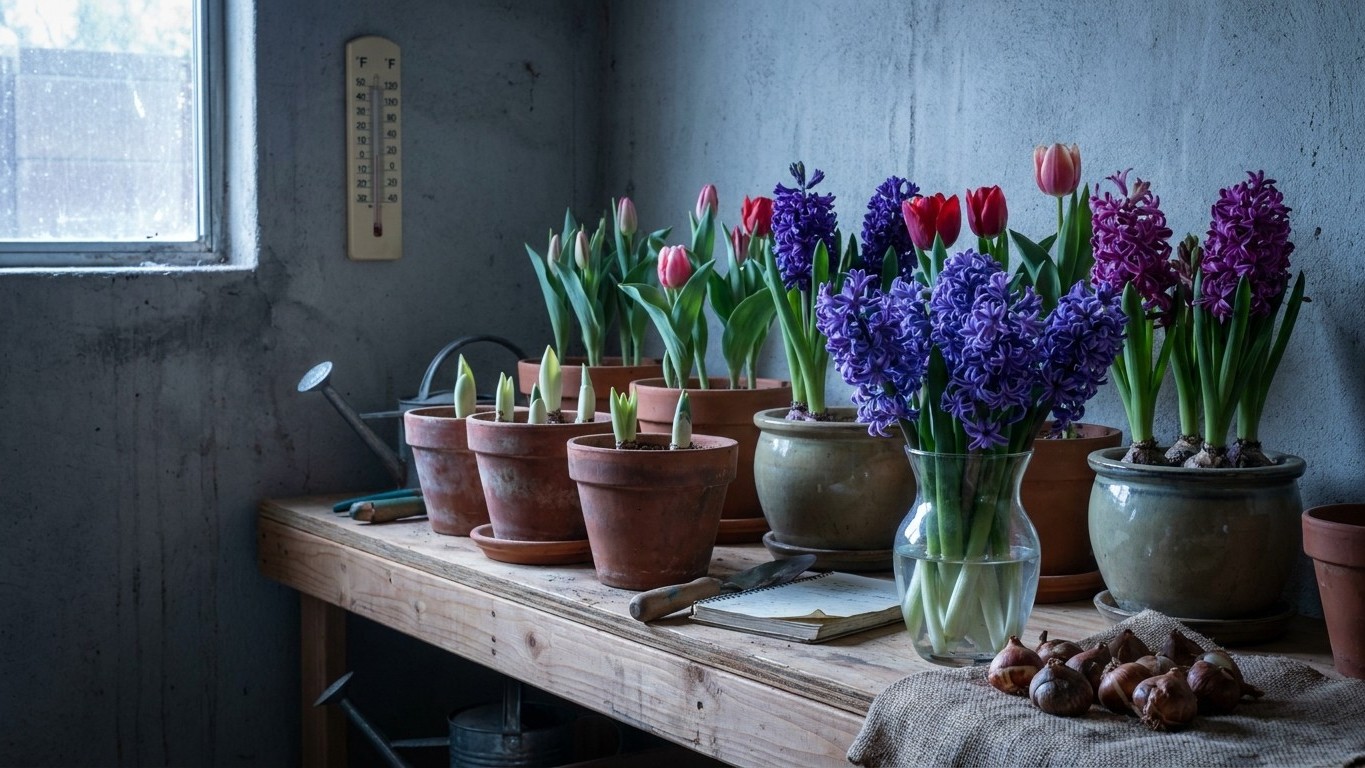

Low-desert Arizona rarely delivers the sustained chill spring bulbs need to bloom on their own, which is exactly why forcing works here: you supply the cold artificially, in a refrigerator or an unheated garage, then bring the bulb indoors to finish what winter couldn’t start. Containers add a second wrinkle worth understanding before you plant a single bulb.
Why this matters in Arizona

The coldest month at the Phoenix reference station has an average daily minimum of 45.3°F, according to NOAA NCEI Climate Normals for 1991-2020. That number matters more than any record low you might remember from a cold snap, because it’s the mean nightly floor across the entire coldest month, and it sits right at the edge of what a tulip or hyacinth needs to break dormancy. Spring bulbs generally require twelve to fourteen consecutive weeks below 45°F to flower properly. A single month hovering right at that threshold, even on its coldest nights, doesn’t come close to stacking up the weeks required.
That puts the low desert squarely in the “not enough cold” category. Tulips, hyacinths, and crocus planted in a Phoenix-area garden bed often come up with leaves and no bloom, or skip flowering entirely the following year, because the ground never holds a long enough cold spell. Forcing sidesteps the problem by moving the chilling requirement indoors, where you control the temperature and the clock.
The picture changes at elevation. The state’s USDA Plant Hardiness Zone range runs from 4b to 10b, a span wide enough to cover both a low-desert winter that barely dips below 45°F and a high-country winter cold enough to freeze ground solid. In those colder zones, the challenge isn’t a shortage of chill, it’s what happens to a bulb sitting in a container rather than in open ground. A pot has no thermal mass to speak of, so it freezes through, roots and all, at a temperature that would only touch the top few inches of a garden bed. A bulb rated hardy for zone 6 in the soil can still die in a zone-6 pot, because the container offers none of the insulation the ground provides.
So the two problems aren’t the same, and they don’t share a fix. One is a lack of cold weeks, solved by forcing indoors. The other is too much unbuffered cold reaching container roots, solved by matching the pot’s effective hardiness to conditions two zones colder than the label suggests, or by sheltering it. Knowing which situation applies to your part of the state changes what you do next.
How to do it here
Forcing is a sequence, and skipping a step usually shows up later as a bulb that leafs out but never blooms. Here’s the order that works, anchored to what’s actually available in an Arizona home.
- Pick bulbs suited to forcing. Small, short-chill species (hyacinth, crocus, grape hyacinth, dwarf tulips) respond more reliably than tall trumpet daffodils or long-stemmed Darwin tulips, which tend to flop once forced.
- Pot in fall, in a shallow container with drainage holes. Use a well-draining bulb or potting mix, set bulbs close together with their tips just at the soil surface, and water lightly.
- Give the pot twelve to fourteen weeks of cold between roughly 35°F and 45°F. A refrigerator’s vegetable crisper drawer works, but keep it away from ripening apples, pears, or other fruit; the ethylene gas they release will kill the flower bud forming inside the bulb before you ever see it. An unheated garage works too, as long as it reliably stays above freezing rather than dropping into the 20s on winter nights, which would damage the bulb outright.
- Check moisture every couple of weeks. The soil should stay slightly damp, never soggy and never bone-dry, for the full chilling period.
- Watch for pale shoots one to two inches tall and visible root growth at the drainage holes. That’s the signal the chilling requirement has been met, not a calendar date.
- Move the pot to indirect light for a few days, then to bright indoor light at room temperature. Jumping straight from cold darkness to a sunny windowsill often produces the short, stunted stems that make forced bulbs disappointing. Blooms typically follow within three to four weeks of the move indoors.
- In the state’s colder, higher-elevation zones, if you’re chilling bulbs in containers left outdoors rather than in a fridge or garage, choose a pot rated at least two USDA zones hardier than the bulb itself, or move the container against a heated wall and mulch it heavily. Otherwise the pot can freeze through before the chilling clock ever finishes.
Which bulbs are worth it
Not every spring bulb rewards the effort of forcing, and the difference comes down to chill requirement and stem height. A bulb that needs a short cold period forces faster and with less risk of rot from prolonged refrigeration. A bulb that naturally grows a tall, heavy stem tends to topple once it’s pushed into bloom indoors, away from the wind and structural support it would get outdoors.
- Paperwhite narcissus: needs no chilling at all, forces in water and pebbles alone
- Hyacinth: short chill requirement, sturdy stem, reliable bloom
- Crocus: fast chiller, compact enough to never need staking
- Grape hyacinth (Muscari): short stem, forgiving of an imperfect chill period
- Dwarf and species tulips: shorter and stiffer than standard tulip varieties, hold up better in a pot
- Darwin hybrid and standard tulips: tall stems that flop once forced indoors without wind resistance
- Trumpet daffodils: long chill requirement and top-heavy blooms that pull the stem over
- Dutch iris: inconsistent bloom timing, finicky about chill duration
- Fritillaria: demanding cold requirements that are hard to replicate in a home refrigerator
| Bulb | Chill needed | Stem height | Forcing verdict |
|---|---|---|---|
| Paperwhite narcissus | None | Short to medium | Reliable |
| Hyacinth | Short | Short | Reliable |
| Crocus | Short | Very short | Reliable |
| Dwarf tulip | Moderate | Short | Reliable |
| Darwin hybrid tulip | Long | Tall | Sulks, often flops |
| Trumpet daffodil | Long | Tall | Sulks, top-heavy |
In the low desert, where winters almost never provide the cold these bulbs need to return the following year, most spring bulbs are a one-season purchase whether you force them or plant them straight into the ground. That means forcing costs nothing in the long run. You get a bloom you were only going to get once anyway, just weeks earlier and on your kitchen table instead of outdoors.
What goes wrong, and when you can still fix it
Leaves and no flower
The bulb put up green growth but never produced a bud. This almost always means the chilling period was cut short, before the twelve-to-fourteen-week minimum was reached. Nothing brings back a flower bud that never formed. The bulb itself likely still has enough stored energy to try again, so set it aside and give it a full, uninterrupted chill cycle next time rather than attempting to save this season’s display.
A flower on a stem too short to see
The bud formed, but the stem never elongated before the flower opened. This happens when a pot moves from cold storage into full light and warmth too abruptly. There’s no way to stretch a stem that’s already finished growing, so this season’s bloom is what you’ll get. Next round, move the pot to a cooler, dimmer spot for several days before full light and warmth, giving the stem time to extend gradually.
Rot in the pot
Soft, mushy bulbs or a sour smell mean water sat around the roots with nowhere to go, usually because the container lacked adequate drainage or was overwatered during the long chilling period. A rotted bulb can’t be saved this season or any other. The fix is entirely preventive: drainage holes, well-draining mix, and soil kept damp rather than wet through the entire chill period.