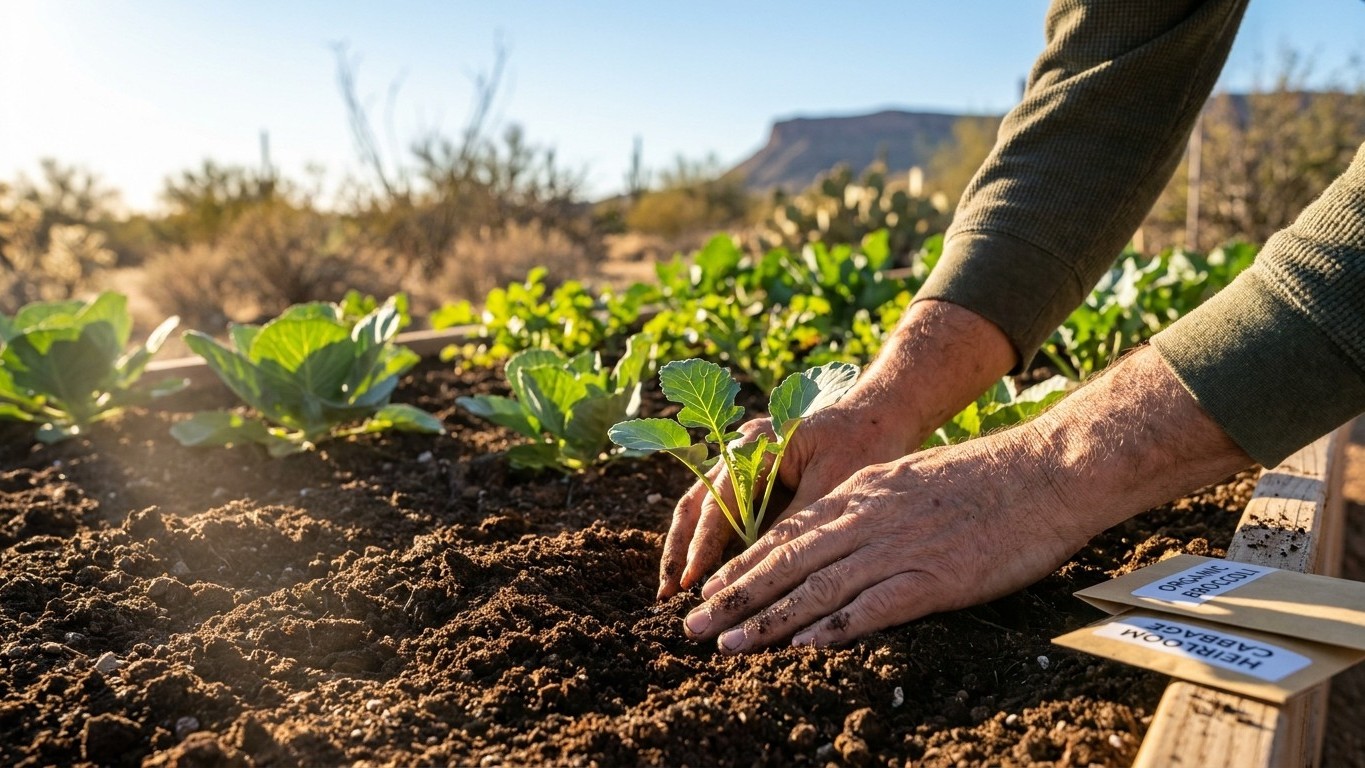

January splits Arizona in two. In the low desert around Phoenix, Tucson and Yuma, it’s one of the best planting months of the year: mild days, cool nights, and almost no frost risk mean cool-season vegetables go straight into the ground. In the high country around Flagstaff and the White Mountains, the soil is frozen and nothing goes outside until spring.
What goes in the ground in January

The calendar means almost nothing here. What decides whether you can plant is elevation, and Arizona spans more of it than almost any other state: from desert floor near sea level to mountain country above 7,000 feet. NOAA’s 1991-2020 climate normals for station USW00023183, which sits in Phoenix, list the frost-free season there as 365 days. Over 30 years of records, Phoenix dropped to 32°F in only 6 of those springs, mostly in a stretch running from late December into mid-January. That’s rare enough that frost isn’t really the constraint on what you plant in the low desert. The real limiting factor is summer heat, which shuts down fruit set on tomatoes, peppers and beans for months on end. January sits right in the middle of the mild window that heat-sensitive crops need, which is why it’s such a productive planting month here rather than a dead one.
In the low desert, direct-sow carrots, beets, radishes, turnips, lettuce, spinach, kale, collards, Swiss chard, and peas now. Transplant broccoli, cabbage, and cauliflower starts. Onion and leek transplants can still go in, and garlic cloves planted a bit later than the ideal fall window will still size up reasonably well. Herbs like cilantro, parsley, and dill germinate readily in the cool soil.
At elevation, the picture flips. Around Flagstaff and the higher plateaus, the ground is frozen or close to it, and nothing goes into open soil this month. What still works: cold frames or low tunnels over anything you managed to get established earlier, bare-root fruit trees and cane berries planted the moment the ground is workable, and forcing rhubarb or chicory indoors for an early harvest while the garden itself waits.
| Region | Example area | January outdoor planting |
|---|---|---|
| Low desert | Phoenix, Tucson, Yuma | Cool-season vegetables direct-sown or transplanted now |
| Mid elevation | Prescott, Sedona | Limited; cold frames extend the season, ground often too cold for direct sowing |
| High country | Flagstaff, White Mountains | Ground frozen; only bare-root planting and cold-frame work |
What to start under cover
In the low desert, January is when tomatoes, peppers, and eggplant should already be started indoors or in a warm protected spot, timed to be transplanted out once soil temperatures climb in February, well before the heat that arrives by late spring shuts pollination down. The arithmetic runs backward from that heat wall rather than from any frost date: figure roughly six to eight weeks of indoor growth before transplant size, then count back from the point where you expect soil to be reliably warm enough for these crops to take off without stalling.
Start too early here and you end up with leggy, rootbound tomato starts sitting in small pots for weeks past their prime, stretching toward the light and losing vigor before they ever see the ground. Start too late and the transplants go out just as the mercury starts its climb toward the temperatures that stop fruit set, cutting the productive window short before it really gets going.
At higher elevations, the same backward-counting logic applies, but it runs off the local last-frost window rather than a heat wall, and that window varies by hundreds of feet of elevation change even within a single county. A specific frost date for Flagstaff or the White Mountains isn’t part of the record cited here, so growers at elevation should pull that number from the local extension office rather than borrow one from the low desert. What holds everywhere: seedlings need real light, not just a warm windowsill, or they’ll stretch and weaken before they ever reach the garden.
What is ready to pick
Citrus carries the low desert garden this month. Grapefruit, navel oranges, and mandarins are typically at peak sweetness now, and the way to tell is by taste rather than color, since citrus can look ripe on the outside well before the sugar catches up. Cool-season vegetables planted back in fall are also coming in: mature broccoli heads, cabbage, leafy greens sized up for cutting, and root vegetables like carrots and beets that have had the cool weeks to sweeten.
At elevation, there’s little or nothing coming out of open ground this month, and that’s worth saying plainly rather than dressing up. What still feeds the table: anything held under a cold frame, sprouts and microgreens grown on a windowsill, and whatever made it into storage back in fall. That stored produce needs a check now. Go through winter squash, potatoes, and onions and pull anything showing a soft spot, a sprout, or a sweet fermented smell before it spreads to the rest of the bin. One rotting potato in a dark storage box will take down its neighbors faster than most gardeners expect.
The jobs that matter this month
Rose pruning is a classic low-desert January job, done while plants are dormant and before the spring push of new growth begins. Deciduous fruit trees at higher elevations, apples and peaches especially, get the same treatment now while they’re leafless and the branch structure is easy to read; wait until they’ve leafed out and you’re cutting blind and losing fruiting wood you meant to keep.
Seed catalogs move fast this time of year, and the specific varieties gardeners actually want tend to sell out before the ground even thaws in the high country. Ordering now, rather than waiting for planting weather to feel imminent, is the difference between getting the variety you planned around and settling for whatever’s left.
Soil work pays off now too. Testing pH and amending with compost gives amendments time to integrate before the spring planting rush, rather than being worked into cold, still-settling soil right before seeds go in. Turn the compost pile if it’s stalled; cold, wet piles left untouched over winter can take months longer to finish than ones turned even occasionally. Mulch beds that are holding overwintering crops to buffer against the occasional cold snap, check drip irrigation lines for winter damage before the watering rhythm ramps back up, and scout winter greens for aphids, which can build up quietly on the undersides of kale and collard leaves during mild spells. Clean and sharpen pruning tools while they’re not in daily use, and walk fence lines and raised bed frames now, before spring planting makes repairs an inconvenience instead of a quiet winter task.
What not to do in January
The most common mistake in the low desert is planting tomatoes, peppers, or melons directly outdoors because a run of warm afternoons made it feel like spring. Air temperature is not soil temperature, and warm-season seeds sitting in soil that’s still cool will rot or germinate weakly instead of taking off. Start those indoors and wait for the soil itself to warm before transplanting.
The second mistake is treating “frost-free” as “frost-proof.” Phoenix’s frost-free classification describes an average, not a guarantee, and NOAA’s own records show 32°F showing up in roughly one out of every five recent springs, generally in that late-December-to-mid-January stretch. Citrus and tender succulents left uncovered during one of those rare cold nights can suffer real damage. Keep frost cloth on hand and use it when a freeze is forecast rather than assuming the odds are always in your favor.
Don’t pull protective covers off the moment a mild spell shows up, either. A few warm days followed by one more cold night can undo weeks of protected growth. And hold off on nitrogen-heavy feeding for anything still dormant; feeding now pushes tender new growth right before the plant would rather still be resting, leaving that growth exposed if a cold snap does arrive.
Checking this against your own county
A statewide month is a starting point, not an instruction. Arizona’s USDA hardiness range runs from 4b in the highest country to 10b in the low desert, according to the USDA Plant Hardiness Zone Map, and that gap alone can shift a planting window by a full season, not just a few weeks. Elevation is doing almost all of the work here, more than latitude or anything else. Check the local frost and planting windows through the University of Arizona Cooperative Extension before locking in a planting date for your own county.
Common questions
Does it actually frost in Phoenix in January?
Rarely. NOAA’s 1991-2020 climate normals for the Phoenix station list a 365-day frost-free season, and 32°F showed up in only 6 of the last 30 springs, mostly between late December and mid-January. It’s uncommon, not impossible.
What USDA hardiness zone is Arizona?
The state spans zones 4b through 10b on the USDA Plant Hardiness Zone Map, covering everything from high mountain country to low desert, so a single statewide zone number doesn’t apply anywhere near evenly.
Can you plant tomatoes outdoors in Arizona in January?
Not in the low desert, and not at elevation either. Start tomato seeds indoors now for a February transplant once soil warms in the low desert; at higher elevations, wait for the local last-frost window before moving anything outdoors.
What fruit is ripe in Arizona gardens in January?
Citrus. Grapefruit, navel oranges, and mandarins are generally at their peak sweetness in the low desert this month, and taste is the better test of readiness than color alone.