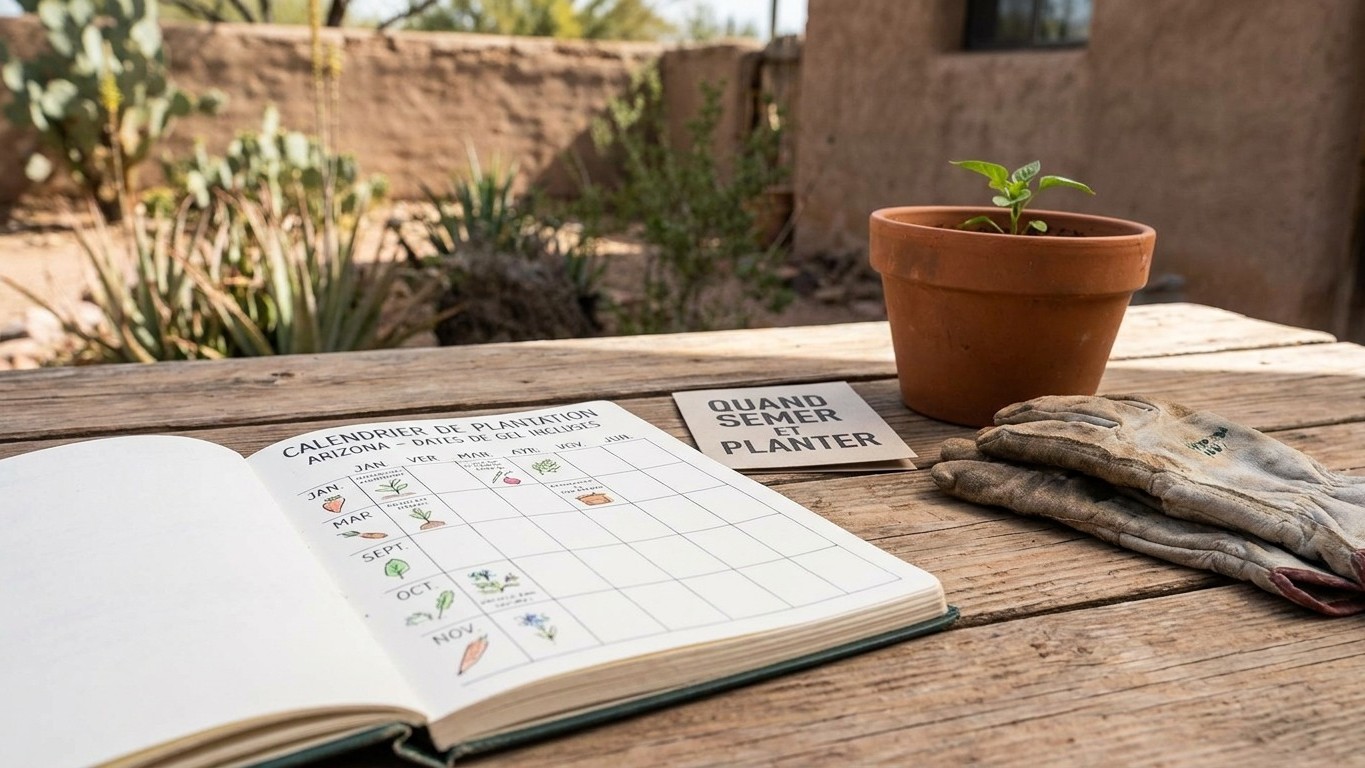

Phoenix’s frost-free season runs 365 days a year, most winters. Say that out loud and it sounds like a gardener’s dream: no last-frost date to track, no first-fall-freeze deadline hanging over October. But that number is exactly why the low desert trips people up. The limit here was never frost. It’s the stretch of summer when heat shuts pollen down and everything you planted just sits there, alive and idle.
The frost window in Arizona

In most states, a planting calendar starts with the last spring freeze and the first fall freeze. Phoenix barely has either. NOAA’s 1991-2020 Climate Normals, measured at station USW00023183, put the frost-free season there at a full 365 days, and NOAA’s RCC ACIS daily records show a 32°F reading in only 6 of the past 30 winters, and always in the narrow window between late December and mid-January, which is exactly why knowing What to Plant in Arizona in December means watching that rare cold snap rather than assuming a hard freeze is coming. For practical purposes, the low desert doesn’t get a killing frost most years.
That doesn’t mean Arizona gardening is easy year-round. The frost window isn’t the constraint in the low desert. Summer heat is. Once daytime highs climb into the range that stops pollen from setting fruit, tomatoes, squash, beans and most warm-season vegetables stay alive but simply stop producing, sometimes for months at a stretch. That’s why an Arizona calendar reads almost backward from a Midwest or East Coast one: gardeners here often plant warm-season crops earlier than colder-climate gardeners would, and finish with them earlier too, which is why knowing What to Plant in Arizona in January sets the tone for the whole season, why knowing What to Plant in Arizona in February matters more than tracking a last-frost date, why knowing What to Plant in Arizona in March often determines how much of a harvest you get before the heat arrives, why What to Plant in Arizona in April often means racing to get warm-season crops in, and why knowing What to Plant in Arizona in November matters just as much once the cooler season crops come back into play before pollen shuts down entirely, and why knowing What to Plant in Arizona in July is really about surviving the heat lull rather than starting anything new before the heat sets in, and why knowing What to Plant in Arizona in May is really about deciding what can still hang on once that heat arrives before the heat sets in, why knowing What to Plant in Arizona in June matters just as much for timing the heat shutdown, and why knowing What to Plant in Arizona in August is about waiting out that same heat before the fall reset begins, and why knowing What to Plant in Arizona in October matters for catching the second planting window as the heat finally breaks.
These figures come from the Phoenix station specifically, and the rest of the state is not the same climate. Flagstaff and the rest of Arizona’s high country sit on a different part of the USDA hardiness map entirely, and they see real, hard freezes every winter, sometimes stretching well into spring. If you garden above the low desert basins, the near-zero frost risk described here doesn’t apply to you. Get your local freeze dates from Arizona Cooperative Extension rather than assuming Phoenix numbers travel uphill.
The practical result is two very different growing seasons depending on elevation. In the low desert, the growing season is effectively continuous, but split into a mild cool season and a long warm season bookended by a heat shutdown instead of by frost. At elevation, the season looks closer to a conventional mountain-state calendar, similar in shape to the frost-bound seasons in a New Mexico planting calendar, where a low desert valley and a high plateau a few hours apart can run on almost opposite schedules.
Cool-season crops
Peas, spinach, lettuce, the brassicas and most root crops are usually described as “plant before your last frost” crops, because they tolerate a light freeze that would kill a tomato. In most of Arizona’s low desert, that instruction doesn’t mean much, since there’s rarely a frost to plant before. Instead, these crops get scheduled around the mild season itself, the stretch of fall, winter and early spring when daytime highs stay comfortable enough for germination and steady growth, before summer heat makes lettuce bolt and turns spinach bitter.
How the schedule actually runs
In the low desert, cool-season crops do most of their growing in what other states call winter. Gardeners direct-sow spinach, lettuce, carrots, beets and radishes through the cooler months and follow with transplants of broccoli, cabbage and cauliflower timed to head up before the heat returns. Peas go in early enough in the mild season to flower and set pods before warmth arrives to stall them.
- Leafy greens (spinach, lettuce, arugula): sown once the worst summer heat has broken, and again as spring heat returns pushes them toward bolting.
- Root crops (carrots, beets, radishes): direct-sown in the same mild stretch, since warm soil tends to push carrots toward woody, bitter roots.
- Brassicas (broccoli, cabbage, cauliflower): started as transplants so heads have time to form before summer heat comes back.
- Peas: sown early in the mild season so vines flower and set pods before warmth stalls them.
None of this schedule depends on a spring frost date, because there mostly isn’t one to build around. What matters instead is watching daytime highs and soil temperature as the mild season narrows at both ends, cooling in through fall and warming back out in spring. The safest approach is to ask Arizona Cooperative Extension for county-specific cool-season sowing windows, since Yuma, Phoenix and Tucson’s low deserts warm up at noticeably different paces even though none of them see reliable frost.
At higher elevations, where real freezes occur, the traditional “before last frost” logic returns. Gardeners there can direct-sow peas and spinach several weeks ahead of their last expected freeze, the way growers in frost-bound states do, but this page doesn’t carry station-level freeze data for those areas. Check with your local extension office for the actual date range.
Warm-season crops

Tomatoes, peppers, squash, beans and corn all need soil that’s genuinely warm to germinate and grow, not just air that isn’t freezing anymore. In a normal frost-bound state, gardeners wait for the last frost date and then a further stretch until soil warms. In Phoenix, where NOAA’s 1991-2020 normals put the frost-free season at 365 days, waiting on frost tells you almost nothing useful. The soil temperature threshold, not the frost date, is what should decide your transplant day. Ask Arizona Cooperative Extension for the soil temperature guidance for your county, and use a soil thermometer rather than a calendar page.
The bigger scheduling problem in Arizona’s low desert runs the other direction: getting a crop finished before the heat, not protecting it from cold. Once summer highs climb into the range that stops tomato pollen from setting, plants keep growing but stop producing fruit, sometimes for months. That single fact should drive variety choice more than anything printed on a seed rack.
Choosing a variety that can beat the heat
Because the practical fruit-set window closes when the heat arrives, and because that shutdown can last for months, a fast cultivar has real value in the low desert even though it wouldn’t matter much in a colder state with a long, mild summer. Counting days to maturity from the transplant date is worth doing even without a fixed frost date to count from: a shorter-season variety needs fewer weeks in the ground before the heat wall arrives, which is why many desert gardeners lean toward the fastest tomatoes in the catalogue rather than the biggest.
| Variety | Days to maturity (from transplant) | Habit | Notable resistance |
|---|---|---|---|
| Sakura | 55 | Indeterminate | Nematodes, Tomato Mosaic Virus, Fusarium Wilt races 1, 2 |
| Edox | 55 | Indeterminate | Nematodes, Tomato Mosaic Virus, Fusarium Wilt races 1, 2 |
| Valentine | 55 | Indeterminate | Early Blight (Intermediate) |
| Glacier | 55 | Determinate | None listed |
| Sun Gold | 57 | Indeterminate | Tobacco Mosaic Virus, Fusarium Wilt race 1 |
| Supersweet 100 | 60 | Indeterminate | Verticillium Wilt, Fusarium Wilt race 1 |
These catalogue figures are counted from the transplant date, not from seed, and they typically run a week or two longer in cooler-than-ideal spring soil, so treat 55 days as a floor rather than a guarantee. Longer-season slicers such as Cherokee Purple (72 days) or San Marzano II (78 days) can still work in the low desert, but they need to go in as early as the soil allows, since every extra week of days-to-maturity is a week closer to the heat shutdown, not a week of safety margin.
Peppers, squash, beans and corn follow the same logic even though this page doesn’t carry catalogue data for them. Match the fastest maturing variety you can find to the mild stretch between soil warm-up and heat shutdown, and start seed indoors early enough that the transplant is already several weeks old on the day the soil crosses that threshold.
The fall planting window
A conventional fall calendar counts backward from the first fall freeze: take a crop’s days to maturity, add a couple of weeks for slowing growth as daylight shortens, and that tells you the last safe sowing date. Around Phoenix, NOAA’s data doesn’t give a reliable first fall freeze to count backward from, since the same station records show frost arriving, if at all, only in a handful of winters and not on a predictable fall date. The fall window in the low desert isn’t set by frost. It’s set by the retreat of summer heat.
Once daytime highs drop back into the range where tomatoes and peppers can set fruit again, a second warm-season planting becomes possible, using the same fast varieties that make sense in spring, such as Juliet (60 days) or Amalfi (68 days), since there’s limited time before cooler weather and shorter days slow fruit-set again. Paste tomatoes with a heavier resistance package, like Tiren or Granadero (both 75 days), need to go in as soon as the heat breaks enough to let them set fruit, leaving little margin for delay.
The same cooling that opens the door for a second tomato crop also starts the mild cool season described earlier, so fall is when the low desert’s leafy greens, brassicas and root crops get sown again for winter harvest. This is the busiest stretch of the Arizona calendar, precisely because there’s no frost forcing a shutdown, unlike a state where the whole garden gets cleared by a single hard freeze.
At elevation, where a genuine fall freeze does occur, the usual rule applies. Crops like kale, carrots, brussels sprouts and parsnips actually improve in flavor after a light frost converts starches to sugars, so gardeners there can leave those crops in the ground past the first frost instead of rushing to harvest. This page doesn’t have station-level fall freeze data for Flagstaff or other high-country locations, so check with Arizona Cooperative Extension for the actual date to count backward from in your county.
Reading a planting calendar properly
A state-wide planting calendar, including this one, describes a pattern, not an instruction for your specific yard. Arizona makes that gap unusually wide, because the state runs from frost-free low desert basins to hard-freezing high country within a single day’s drive. Elevation changes the entire logic of the calendar, not just the dates on it: in the low desert, you plan around a heat shutdown, while at elevation you plan around a genuine freeze, and the two calendars can look almost like mirror images of each other.
Even within the low desert, local effects shift things further. Urban heat from pavement and buildings keeps central Phoenix measurably warmer overnight than outlying areas, which is part of why the 365-day frost-free average holds up even in years when a nearby, less built-up spot sees a freeze the official station doesn’t record. A rare cold snap can still catch a garden off guard in the window NOAA’s data flags, roughly late December through mid-January, even in a year when the official record shows no freeze at all.
The most reliable fix is to watch your own garden rather than trust a printed date. Track your own soil temperature with a simple thermometer, note when your neighbors’ tomatoes actually start setting fruit, and keep a season-by-season log of when your cool-season crops bolt in spring and when the fall heat finally breaks enough for a second warm-season planting. Two gardens on opposite sides of the same city can run a week or more apart because of shade, slope, or a nearby wall radiating heat.
Every state’s calendar carries this same limitation to some degree. A gardener working from a fixed frost date in Pennsylvania still needs to watch for a late cold snap that beats the average, the same way a Phoenix gardener needs to watch for the rare freeze that beats the odds; a printed calendar sets the expectation, not the guarantee. See how differently that plays out in a state built entirely around a hard frost date, like the Pennsylvania planting calendar, where the whole structure depends on a freeze that Arizona’s low desert mostly doesn’t have.
Local help
Everything above works at the scale of the whole state, but Arizona’s actual planting windows are set county by county, sometimes yard by yard once you’re comparing low desert to high country. Arizona Cooperative Extension publishes county-level guidance, soil testing services and localized planting dates that this page can’t responsibly narrow down to a single number. Find your county office through Arizona Cooperative Extension before you commit to a planting date, and browse our other Arizona guides for related topics.
Common questions
Can I really grow tomatoes year-round in Phoenix since there’s no frost?
Not for fruit production. The plants can survive outdoors through much of the year in the low desert, but once summer heat arrives, pollen stops setting and the vines stop producing, sometimes for months at a stretch. Most low-desert gardeners run two shorter tomato seasons, spring and fall, rather than one continuous one.
Does the Phoenix frost data in this article apply to Tucson too?
Not exactly. This page’s frost figures come from a Phoenix-area NOAA station, and while much of southern Arizona’s low desert behaves similarly, elevation and local terrain shift the numbers city by city. Check Arizona Cooperative Extension for Pima County specifics before relying on Phoenix figures for a Tucson garden.
Should I still cover my plants if a frost warning is issued in the Phoenix area?
Yes. NOAA’s records show a 32°F reading in 6 of the last 30 winters, always between late December and mid-January, so the odds are low but not zero. Tender seedlings and warm-season transplants set out early in the year are the ones most worth covering on those nights.
What planting dates should I use for Flagstaff or other high-elevation towns?
Different ones entirely, and not the numbers on this page. Flagstaff and Arizona’s high country sit on a different part of the USDA hardiness map and see genuine hard freezes most winters, closer in pattern to a mountain-state calendar than to anything in the low desert. Arizona Cooperative Extension’s county offices carry the local freeze dates for those areas.
Can I just use a generic vegetable planting calendar for Arizona?
Not a useful one, if it’s built around a single frost date. Most published calendars assume a garden that gets shut down by a hard freeze every winter, which describes Arizona’s high country but not its low desert basins, where a summer heat shutdown does the same job a freeze does everywhere else.
Related guides
- California Planting Calendar: When to Sow and Plant, Frost Dates Included
- Nevada Planting Calendar: When to Sow and Plant, Frost Dates Included
- New Mexico Planting Calendar: When to Sow and Plant, Frost Dates Included